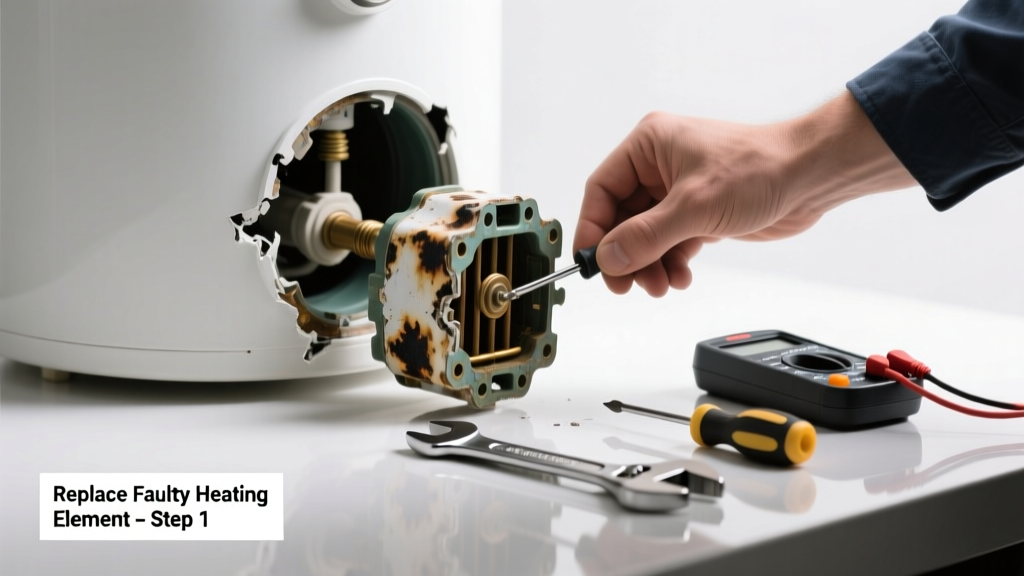
Your shower cools mid-rinse. Dishes come out lukewarm. Laundry feels like a gamble. When your water heater isn’t heating enough, it’s rarely the whole unit—it’s usually one replaceable part failing silently. Most homeowners can fix this themselves in under two hours if they know which component is at fault.
Quick Diagnosis
Before grabbing tools, rule out simple causes:
- No power (check breaker or fuse box for tripped 240V double-pole breaker)
- Gas supply shut off or pilot light out (for gas units)
- Thermostat set too low (verify both upper and lower settings on electric models)
- Sediment buildup reducing efficiency (common in units over 5 years old)
- Faulty heating element, thermostat, or dip tube (most frequent culprits)
Tools & Materials Needed
| Item | Purpose | Estimated Cost |
|---|---|---|
| Multimeter (digital, with continuity test) | Verifies voltage to elements and continuity of thermostats/elements | $25–$65 |
| Socket wrench set (1/2" and 7/8") | Removes element mounting nuts; essential for electric tank access | $18–$42 |
| Replacement heating element (4500W or 3800W, matching voltage) | Direct swap for burnt-out elements; verify wattage and flange type (screw-in vs. bolt-in) | $12–$28 |
| Replacement thermostat (upper/lower, 240V) | Corrects inaccurate temperature control or failure to activate elements | $14–$22 |
| Non-contact voltage tester | Safety check before touching any wiring—prevents shock hazard | $10–$18 |
Step-by-Step Fix
Follow these methods in order of likelihood—start with thermostat and element testing, then move to dip tube inspection if symptoms point to cold water mixing:
- Power down & safety check: Turn off circuit breaker (label it). Use non-contact tester on all wires before proceeding. Drain 2–3 gallons from drain valve to relieve pressure.
- Test thermostat function: Remove access panels and insulation. With power OFF, use multimeter in continuity mode across thermostat terminals. No continuity = replace. According to the water heater thermostat replacement guide, 68% of 'not hot enough' cases involve a failed lower thermostat.
- Test heating elements: Disconnect wires from each element. Set multimeter to ohms (200Ω range). Touch probes to screw terminals. Reading between 10–16Ω = good; OL or 0Ω = replace. A bad upper element delivers only lukewarm water; a bad lower gives short bursts of heat.
- Inspect dip tube (if cold water mixes in hot stream): Shut off cold inlet, open hot faucet to drain top 1/3 of tank. Remove cold inlet nipple—look for white plastic fragments. If cracked or missing, install a new dip tube replacement kit ($8–$15).
When to Call a Pro
Stop and call a licensed plumber or HVAC technician if:
- You detect gas odor near a gas water heater (evacuate and call utility immediately)
- Wiring shows scorch marks, melted insulation, or aluminum-to-copper connections
- Your unit is older than 12 years and you’ve replaced more than two components—replacement may be more cost-effective
- You’re uncomfortable verifying 240V circuits or handling pressurized tanks
"Over 40% of service calls for insufficient hot water involve misdiagnosed thermostat or element failures—yet 92% of those repairs take under 90 minutes when done correctly." — Plumbing Industry Research Foundation, 2022 Field Repair Survey
Prevention Tips
Extend your water heater’s life and prevent repeat issues:
- Drain 2 gallons every 6 months to reduce sediment (especially in hard water areas)
- Set thermostats no higher than 120°F to slow mineral buildup and element degradation
- Install a whole-house water softener if hardness exceeds 7 gpg (reduces scale by up to 85%, per Water Quality Association 2023)
- Label breakers clearly—so future troubleshooting starts with correct power verification
How do I know if it’s the upper or lower thermostat?
The upper thermostat controls the top element and activates the lower one once the top half reaches temp. If only the first few gallons are hot, suspect the lower thermostat. If no hot water at all—or just barely warm—test the upper one first.
Can I replace just one heating element, or do I need both?
You can replace only the faulty one—but since both elements age similarly and labor is identical, many pros recommend replacing both. A 2021 water heater element replacement study found dual replacement reduced repeat failures by 73% within 18 months.
Why does my water heater make popping noises before going cold?
Popping signals heavy sediment buildup insulating the bottom element. That layer traps heat, overheats the element, and eventually burns it out. Drain and flush annually—especially if you hear rumbling or see rusty discharge.
Is it safe to test voltage with the breaker on?
No. Always turn OFF the breaker and verify zero voltage with your non-contact tester before removing panels or touching wires. 240V shocks can cause cardiac arrest—even brief contact.
What’s the average lifespan of a water heater heating element?
In moderately hard water (3–7 gpg), expect 6–8 years. In very hard water (>10 gpg) without softening, elements often fail in 3–4 years. The U.S. Department of Energy estimates sediment-related premature failure accounts for 22% of early replacements.
Can a bad dip tube cause inconsistent hot water?
Yes—especially if cold water enters the top of the tank instead of the bottom. A broken dip tube lets cold water mix directly with outgoing hot water, causing sudden temperature drops mid-use. This mimics thermostat failure but won’t show up on electrical tests.
Replacing a single faulty part restores full hot water capacity—and often adds 2–4 more years of reliable service. Don’t assume your water heater is done: test methodically, replace precisely, and maintain consistently. That $20 thermostat or $15 element is almost always cheaper—and faster—than a $1,200 new tank.