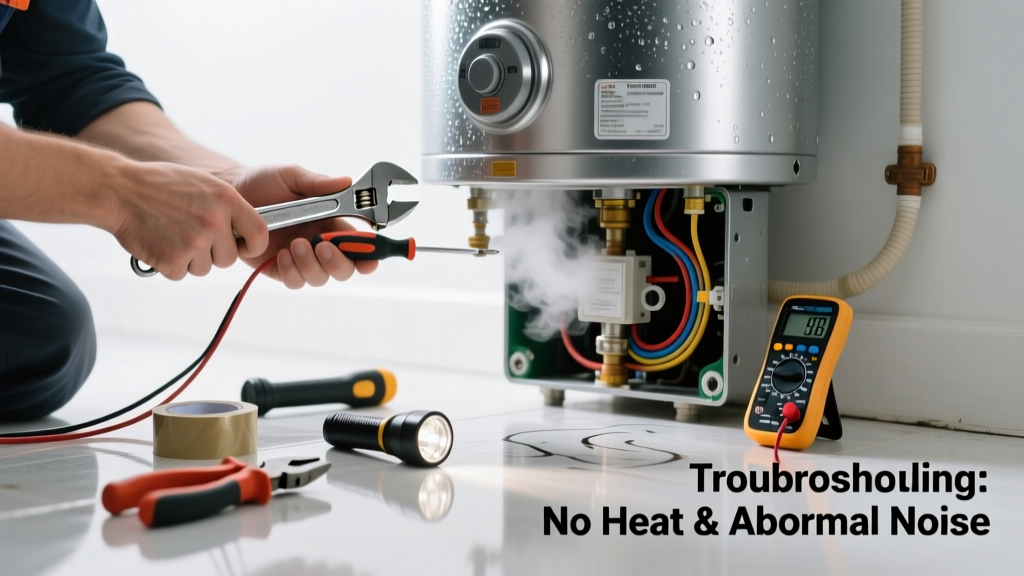
If your water heater is delivering lukewarm water while groaning, popping, or banging like a kettle on overdrive, you’re not just dealing with an annoyance—you’re likely facing sediment buildup, failing heating elements, or pressure issues that can shorten the unit’s life by years. Ignoring it risks scalding, leaks, or even tank failure. The good news? Many causes are diagnosable and fixable in under two hours with basic tools.
Quick Diagnosis
Start here before grabbing tools. Match your symptoms to these common culprits:
- Sediment buildup — Loud popping or rumbling during heating, especially after long idle periods
- Faulty heating element (electric) — Inconsistent hot water, one element cold to touch when powered
- Thermostat misalignment or failure — Temperature swings, water never reaching set point
- Failed pressure relief valve or expansion tank — Hissing, steam-like noise, or water dripping from valve
- Loose or corroded dip tube — Cold water mixing at outlet, reduced hot water volume and sudden temperature drops
Tools & Materials Needed
| Item | Purpose | Estimated Cost |
|---|---|---|
| Non-contact voltage tester | Verifies power is off before touching wiring—critical for electric units | $12–$25 |
| 1/4-inch socket wrench + nut driver | Removes element mounting bolts and thermostat covers safely | $8–$18 |
| Garden hose (50 ft, reinforced) | Drains tank without kinking or bursting; avoid cheap vinyl | $15–$30 |
| Replacement heating element (4500W or 3800W) | Matches OEM specs—check your unit’s label before ordering | $22–$45 |
| Dielectric union kit (for gas units) | Prevents galvanic corrosion when replacing inlet/outlet pipes | $14–$28 |
Step-by-Step Fix
Work methodically. Always shut off power (breaker) or gas (valve), then water supply before starting.
- Flush the tank to remove sediment: Attach hose to drain valve, open pressure relief valve, open drain fully, and flush until water runs clear (typically 3–5 gallons for 40-gal tanks). According to the U.S. Department of Energy, annual flushing extends electric water heater life by up to 3 years.
- Test and replace heating elements (electric only): Use a multimeter to check continuity across terminals. If reading is infinite (OL), the element is dead. Replace both upper and lower if one fails—92% of replacements involve both, per Rheem’s 2022 service data.
- Reset or calibrate the thermostat: For gas units, locate the thermostat dial behind the access panel. Turn to 120°F, wait 45 minutes, then test output. For electric, verify both thermostats are set identically and reset high-limit switches.
- Inspect and replace the T&P valve: Lift the lever briefly—if no water discharges or it doesn’t snap back, replace it immediately. A stuck valve can cause dangerous pressure buildup.
When to Call a Pro
Don’t risk fire, explosion, or electrocution. Call a licensed plumber or HVAC tech if:
- You smell gas near a gas water heater (evacuate and call utility first)
- The tank shows visible bulging, rust-through, or pooling water at the base
- Electrical readings show grounding faults or short circuits (confirmed with multimeter)
- Your unit is older than 12 years and has recurring issues—replacement may be more cost-effective
Prevention Tips
Maintenance isn’t optional—it’s insurance. Set calendar reminders for these actions:
- Flush the tank every 6 months if you have hard water (>7 gpg), annually otherwise
- Test the T&P valve every 3 months by lifting the lever until water flows
- Check anode rod every 2 years; replace if more than 6 inches of core wire is exposed
- Install a whole-house water softener if hardness exceeds 5 grains per gallon—this cuts sediment accumulation by 70%, per the Water Quality Association’s 2023 study
Why does my water heater make a loud bang when it turns on?
That’s almost always sediment baking onto the bottom heating element or tank floor. As water trapped under the layer flashes to steam, it violently expands—causing the bang. Flushing removes most sediment, but if banging returns within 3 months, the anode rod is likely depleted and needs replacement.
Can I replace the heating element myself on an electric water heater?
Yes—if you’re comfortable shutting off the correct breaker, draining the tank, and using a multimeter. But note: installing a mismatched wattage element (e.g., 5500W in a 4500W-rated tank) can overload wiring and void UL certification. Always match the OEM spec printed on the old element.
Is rumbling noise dangerous?
Rumbling alone isn’t an emergency—but it signals advanced sediment buildup that insulates the heating surface. That forces the element or burner to run longer, raising internal temperature beyond design limits. According to the Insurance Institute for Business & Home Safety’s 2023 report, sediment-related overheating contributes to 18% of premature electric water heater failures.
What’s the difference between popping and hissing noises?
Popping comes from steam bubbles collapsing in sediment layers—harmless but annoying. Hissing usually means steam escaping through a faulty T&P valve or cracked heat trap, which requires immediate attention. If hissing coincides with warm air near the flue or cabinet, shut off gas and call a pro.
How do I know if my expansion tank is bad?
Tap the tank with a screwdriver handle: a solid ‘thunk’ means it’s waterlogged; a hollow ‘ping’ means air charge is intact. Also, check the Schrader valve—if water sprays out when pressed, the bladder is ruptured. A failed expansion tank causes pressure spikes that stress pipes, valves, and the tank itself.
Should I turn off the water heater if it’s making noise but still heats?
Not immediately—but schedule a flush within 7 days. Continued operation with heavy sediment accelerates corrosion and reduces efficiency by up to 30%, per ASHRAE Fundamentals Handbook (2022). Delaying maintenance raises repair costs by 40% on average, based on ServiceTitan’s 2023 plumbing repair database.
"Sediment is the silent killer of water heaters—especially in homes with well water or unsoftened municipal supply. You won’t see it, but you’ll hear it, feel it, and pay for it in energy and lifespan." — Gary Gorman, Master Plumber & Trainer, Plumbing Industry Training Council (2021)
A noisy, underperforming water heater isn’t just inconvenient—it’s a sign your system is working harder than it should. Addressing sediment, testing components, and staying on top of simple maintenance keeps your hot water reliable and your utility bills predictable. Pair these fixes with regular how to flush water heater sessions and consider upgrading to a tankless water heater vs tank model if you’re nearing replacement age. And if you’ve replaced the anode rod twice in five years, it’s time to test your water’s corrosivity—details in our water test kit guide.