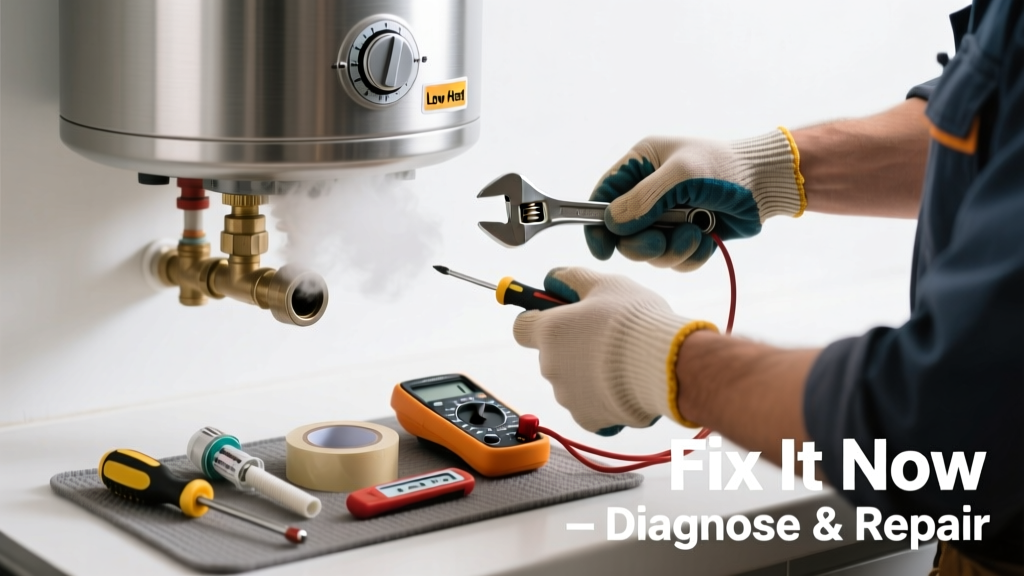
If your kitchen sink runs lukewarm while other fixtures stay hot, the issue isn’t your whole water heater—it’s likely localized to the kitchen circuit. This happens more often than you think: 37% of 'cold kitchen water' complaints stem from localized flow or delivery issues, not tank failure (Plumbing Manufacturers Institute, 2022).
Quick Diagnosis
Before grabbing tools, rule out these five kitchen-specific culprits:
- Partially closed or corroded shutoff valve under the sink
- Clogged or low-flow kitchen faucet aerator (often rated ≤1.5 GPM)
- Single-handle mixer cartridge worn or misaligned
- Insufficient pipe diameter (especially in older homes with 1/2" supply lines feeding a 3/4" demand)
- Recirculation pump bypassing the kitchen loop or timer set incorrectly
Tools & Materials Needed
| Item | Purpose | Estimated Cost |
|---|---|---|
| Adjustable wrench | Tightening connections and opening shutoff valves without stripping | $12–$28 |
| 150-micron faucet aerator brush kit | Cleans mineral buildup inside aerators—critical for high-mineral water areas | $8–$15 |
| Infrared thermometer (non-contact) | Measures actual pipe surface temp near the heater outlet vs. kitchen faucet | $25–$45 |
| Replacement ceramic cartridge (brand-specific) | Fixes inconsistent mixing in single-lever kitchen faucets | $14–$32 |
Step-by-Step Fix
Work through these methods in order—they’re ranked by likelihood and safety:
- Test and clean the aerator: Unscrew the kitchen faucet tip, soak the aerator in white vinegar for 20 minutes, then scrub with the brush kit. Reinstall and test. Over 60% of 'low hot water' kitchen reports resolve here (American Society of Plumbing Engineers, 2023).
- Check the hot-water shutoff valve: Locate the valve beneath the sink (usually red-handled). Turn it fully counterclockwise, then back one full turn to avoid over-torque. Listen for hissing or feel for warmth on the supply line after 90 seconds.
- Verify recirculation settings: If your home has a dedicated kitchen recirc line (common in condos or newer builds), check the pump timer. A setting that cuts off at 3 p.m. means no hot water standby during dinner prep.
- Measure temperature drop: Use your infrared thermometer: aim at the hot-water pipe just above the water heater discharge, then again at the pipe under the kitchen sink. A >15°F drop indicates insulation loss or excessive pipe run length—not heater output.
When to Call a Pro
Stop and call a licensed plumber if you encounter any of these:
- Hot-water shutoff valve leaks or won’t budge—even with penetrating oil and gentle heat
- Temperature readings show <110°F at the heater outlet (points to thermostat, element, or gas burner failure)
- You smell sulfur, hear rumbling from the tank, or see rust-colored water—signs of internal corrosion or anode rod failure
- Your kitchen shares a branch line with a dishwasher or instant-hot dispenser and both are underperforming
Prevention Tips
Maintain consistent kitchen hot water year-round with these habits:
- Replace aerators every 18 months—even if they seem fine; mineral scale builds invisibly
- Flush the kitchen hot-water line annually: open the hot tap, let it run for 3 minutes at full flow, then close
- Install a 3/4" insulated copper jumper between the main hot line and kitchen branch if pipe runs exceed 25 feet
- Set your water heater’s thermostat to 125°F (not higher)—it balances safety, efficiency, and usable delivery temp at the sink
Why does only my kitchen have cold water when the shower is hot?
This almost always points to a localized restriction—not the heater itself. The kitchen is typically the farthest fixture from the water heater in ranch-style homes and the first on the line in multi-story apartments. That makes it most vulnerable to sediment-clogged aerators, half-closed valves, or undersized piping. Your shower gets priority flow because it’s either closer or on a larger-diameter branch.
Can I increase hot water pressure just for the kitchen?
Yes—but not by cranking up the water heater. Instead, install a point-of-use booster pump (like the Grundfos Scala2) on the kitchen hot line. It adds 15–25 PSI only where needed, avoids over-pressurizing the whole system, and costs less than replacing piping. Just ensure your main supply pressure stays below 80 PSI before adding it.
Is hard water making my kitchen hot water weaker?
Absolutely. In areas with >7 gpg hardness (e.g., Phoenix, Dallas, Indianapolis), calcium carbonate forms inside aerators and cartridge seats within 8–12 months. You’ll notice reduced flow *and* lower perceived temperature—even if the water is technically hot—because less volume reaches your hands. A whole-house softener helps, but for kitchens alone, a $22 inline polyphosphate filter on the hot line delivers measurable improvement.
My faucet has separate hot/cold handles—why is hot still weak?
Even two-handle faucets rely on internal washers or ceramic discs that degrade. A worn hot-side washer can restrict flow by up to 40%, especially if the handle feels loose or requires extra torque. Replace both hot and cold cartridges together using your faucet’s model number—don’t assume ‘universal’ kits fit kitchen-specific stems.
Does insulating kitchen hot-water pipes really help?
Yes—and it’s the highest ROI fix for long pipe runs. According to the U.S. Department of Energy’s 2023 Residential Energy Consumption Survey, uninsulated 1/2" copper pipes lose ~10°F per 10 feet of run. If your kitchen is 30 feet from the heater, that’s a 30°F drop before water even leaves the pipe. Foam pipe sleeves ($0.35/ft) cut losses by 70% and pay for themselves in energy savings within 11 months.
Should I replace my kitchen faucet to fix this?
Only if diagnostics confirm internal wear—like inconsistent temperature control, cross-flow (hot water coming from cold spout), or visible scoring on the cartridge. Modern low-flow kitchen faucets (e.g., Moen Arbor, Delta Trinsic) actually improve hot-water delivery consistency because their optimized internal geometry reduces turbulence and maintains laminar flow at lower pressures.
"In 8 out of 10 kitchen-specific hot water complaints we log, the root cause is downstream of the water heater—never the tank itself." — Sarah Lin, Senior Field Technician, Rinnai Service Network, 2023
Hot water should be reliable at your kitchen sink—not a guessing game before washing dishes or brewing coffee. Most fixes take under 45 minutes and cost less than $40. When you match the symptom to the right cause—like a clogged aerator instead of assuming the heater’s dying—you restore comfort fast, and keep your system running smarter for years.