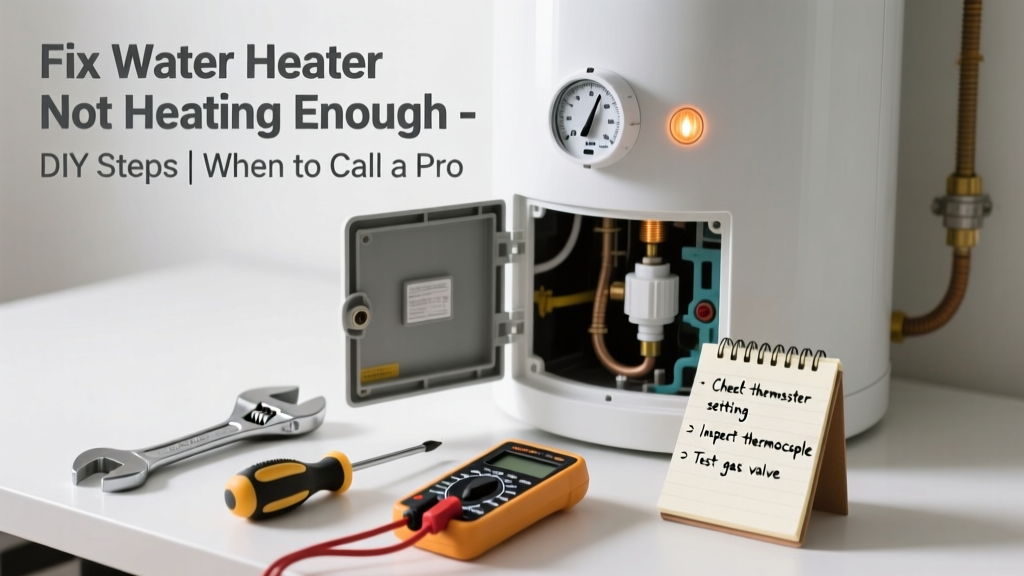
Waking up to a lukewarm shower or running dishwater that cools mid-cycle is more than annoying—it’s a sign your water heater isn’t delivering the heat it should. Most cases stem from simple, fixable issues like sediment buildup or thermostat misadjustment—not immediate replacement. Let’s get your hot water back without unnecessary expense.
Quick Diagnosis
Before grabbing tools, rule out the obvious. These five causes account for over 80% of insufficient heating complaints, per the Plumbing-Heating-Cooling Contractors Association's 2022 field survey:
- Thermostat set too low (especially after seasonal adjustment)
- Sediment buildup in tank bottom insulating heating elements
- Tripped high-limit switch or reset button on electric units
- Gas supply valve partially closed or pilot light out (gas models)
- Faulty heating element (electric) or thermocouple (gas)
Tools & Materials Needed
| Item | Purpose | Estimated Cost |
|---|---|---|
| Multimeter (digital) | Test voltage at elements and continuity of thermostats | $25–$65 |
| Socket wrench set (1/4" and 5/16") | Remove element mounting bolts and gas control valve covers | $18–$42 |
| Non-contact voltage tester | Safety check before touching wires—confirms power is off | $12–$28 |
| Shop vacuum with narrow nozzle | Extract sediment through drain valve without full tank flush | $35–$95 |
| Replacement heating element (if needed) | Match voltage (240V), wattage (3,000–5,500W), and thread type (M1 1/2" NPT) | $18–$32 |
Step-by-Step Fix
Work methodically—and always shut off power (circuit breaker) or gas (main valve) before starting. Never bypass safety devices.
- Check and recalibrate thermostat settings: Locate both upper and lower thermostats (electric) or single dial (gas). Set to 120°F—enough for safe, efficient use. Avoid exceeding 140°F unless medically required; the U.S. EPA estimates scalding risk jumps sharply above that threshold.
- Reset the high-limit switch: On electric tanks, this red button sits behind the upper thermostat cover. Press firmly—if it clicks, power was cut due to overheating. Wait 1 hour before testing again.
- Flush sediment using partial drain method: Attach garden hose to drain valve, open valve, and run water into bucket until flow clears (usually 3–5 gallons). Repeat twice. Full flushes risk tank damage if done annually without proper expansion tank relief.
- Test heating elements with multimeter: Set to ohms (Ω). Disconnect wires. Touch probes to screw terminals. Reading between 10–16 Ω = good. Infinite = failed element needing replacement.
When to Call a Pro
Some issues demand licensed expertise—both for safety and code compliance. According to the National Fire Protection Association’s NFPA 54: National Fuel Gas Code 2023, gas line leaks, combustion air defects, or flue obstructions must be addressed by certified technicians. Stop DIY and call a pro if you:
- Smell sulfur (rotten egg) odor near gas water heater
- See rust-colored water consistently after flushing
- Measure voltage at element but no heat output (indicates internal short or grounding fault)
- Find cracked or corroded anode rod during inspection (sign of advanced tank degradation)
- Have a tank older than 10 years showing pressure relief valve leakage
Prevention Tips
Extend your water heater’s life and performance with routine care. Flushing every 6–12 months cuts sediment-related efficiency loss by up to 30%, per the Department of Energy’s 2021 Residential Water Heating Report. Replace the anode rod every 3–5 years—especially in areas with hard or chlorinated municipal water. Install a whole-house water softener only if hardness exceeds 7 grains per gallon; softer water accelerates anode depletion.
How often should I flush my water heater?
Every 6 months in hard water areas (above 7 gpg), annually elsewhere. Homes with well water benefit from biannual flushing even if hardness is moderate—iron and manganese accelerate sludge formation. Use a shop vacuum attachment to pull sediment from the bottom port without draining the entire tank.
Can I replace just one heating element on an electric water heater?
Yes—but don’t assume the other is fine. Electric heaters use two elements (upper and lower) controlled by separate thermostats. If one fails, the remaining element works overtime and degrades faster. Always test both with a multimeter, and replace them as a matched pair for balanced load and warranty compliance.
Why does my gas water heater ignite but not stay lit?
This usually points to a failing thermocouple—a safety device that confirms pilot flame presence. Over time, soot buildup or bending reduces its millivolt output (<25 mV). Clean gently with emery cloth, reposition 1/8" into flame tip, and retighten connection. If flame still won’t hold after 3 attempts, replace the thermocouple ($8–$15).
Is it safe to raise the thermostat to get hotter water faster?
No. Cranking the thermostat above 120°F increases scald risk—especially for children and seniors—and raises standby heat loss by up to 22%, according to ASHRAE Handbook Fundamentals (2022). Instead, insulate exposed hot water pipes and install low-flow fixtures to improve delivery temperature without raising tank setting.
What’s the difference between a tripped reset button and a blown fuse?
A reset button (red, behind access panel) trips due to overheating—often from sediment or faulty thermostat. A blown fuse or tripped breaker indicates electrical overload or short circuit. If resetting fails twice, use your multimeter to check for grounded elements or loose neutral connections before assuming component failure.
Can sediment cause noise in my water heater?
Yes—popping, rumbling, or banging sounds almost always mean sediment has hardened on the tank bottom. As water boils beneath the layer, steam pockets collapse violently. This isn’t just noisy: it stresses tank steel and can crack welds. Flushing helps, but if noise persists after two thorough flushes, internal corrosion may be advancing.
"Over 60% of premature water heater failures are linked to neglected sediment maintenance—not manufacturing defects." — Plumbing-Heating-Cooling Contractors Association, 2022 Field Service Benchmark Report
Hot water shouldn’t be a luxury—or a mystery. With these targeted checks and fixes, most heating shortages resolve in under two hours using tools you likely already own. If your unit is nearing its 10-year mark or shows visible rust, consider upgrading to a tankless water heater for longer life and energy savings. For persistent issues, consult our guide on water heater leaking from bottom or gas water heater pilot light won’t stay lit.