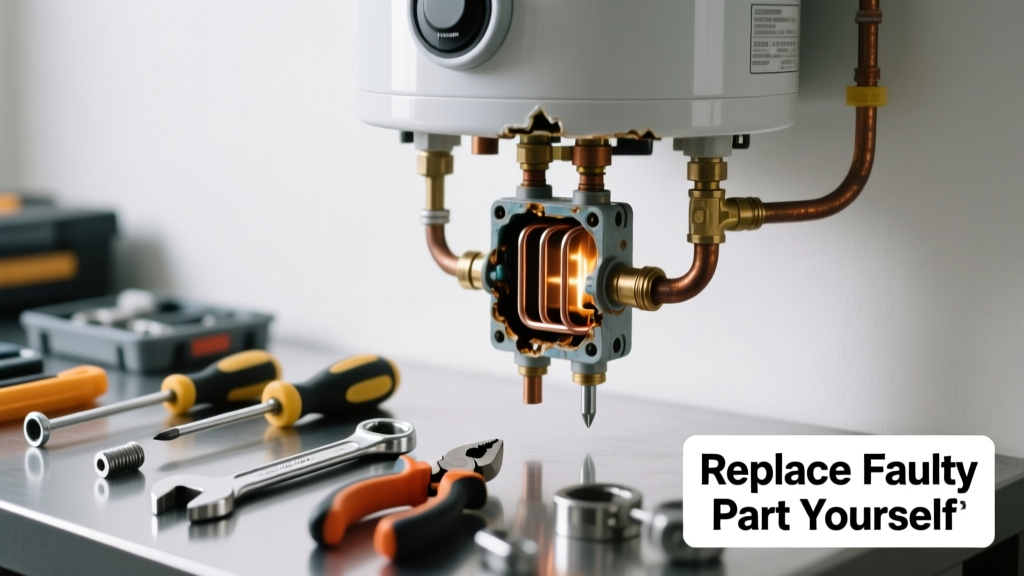
If your water heater suddenly delivers only cold water—and you’ve ruled out tripped breakers or gas supply issues—the culprit is likely a failed internal component. Most often, it’s not the whole unit that’s dead, but one of three replaceable parts: the thermostat, heating element (electric), or dip tube (gas or electric). Replacing the right part takes under two hours and costs less than $75 in parts.
Quick Diagnosis
Before grabbing tools, confirm which part has failed. Don’t guess—test first:
- Electric units: Check both upper and lower thermostats with a multimeter; test continuity on each heating element.
- Gas units: Listen for the burner firing; if silent but pilot is lit, suspect thermocouple or gas control valve failure.
- Both types: If hot water runs out unusually fast (e.g., 5 minutes instead of 20), inspect the dip tube for disintegration—common in units built between 1993–1997.
- Temperature drop over time: A failing thermostat often causes inconsistent output—not total loss—but paired with no reset button action, it’s likely faulty.
Tools & Materials Needed
| Item | Purpose | Estimated Cost |
|---|---|---|
| Multimeter (digital) | Verifies thermostat continuity and heating element resistance (should read 10–16 Ω) | $18–$35 |
| Socket wrench set (1/2" and 7/8") | Removes heating element mounting nuts and thermostat covers | $22–$48 |
| Replacement heating element (4500W, 240V) | Standard for most residential electric tanks; verify wattage/voltage match on old unit label | $14–$26 |
| Thermostat kit (upper/lower) | Includes both thermostats + high-limit switch; compatible with Rheem, AO Smith, Bradford White | $29–$42 |
| Dip tube replacement kit | Includes new polypropylene tube + O-ring; required if white plastic flakes appear in faucet aerators | $12–$21 |
Step-by-Step Fix
Follow these methods in order—start with testing, not replacing:
- Power down & drain: Shut off electricity at the breaker (or gas valve for gas units). Close cold inlet valve. Attach garden hose to drain valve and empty 2–3 gallons to relieve pressure and cool tank.
- Test thermostat(s): Remove access panels and insulation. Set multimeter to continuity mode. Touch probes to thermostat terminals. No beep = replace. For electric units, also test upper thermostat first—it controls lower one.
- Replace heating element (electric only): Unscrew old element with 1-1/2" socket. Wrap new element threads with Teflon tape (2–3 wraps). Tighten firmly—but don’t overtighten or crack tank lining. Refill tank before restoring power.
- Swap dip tube (if confirmed degraded): Disconnect cold water inlet pipe. Pull old tube (often brittle and crumbled). Insert new tube fully into inlet nipple until seated. Reconnect pipe with new compression ring.
When to Call a Pro
Some failures require licensed expertise—and insurance coverage—for safety and code compliance:
- You smell gas near a gas water heater (evacuate and call utility immediately).
- There’s visible corrosion or bulging on the tank exterior—this signals imminent failure, not part failure.
- Your unit is older than 12 years and has recurring issues; replacement may be more cost-effective than repeated part swaps.
- You’re uncomfortable working with 240V wiring or gas line connections—even minor errors risk fire or explosion.
"Over 60% of 'no hot water' service calls involve a single replaceable component—not full unit replacement," says Mike Rinaldi, Master Plumber and technical advisor for the Plumbing-Heating-Cooling Contractors Association (PHCC) 2023 Field Survey.
Prevention Tips
Extend your water heater’s life and avoid surprise failures with routine care:
- Drain 1–2 gallons every 6 months to reduce sediment buildup that insulates heating elements and stresses thermostats.
- Test the pressure relief valve annually by lifting its lever—listen for a hiss and watch for water discharge.
- Set thermostat to 120°F—higher temps accelerate mineral scaling and increase element wear.
- Install a whole-house water softener if your hardness exceeds 7 gpg (grains per gallon); hard water cuts element life by up to 40%, per the Water Quality Association’s 2022 Corrosion Study.
How do I know if my heating element is bad?
Use a multimeter set to ohms (Ω). Disconnect wires from the element. Place probes on screw terminals. A reading between 10–16 Ω means it’s functional. Infinite resistance (OL) or zero Ω means it’s failed. Also check for visible blistering or cracked sheathing.
Can I replace just the upper thermostat without touching the lower one?
Yes—but only if testing confirms the upper one is faulty and the lower one reads continuity. The upper thermostat powers the lower one in most dual-element systems. Replacing only the upper thermostat is common and safe, provided wiring matches exactly. See standard wiring diagrams here.
Why does my water heater make popping noises before losing hot water?
Popping indicates sediment buildup on the tank bottom. When the heating element fires, trapped water under sediment flashes to steam, causing mini-explosions. This stresses the element and can burn out thermostats prematurely. Drain and flush the tank before replacing parts.
Do gas water heaters have dip tubes too?
Yes—both gas and electric storage tanks use dip tubes to direct cold water to the bottom of the tank. Degraded dip tubes cause cold water mixing at the outlet, mimicking a heating failure. Look for white plastic fragments in faucet screens—a telltale sign. Full gas-unit dip tube guide here.
Is it safe to replace a thermostat myself on an electric water heater?
Yes—if you shut off power at the main breaker (not just the disconnect switch) and verify zero voltage with a non-contact tester. Always replace both upper and lower thermostats as a matched set if either fails, since mismatched models can cause overheating or cycling issues.
What’s the average lifespan of a water heater heating element?
Most factory-installed elements last 6–10 years in moderately hard water. In areas with >10 gpg hardness, expect 3–5 years unless you flush annually. According to the U.S. Department of Energy’s 2023 Appliance Life Expectancy Report, sediment-related element failure accounts for 31% of premature electric water heater repairs.
Replacing the right part restores hot water faster and cheaper than assuming the whole unit is shot. Keep your multimeter calibrated, label wires before disconnecting, and never restore power until the tank is completely full. If you’ve done this repair before, you’ll notice the difference in response time—and your wallet will thank you for skipping the $225 service call. For deeper system checks, consider pairing this fix with a anode rod inspection to prevent internal corrosion.