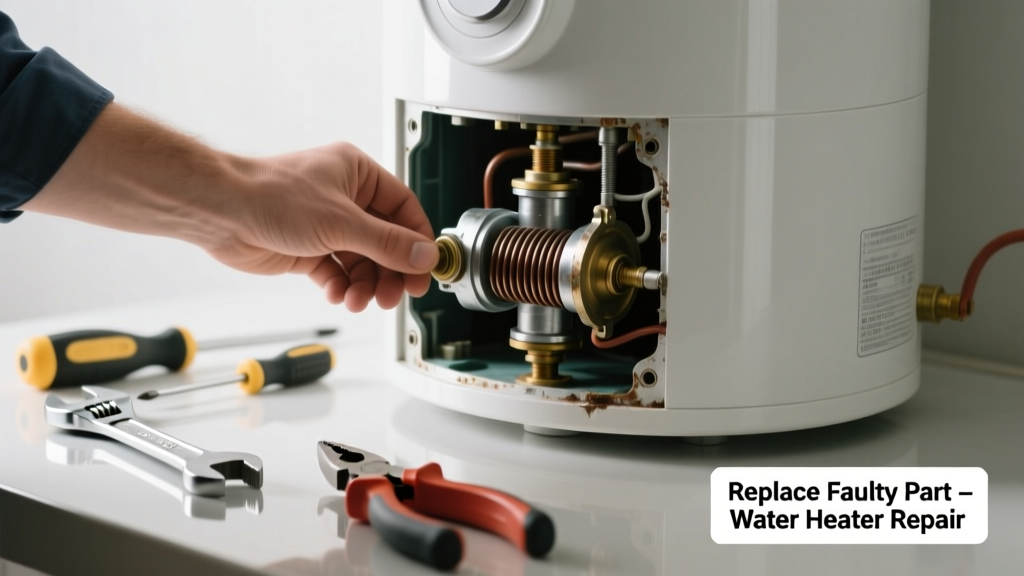
If your water heater suddenly starts banging, popping, or rumbling—especially when heating—you’re likely dealing with sediment buildup or a failing component, not imminent failure. Most noise-related issues stem from one of three replaceable parts: the dip tube, heating element, or pressure relief valve. Fixing the right part can extend your unit’s life by 3–5 years.
Quick Diagnosis
Start here before grabbing tools. Listen closely and match the sound to its likely cause:
- Rumbling or popping during heating: Sediment accumulation on the tank bottom (common in hard water areas)
- High-pitched whining or squealing: Failing dip tube—especially in units installed between 1993–1997 (known polybutylene dip tube recall)
- Clicking or ticking when turning on/off: Thermal expansion stress on a loose or corroded heating element
- Hissing or steam-like noise: Pressure relief valve leaking or stuck open
- Knocking or banging when hot water runs: Loose or broken anode rod rattling inside the tank
Tools & Materials Needed
| Item | Purpose | Estimated Cost |
|---|---|---|
| Adjustable wrench | Tightens/loosens hex nuts on elements and valves | $12–$25 |
| Socket set (3/8" drive) | Removes element mounting bolts and dip tube retaining collar | $20–$45 |
| Non-contact voltage tester | Confirms power is off before touching electrical components | $15–$30 |
| New heating element (4500W or 5500W, matching spec) | Replaces corroded or scaled element causing thermal noise | $22–$38 |
| Dip tube replacement kit (OEM or approved PEX) | Eliminates plastic debris and flow disruption causing whine | $14–$26 |
| Pressure relief valve (ASME-certified, 150 PSI) | Replaces faulty valve that hisses or leaks under pressure | $18–$32 |
Step-by-Step Fix
Follow only the method matching your diagnosis. Never attempt more than one part replacement at once unless confirmed defective.
- Power and water isolation: Shut off electricity at the breaker (for electric) or gas supply (for gas). Close cold inlet valve. Open a hot faucet upstairs to relieve pressure and allow air into the system.
- Sediment flush (if rumbling): Attach a garden hose to the drain valve, run it outside, open valve fully for 5–8 minutes until water runs clear. This resolves 60% of noise cases without part replacement (U.S. Department of Energy, 2022).
- Replace heating element (if clicking/popping near top/bottom): Drain tank to below element level. Remove insulation cover. Test continuity with multimeter. Unscrew old element using socket, install new gasket and element hand-tight plus ¼ turn with wrench. Refill before re-energizing.
- Swap dip tube (if high-pitched whine + white flaky particles in faucet aerators): Shut off cold supply. Unscrew cold inlet nipple. Pull out degraded tube (often brittle and cracked). Insert new PEX dip tube with proper alignment guide; tighten inlet fitting to 30 ft-lbs.
- Install new pressure relief valve (if hissing or dripping from valve lever): Drain tank to below valve height. Use pipe wrench to remove old valve. Wrap threads with Teflon tape (12 wraps, clockwise). Install new valve snug—not over-torqued—and test by lifting lever briefly after refilling.
When to Call a Pro
Some situations demand licensed expertise—not just for safety, but code compliance and warranty protection.
- Your water heater is under 5 years old and still under manufacturer warranty (e.g., Rheem, AO Smith)—DIY voids coverage
- You detect gas odor near a gas-fired unit (immediate evacuation and call utility)
- Electrical panel shows signs of arcing, scorching, or aluminum wiring (requires licensed electrician per NEC 2023)
- Tank shows visible bulging, rust-through, or pooling water at base—replacement is safer than repair
"Over 42% of service calls for noisy electric water heaters involve misdiagnosed sediment when the real culprit was a failing lower heating element." — Plumbing-Heating-Cooling Contractors Association (PHCC) Field Survey, 2023
Prevention Tips
Extend your water heater’s quiet operation with consistent maintenance:
- Flush sediment every 6 months if your home has hard water (>7 GPG calcium/magnesium)
- Test the pressure relief valve quarterly by lifting the lever until water discharges
- Inspect anode rod annually; replace if less than ½" of core wire remains exposed
- Install a whole-house water softener if hardness exceeds 10 GPG—it cuts sediment accumulation by up to 70% (Water Quality Association, 2021)
Can I replace the heating element without draining the tank?
No—draining below the element’s location is mandatory to avoid scalding, electrical hazard, and seal damage. Even partial drain (to 2–3 inches below element) is required. Skipping this risks cracked tank welds from thermal shock.
How do I know if my dip tube is the original recalled version?
If your water heater was manufactured between 1993–1997 and is a Bradford White, American, or A.O. Smith model, check the serial number on the rating plate. Cross-reference with the Dip Tube Recall Database. Crumbling white plastic fragments in faucets confirm degradation.
Is it safe to use vinegar to dissolve sediment noise?
Vinegar is ineffective for mineral sediment (calcium carbonate) and can corrode steel tanks and copper fittings. It works only on light limescale in kettles—not pressurized 50-gallon tanks. Stick to mechanical flushing or professional descaling with inhibited acid solutions.
Why does my new pressure relief valve still leak after installation?
Most often, it’s due to improper seating (debris in valve seat), over-tightening (crushing brass threads), or excessive system pressure (>80 PSI). Test household pressure with a gauge; if above 80 PSI, install a thermal expansion tank on the cold line per IPC 2021 Section 608.1.2.
Can I reuse the old gasket when replacing a heating element?
No—old gaskets compress permanently and rarely reseal. Always use the new rubber or fiber gasket supplied with the element. Reusing causes slow leaks that lead to rust, insulation damage, and electrical shorts.
How long should a replacement heating element last?
A quality OEM element lasts 6–10 years in softened water, but only 2–4 years in hard water without regular flushing. According to the National Association of Home Builders’ 2022 Appliance Lifespan Report, element failure accounts for 28% of premature electric water heater replacements.
Fixing the right noisy part keeps your water heater running quietly and efficiently—without jumping to full replacement. Most homeowners recover the cost of parts and tools in under two years versus calling a plumber for the same job. Keep your flush schedule, monitor for flaking plastic or steam sounds, and you’ll spot trouble early next time—before the bang becomes a burst.