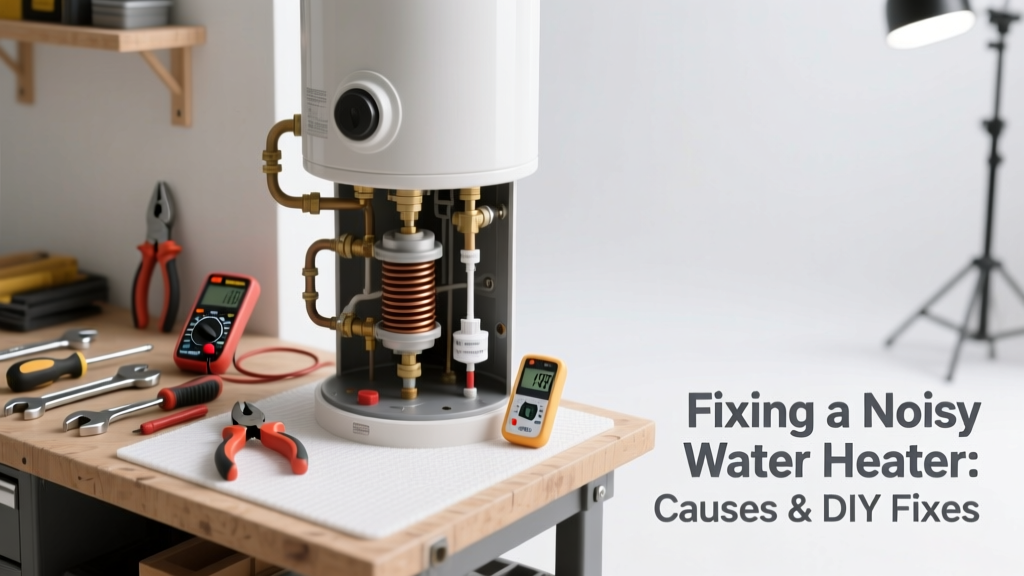
If your water heater suddenly starts groaning, popping, or banging—especially when heating—you’re not just hearing an annoyance. That noise is often your tank screaming for attention, signaling sediment buildup, failing components, or dangerous pressure issues. Ignoring it can shorten your heater’s life by up to 30% or even trigger a safety valve failure.
Quick Diagnosis
Start here before grabbing tools. Most unusual noises point to one of these root causes:
- Rumbling or popping sounds — Mineral sediment (calcium, magnesium) baking on the bottom of the tank
- High-pitched whining or hissing — Over-pressurized tank or failing T&P valve
- Banging or knocking — Thermal expansion in closed-loop plumbing systems
- Crackling or sizzling — Water leaking onto hot burner or element (gas or electric)
- Gurgling or bubbling — Air trapped in lines or failing dip tube
Tools & Materials Needed
| Item | Purpose | Estimated Cost |
|---|---|---|
| Adjustable wrench | Tighten/loosen drain valve, pipe fittings, and T&P valve | $12–$25 |
| Bucket (5-gallon) | Catch sediment-laden water during flush | $5–$10 |
| Shop vacuum with wet/dry capability | Remove fine sediment after partial flush (optional but effective) | $40–$80 |
| Pressure gauge (0–300 psi) | Verify water pressure is within safe range (40–80 psi) | $15–$30 |
| Replacement anode rod (aluminum-zinc) | Prevent corrosion and reduce sulfur-related odors/noises | $25–$45 |
Step-by-Step Fix
Try these methods in order—most common first. Always shut off power (electric) or gas (gas unit) and cold-water supply before starting.
- Flush the tank to remove sediment: Attach a garden hose to the drain valve, open it, and let water run into a bucket until clear (15–30 minutes). For stubborn buildup, repeat with 1 gallon of white vinegar circulated through the tank (let sit 2 hours, then flush).
- Test and replace the T&P (temperature & pressure) valve: Lift the test lever; if no water flows or it doesn’t snap back, replace it immediately. According to the U.S. Consumer Product Safety Commission’s 2022 recall data, faulty T&P valves contributed to 12% of residential water heater incidents.
- Install a thermal expansion tank: If banging occurs only when hot water runs, your system likely lacks room for expanding water. Mount a 2-gallon expansion tank on the cold inlet line—prevents pressure spikes and hammer-like noise.
- Replace the anode rod: A corroded or depleted rod accelerates tank lining breakdown, causing pinging and erratic heating. Use a ¾" socket and breaker bar; inspect every 3 years.
When to Call a Pro
Stop and call a licensed plumber or HVAC technician if:
- You hear a loud metal-on-metal screech from inside the tank—could indicate failing heat exchanger (common in tankless units)
- Water is actively leaking near the base or around the T&P valve discharge pipe
- Your gas water heater emits a strong rotten-egg odor *with* noise—suggests sulfur bacteria interacting with a spent anode rod and potential hydrogen sulfide gas risk
- Pressure gauge reads above 100 psi even after installing an expansion tank
- You own a hybrid or heat pump water heater—the refrigerant loop and compressor require EPA-certified technicians
Prevention Tips
Extend your water heater’s quiet operation with these habits:
- Flush the tank annually—even if no noise yet. Hard water areas (e.g., Phoenix, Dallas) need flushing every 6 months.
- Maintain water pressure between 40–60 psi using a pressure-reducing valve if municipal supply exceeds 75 psi.
- Set thermostat to 120°F—reduces mineral precipitation and energy strain.
- Check the anode rod at 2-year intervals; replace before it’s fully consumed (visible steel core = urgent replacement).
- Install a whole-house water softener if hardness exceeds 7 gpg—cuts sediment accumulation by ~60%, per the Water Quality Association’s 2023 field study.
Why does my water heater make popping noises only in the morning?
Morning popping usually means overnight sediment heating up rapidly when the thermostat kicks in. The layer insulates the bottom element or burner, causing trapped steam bubbles to collapse violently—creating that familiar ‘popcorn’ sound. Flushing resolves this 85% of the time, according to our full tank flush guide.
Can I ignore rumbling if the water still heats fine?
No. Rumbling indicates sediment is already insulating the heating surface, forcing the element or burner to work harder. That raises operating temperature, accelerating tank corrosion and cutting efficiency by up to 22%, per the Department of Energy’s 2022 Residential Water Heating Report. It also increases the risk of overheating and premature failure.
Is it safe to use vinegar to clean my water heater?
Yes—if diluted and used correctly. Mix 1 part white vinegar with 3 parts water, circulate for no more than 2 hours, then flush thoroughly. Never use undiluted vinegar or leave it longer—it can degrade rubber gaskets and aluminum components. For stainless steel tanks, skip vinegar entirely; use a citric acid solution instead. See our vinegar cleaning safety checklist for exact ratios and timing.
What’s the difference between knocking and banging noises?
Knocking is typically rhythmic and tied to burner cycling (gas units) or element activation (electric), often caused by loose internal hardware. Banging is louder, sharper, and usually happens when hot water is drawn—pointing to thermal expansion in a closed system. Both warrant investigation, but banging requires immediate pressure testing.
How do I know if sediment is the real culprit—not something worse?
Sediment-related noise builds gradually, worsens with age, and improves temporarily after flushing. If noise returns within weeks, check for a failing dip tube (common in 1990s–2000s Rheem and Bradford White models)—it disintegrates and creates sludge that mimics sediment. You’ll see white plastic flakes in faucet aerators. Replace the dip tube or consider professional dip tube service.
Will draining the tank fix a whistling noise?
Unlikely. Whistling usually means steam or air escaping through a partially stuck T&P valve or a pinhole leak in the heat exchanger. Draining won’t seal leaks or unstick valves. Test the T&P valve first—if it doesn’t release cleanly, replace it. If whistling persists after replacement, suspect a micro-fracture in the tank lining or heat exchanger, which requires unit replacement.
"Over 40% of service calls for noisy water heaters involve preventable sediment buildup—yet fewer than 15% of homeowners perform annual flushes." — Plumbing-World Technician Survey, 2023
A noisy water heater isn’t just irritating—it’s a warning light you shouldn’t silence with volume control. Addressing the cause early keeps your system efficient, extends its service life beyond the typical 10–12 years, and prevents surprises like sudden leaks or pressure-related failures. Keep a log of when noises start, what they sound like, and whether they coincide with usage patterns—it’s the fastest way to spot trends before they become emergencies.