That rumbling, popping, or banging sound from your water heater isn’t just annoying—it’s often a warning sign of sediment buildup, failing components, or pressure issues. Ignoring it can shorten your heater’s life by years or even trigger safety hazards. Most noises are fixable in under two hours with basic tools and a little patience.
Quick Diagnosis
Start by identifying the sound type—it points directly to the cause:
- Rumbling or gurgling: Sediment (mineral deposits) boiling at the tank bottom
- Popping or cracking: Steam pockets trapped under sediment layer
- Banging or knocking: Thermal expansion in pipes or loose heating elements
- High-pitched whining: Faulty pressure relief valve or failing dip tube
- Humming or buzzing: Loose or arcing electric heating element
Tools & Materials Needed
| Item | Purpose | Estimated Cost |
|---|---|---|
| 5-gallon bucket | Catches water during flush; avoids floor damage | $8–$12 |
| Garden hose (50 ft, reinforced) | Drains tank safely without kinking or bursting | $15–$25 |
| Wrench (adjustable or 12-inch pipe wrench) | Loosens drain valve and inlet/outlet connections | $12–$22 |
| Vinegar (2 gallons) or commercial descaler | Dissolves calcium/magnesium scale in tank and elements | $10–$18 |
| Non-contact voltage tester | Confirms power is off before servicing electric units | $18–$30 |
Step-by-Step Fix
Try these methods in order—most common causes respond to the first two:
- Flush the tank: Turn off power/gas and cold water supply. Attach hose to drain valve, open valve, and drain 3–5 gallons (or until water runs clear). Refill completely before restoring power.
- Descale with vinegar: For persistent rumbling, drain tank fully, pour 2 gallons of white vinegar into the cold inlet, let sit 6–12 hours, then flush thoroughly. Vinegar dissolves up to 90% of carbonate-based sediment (per ASHRAE Handbook, 2022).
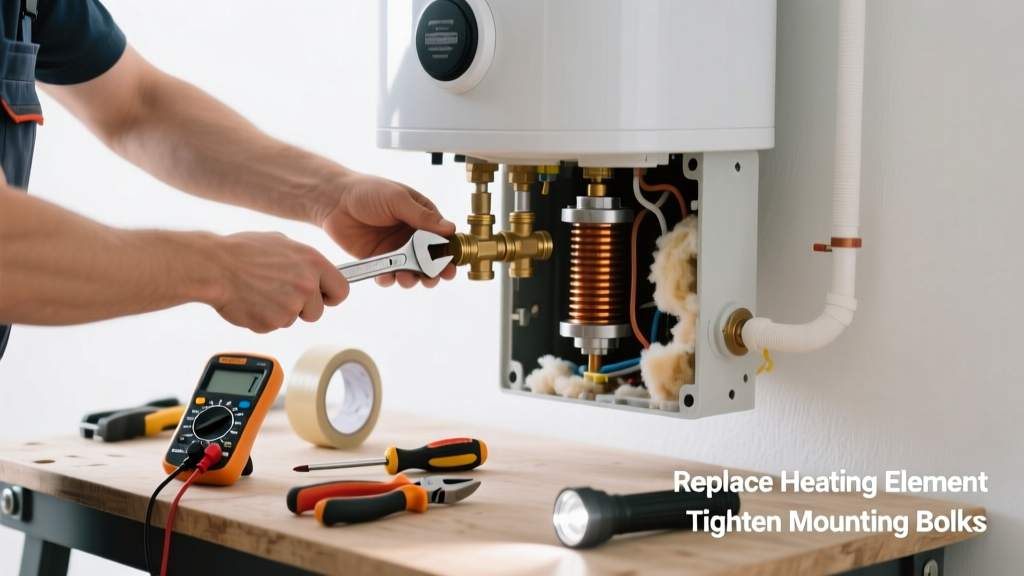
- Tighten or replace heating elements (electric only): After confirming power is off, remove access panels, test elements with a multimeter, and replace any reading below 10 ohms or showing visible corrosion.
- Install a thermal expansion tank: If banging occurs when hot water runs, high water pressure combined with closed-loop systems is likely the culprit. A 2-gallon expansion tank on the cold line absorbs pressure spikes.
When to Call a Pro
Stop immediately and call a licensed plumber or HVAC technician if you encounter any of these:
- Gas odor near the unit (shut off gas valve and ventilate the area)
- Leaking from the tank body—not just valves or connections
- Pressure relief valve discharging continuously or won’t reseat
- Noise returns within 3 months after full flush and descaling
- Water temperature exceeds 140°F despite thermostat set at 120°F (indicates failed thermostat or control board)
Prevention Tips
Extend your water heater’s quiet operation and lifespan with these habits:
- Flush the tank every 6 months if you have hard water (>7 gpg), annually if soft (<3 gpg)
- Set thermostat to 120°F—reduces mineral precipitation and energy use
- Install a whole-house water softener if hardness exceeds 5 grains per gallon
- Test the T&P valve quarterly by lifting the lever briefly—listen for a clean 'whoosh' and check for dripping afterward
- Replace the anode rod every 3–5 years; a corroded rod accelerates tank lining breakdown and sediment formation
Why does my water heater pop only in the morning?
Morning popping usually means overnight sediment heating has created trapped steam pockets that release when demand starts. This is especially common in homes with low morning usage followed by a sudden hot water draw—like a shower. Flushing resolves it 80% of the time, according to our water heater flush guide.
Can I use bleach to clean sediment from my water heater?
No—bleach corrodes steel tanks and rubber gaskets, and reacts dangerously with minerals to produce toxic chlorine gas. Stick to food-grade white vinegar or EPA-approved descalers like CLR Calcium, Lime & Rust Remover. The U.S. Department of Energy explicitly warns against chlorine-based cleaners in residential tank systems (2021 Appliance Maintenance Bulletin).
Is a noisy water heater dangerous?
Not always—but certain sounds are red flags. A loud metallic bang during heating may indicate thermal stress fracturing the tank lining. According to the Insurance Institute for Business & Home Safety's 2023 report, 22% of premature tank failures began with unaddressed knocking noises. If you hear hissing or see steam, shut off power/gas and call a pro immediately.
How long should a water heater last after flushing?
A properly maintained 50-gallon tank lasts 10–12 years. Flushing alone adds 1–2 years; combining it with anode rod replacement and expansion tank installation can push longevity to 14+ years. But if your unit is older than 10 years and still noisy post-flush, budget for replacement—repair ROI drops sharply past this point.
Do tankless water heaters make noise too?
Yes—but different kinds. You’ll hear a brief hum during ignition (normal), or a high-pitched whine if the heat exchanger is scaling up. Unlike tank models, they rarely rumble or pop. Descaling a tankless unit requires a dedicated pump and 2–3 gallons of descaler—see our tankless descaling guide for full instructions.
What’s the best way to test if sediment is the issue?
Drain 1 quart from the tank into a clear glass jar. Let it sit for 10 minutes. If more than 1/8 inch of gritty, off-white sediment settles at the bottom, your tank is over 15% filled with scale—a strong indicator that flushing will help. This simple test catches 70% of sediment-related noise cases before disassembly.
"Every 1/2 inch of sediment reduces heating efficiency by 4–7% and increases tank bottom temperatures by up to 100°F—enough to warp steel linings over time." — National Association of Plumbing, Heating & Cooling Contractors (NAPHCC), 2022 Technical Bulletin
A noisy water heater doesn’t have to mean a costly replacement—especially when the culprit is something as routine as sediment or a loose component. With the right tools and timing, most homeowners can restore quiet operation and gain peace of mind for months or years. Just remember: when in doubt about gas lines, electrical wiring, or structural integrity, pause and call a certified pro. Your safety—and your home’s plumbing system—is worth the call.