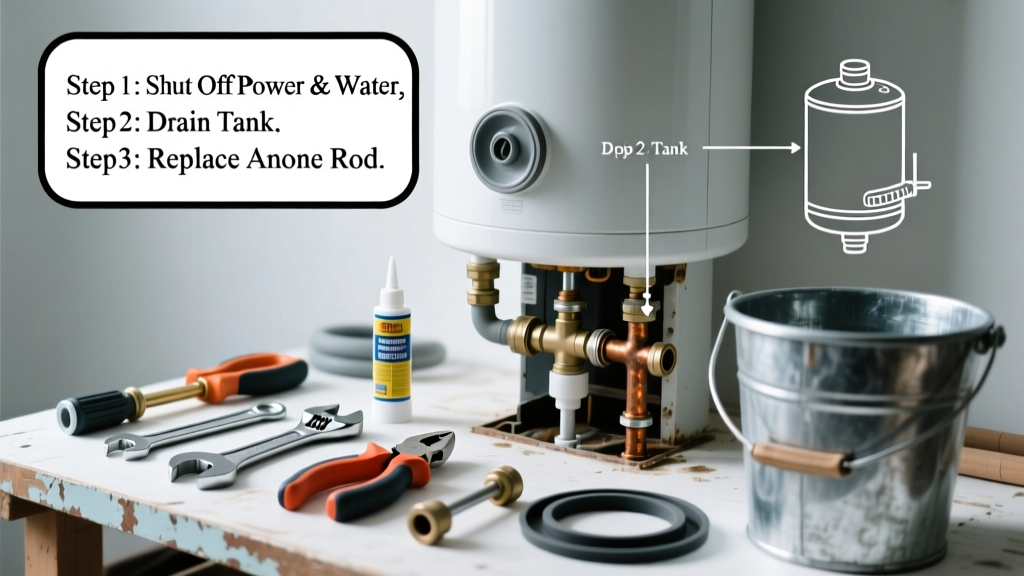
If your water heater is dripping water while humming, popping, or banging, don’t ignore it—this combo often signals sediment buildup, pressure issues, or failing components. Left unaddressed, it can lead to tank failure, scalding risks, or even flooding. Most causes are fixable in under two hours with basic tools and careful attention.
Quick Diagnosis
Start by identifying the noise type and leak location—they point directly to the root cause:
- Popping or rumbling + warm puddle near base = sediment accumulation heating unevenly
- Hissing or sputtering + wetness around temperature/pressure (T&P) valve = valve failure or excessive pressure
- High-pitched whine + dripping from cold inlet pipe = loose or corroded dielectric nipple
- Thumping or banging + leak at bottom element access panel = failed heating element gasket (electric units)
- Gurgling + moisture on gas control valve = condensation mixed with internal corrosion (common in older gas units)
Tools & Materials Needed
| Item | Purpose | Estimated Cost |
|---|---|---|
| 10-in adjustable wrench | Tightens or removes T&P valve, drain valve, and pipe connections | $12–$25 |
| 3/8-in socket set with ratchet | Removes element cover plates and mounting screws on electric heaters | $18–$35 |
| Bucket and garden hose | Catches water during draining; essential for sediment flush | $5–$12 |
| New T&P valve (ASME-certified) | Replaces faulty pressure relief valve—required by code if leaking or stuck | $8–$16 |
| Dielectric union kit (½-in) | Prevents galvanic corrosion between copper and steel pipes | $14–$22 |
Step-by-Step Fix
Follow these methods in order of likelihood—start with the simplest and safest:
- Flush sediment (for popping/rumbling): Turn off power/gas and cold water supply. Attach hose to drain valve, open T&P valve slightly to break vacuum, then fully open drain valve into bucket. Run until water runs clear (usually 3–5 gallons). Refill tank before restoring power.
- Replace the T&P valve (for hissing/dripping): After draining 2–3 gallons, use wrench to unscrew old valve counterclockwise. Wrap threads of new ASME-certified valve with Teflon tape (3 wraps), screw in clockwise until snug—do not over-tighten. Test by lifting lever; water should discharge smoothly, then stop when released.
- Install dielectric unions (for whining + inlet leaks): Shut off cold supply, drain 5 gallons. Cut cold inlet pipe 2 inches above heater, deburr ends, then install union with brass-to-copper transition. Tighten only hand-tight plus 1/4 turn with wrench—overtightening cracks fittings.
- Replace element gasket (electric units only): Power off at breaker. Remove access panel and insulation. Unscrew heating element with socket, discard old rubber gasket, install new silicone-rated gasket, reassemble. Test for leaks before restoring power.
When to Call a Pro
Some situations demand licensed expertise—not just for safety, but code compliance:
- Leak originates from the tank body itself (not valves, pipes, or fittings)—this means imminent failure
- You smell gas near a gas water heater (shut off gas supply immediately and call utility)
- Water tests positive for rust or metallic taste after flushing—indicates internal tank corrosion
- Your unit is over 10 years old and has never had its anode rod replaced (anode inspection requires draining and special tool)
- Local code prohibits homeowner replacement of T&P valves or gas connectors (e.g., Massachusetts and Washington require licensed plumbers)
"Over 70% of premature water heater failures stem from neglected sediment buildup or delayed T&P valve replacement," says the Plumbing-Heating-Cooling Contractors Association's 2022 Field Service Report.
Prevention Tips
Extend your water heater’s life and avoid repeat issues with these habits:
- Drain and flush the tank every 6 months if you have hard water (over 7 grains per gallon)
- Test the T&P valve quarterly by lifting its lever—replace if it doesn’t discharge or won’t reseal
- Check anode rod condition every 2 years; replace if more than 6 inches of core wire is exposed
- Install a whole-house water softener if hardness exceeds 10 GPG—reduces sediment by up to 90% (Water Quality Association, 2023)
- Set thermostat to 120°F—higher temps accelerate scale formation and pressure stress
Can I tighten a leaking T&P valve instead of replacing it?
No—T&P valves are single-use safety devices. If it leaks, the internal spring or seal is compromised. Tightening may cause thread damage or prevent proper pressure release. Always replace with an ASME-certified valve matching your heater’s PSI rating (typically 150 psi).
Why does my water heater bang only when the hot water turns on?
This points to thermal expansion in closed-loop systems. When cold water enters the heated tank, it expands—but without an expansion tank, pressure spikes force water backward through the cold line, causing pipe vibration and banging. Install a 2-gallon expansion tank on the cold inlet, pre-charged to your home’s water pressure (usually 40–60 psi).
Is it safe to drain a water heater while it’s still hot?
It’s possible but risky. Hot water can scald instantly, and sudden cooling may warp tank seams. Always shut off power/gas and let the tank cool for at least 2 hours before draining. The U.S. EPA estimates that 14% of household water usage is from leaks—including those caused by rushed maintenance.
What noise means the heating element is about to fail?
A persistent, low-frequency hum or buzz—especially when no other appliances are running—is often the first sign of arcing inside a failing electric heating element. If accompanied by tripped breakers or inconsistent hot water, test resistance with a multimeter (should read 10–16 ohms). Replace both elements if one fails—the other is likely near end-of-life.
How do I know if the leak is from condensation, not a real failure?
Condensation forms on cold tanks in humid basements during winter—look for uniform dampness on the outer jacket (not pooling), no drips from valves or pipes, and no mineral stains. Wipe dry, run heater for 1 hour, then check again. Real leaks leave white calcium rings or wet streaks pointing toward a fitting.
Can I use vinegar to dissolve sediment instead of flushing?
Vinegar is ineffective for heavy sediment (mostly calcium carbonate and rust). It may loosen minor scale but won’t dislodge hardened layers—and prolonged exposure can corrode steel tank linings. Stick to mechanical flushing. For severe cases, consider professional hydro-jetting services like water heater flush service.
A noisy, leaking water heater isn’t just annoying—it’s your system shouting for attention. Most fixes take less time than waiting for a plumber, and catching issues early prevents $1,200+ tank replacements. Keep a log of flush dates and valve tests; that simple habit cuts unexpected failures by nearly half, according to the National Association of Home Builders’ 2023 Maintenance Survey. If you’ve tackled the flush and valve swap, you’re already ahead of 80% of homeowners—now go enjoy that quiet, steady hot water.