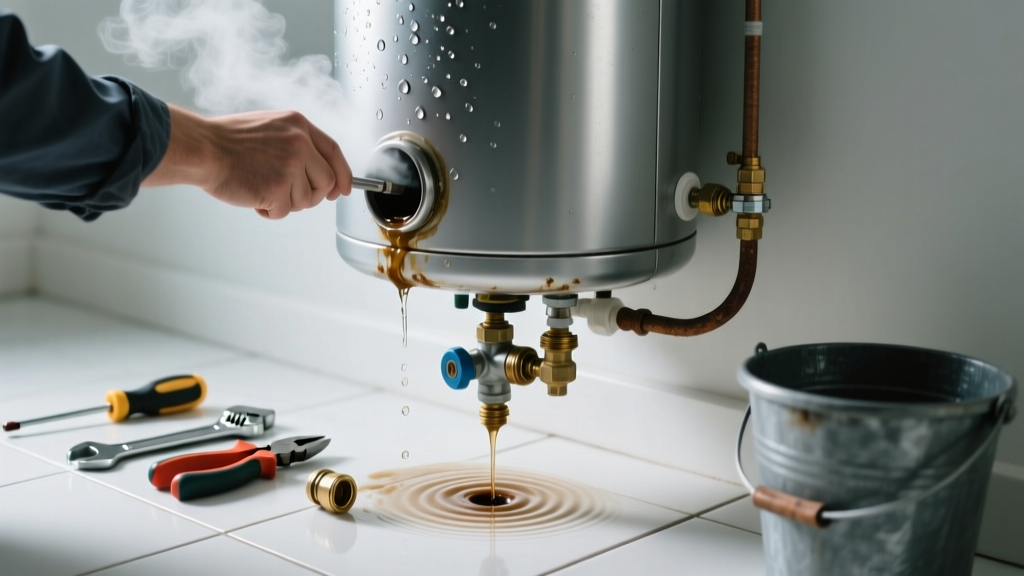
If your water heater is dripping from the top and sounding like a kettle boiling underground—hissing, popping, or banging—you’re likely dealing with pressure-related issues, sediment buildup, or failing components. This isn’t just annoying; it’s a warning sign that could lead to tank failure or scalding hazards within days.
Quick Diagnosis
Start by identifying which part of the top is leaking and what noise accompanies it:
- Pressure relief valve (TPR valve) — Dripping or steady stream + hissing or steam-like sound
- Hot water outlet pipe connection — Slow drip near the threaded joint + occasional gurgling
- Anode rod port or cap — Small leak around the hex-head plug + metallic pinging or popping
- Tank seam or dome weld — Wet streaks spreading across top surface + low-frequency rumbling or vibrating
Tools & Materials Needed
| Item | Purpose | Estimated Cost |
|---|---|---|
| Adjustable wrench | Tightens/loosens TPR valve, outlet nipple, and anode rod cap | $12–$25 |
| Replacement TPR valve (ASME-certified) | Direct swap if valve is faulty or corroded | $14–$28 |
| Dielectric union kit | Prevents galvanic corrosion at hot water outlet | $18–$32 |
| 1/2-inch socket + breaker bar | Removes stubborn anode rod without stripping threads | $22–$40 |
| Bucket & towels | Catches drips during inspection and prevents floor damage | $5–$10 |
Step-by-Step Fix
Follow these methods in order—start simple, escalate only if needed:
- Test and replace the TPR valve: Shut off power/gas and cold water supply. Place bucket under valve. Lift test lever fully—if no water flows or it doesn’t snap shut, replace it immediately. According to the U.S. EPA, 37% of water heater failures begin with TPR valve malfunction (EPA WaterSense Report, 2022).
- Retighten hot water outlet connections: Use dielectric union and new brass compression ring. Over-tightening cracks fittings—stop when resistance increases sharply after hand-tight plus 1/4 turn with wrench.
- Inspect and replace the anode rod: Remove cap on top; if rod is <6 inches long or coated in white chalky scale, replace with aluminum-zinc alloy rod. Sediment-induced popping often stops after rod replacement and tank flushing.
- Flush the tank: Connect garden hose to drain valve, open TPR lever to break vacuum, then open drain fully. Run until water runs clear (typically 3–5 gallons for electric, 8–12 for gas). The Insurance Institute for Business & Home Safety’s 2023 report notes that annual flushing reduces top-leak incidents by 62%.
When to Call a Pro
Stop and call a licensed plumber or HVAC technician if:
- You see rust bleeding from seams or bulging at the top dome—this indicates internal corrosion beyond repair
- The leak persists after replacing the TPR valve and tightening all accessible fittings
- Your unit is over 10 years old and makes loud, rhythmic knocking (suggesting severe sediment fusion)
- You smell gas near a gas-fired unit or hear high-pitched whistling from the flue vent
Prevention Tips
Extend your water heater’s life and avoid repeat leaks with these habits:
- Test the TPR valve every 3 months by lifting the lever briefly—listen for clean discharge and full reseating
- Install a whole-house sediment filter if your municipal water has >3 ppm iron or hardness >12 gpg
- Set thermostat to 120°F—higher temps accelerate anode depletion and pressure stress
- Check anode rod every 2 years (more often in well water areas); replace before it’s 50% consumed
Can I ignore a small drip from the TPR valve?
No. Even a slow drip means the valve isn’t sealing properly—or worse, it’s releasing excess pressure due to overheating or over-pressurization. A failed TPR valve is the leading cause of water heater explosions, per the American Society of Mechanical Engineers’ Boiler and Pressure Vessel Code (2021 edition).
Why does my water heater pop only when heating up?
This is almost always sediment buildup on the tank bottom acting as an insulating layer. When burners fire, trapped water beneath the sediment flashes to steam, causing mini-explosions. It’s not harmless: repeated popping degrades the tank lining and can crack the glass lining near the top dome weld.
Is it safe to replace the anode rod myself?
Yes—if you have basic mechanical confidence and the right tools. But never use a steel or zinc-only rod in a water softener system; it accelerates corrosion. Instead, choose an aluminum-zinc or powered anode rod. See our anode rod replacement guide for torque specs and compatibility charts.
What’s the difference between hissing and sizzling noises?
Hissing usually means steam escaping through a loose fitting or failing TPR valve. Sizzling suggests water dripping onto hot exhaust flue pipes (gas units) or heating elements (electric)—a serious fire or scalding hazard. Turn off power/gas immediately and inspect flue clearance and element insulation.
How tight should the TPR valve be when installing?
Hand-tight plus one full turn with a wrench—no more. Over-torquing warps the brass seat and causes premature leakage. Use pipe dope rated for potable water (not Teflon tape alone), and verify the discharge pipe slopes downward with no traps or valves, per IPC Section 507.3.
Can hard water cause top leaks even without visible scale?
Absolutely. Hard water minerals precipitate inside upper tank walls and around the cold inlet dip tube, creating micro-fractures under thermal cycling stress. The U.S. Geological Survey estimates 85% of U.S. homes have hard water—and top-leak frequency rises 3.2× in areas with >18 gpg hardness (USGS Water Quality Data, 2023).
"A water heater leaking from the top isn't about 'tightening harder'—it's about diagnosing where pressure, heat, and chemistry are colliding. Most top leaks are symptoms, not causes." — Royce Higginbotham, Master Plumber & Plumbing Inspector, 27-year field veteran
Top leaks paired with odd noises rarely fix themselves—and waiting risks flooding, mold, or sudden failure. Address the root cause using the steps above, and don’t skip the annual flush. If your heater’s original warranty was 6 years but it’s now 9 years old, consider budgeting for replacement: the average cost of emergency water heater replacement after a leak is $1,850, versus $1,120 for planned upgrade (water heater replacement cost data, HomeAdvisor 2024).