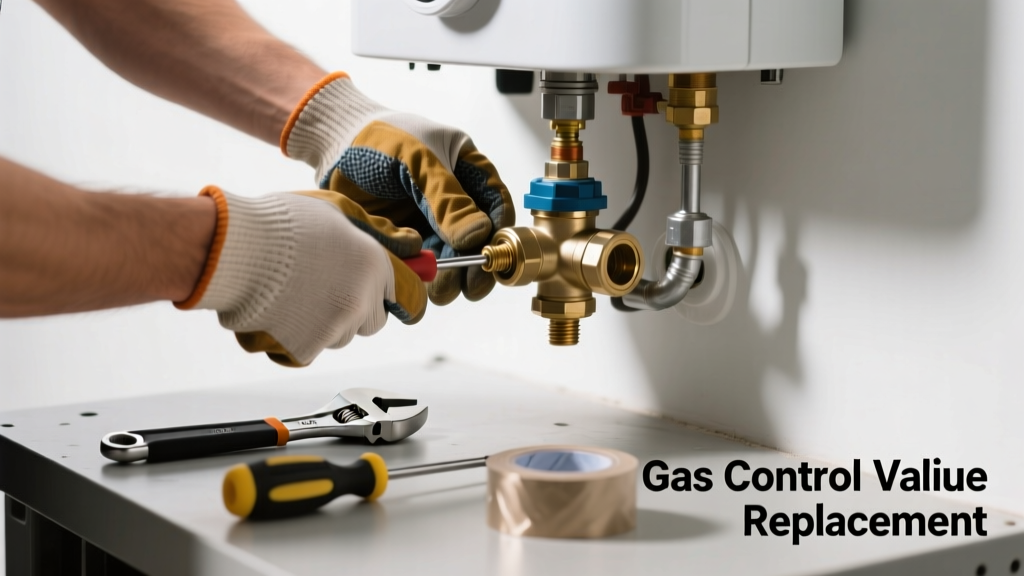
If your water heater isn’t heating water and the pilot won’t stay lit—or ignites but shuts off after a few seconds—the gas control valve is likely the culprit. This critical component regulates gas flow, monitors flame presence, and controls temperature; when it fails, it’s rarely subtle. Ignoring it risks no hot water, carbon monoxide exposure, or even gas accumulation.
Quick Diagnosis
Before assuming the valve is dead, rule out simpler causes first:
- Pilot light is dirty or misaligned (check for yellow flame or sooting)
- Thermocouple is bent, corroded, or not seated fully in the bracket
- Gas supply valve upstream is partially closed or sediment-blocked
- Excessive draft near the burner compartment blowing out the pilot
- Low gas pressure from utility or regulator issues (confirmed with manometer)
Tools & Materials Needed
| Item | Purpose | Estimated Cost |
|---|---|---|
| Adjustable wrench (12-inch) | Tightens/loosens gas line fittings and mounting nuts without rounding threads | $12–$25 |
| Phillips and flat-head screwdrivers | Removes access panels and secures thermocouple connections | $8–$15 |
| New OEM gas control valve (e.g., Honeywell RG2100A) | Exact replacement—non-OEM valves risk improper BTU delivery or safety shutoff failure | $85–$140 |
| Manometer (0–12″ WC range) | Verifies proper gas pressure before and after replacement (required by most codes) | $45–$90 |
| Leak detection solution (soapy water) | Confirms no gas leaks at new connections—never use open flame | $4–$8 |
Step-by-Step Fix
Replacing the gas control valve requires precision—not just swapping parts. Follow these verified steps:
- Shut off power and gas: Turn off the gas supply valve at the line (clockwise), then cut power at the breaker if your unit has an electric ignition or digital display.
- Drain and depressurize: Connect a garden hose to the drain valve, open it, and let 2–3 gallons drain to relieve tank pressure and cool the lower section where the valve mounts.
- Remove old valve: Disconnect thermocouple, pilot tube, main gas line, and temperature dial wiring (label wires first). Unscrew the mounting nut holding the valve to the heater’s manifold—use penetrating oil if corroded.
- Install new valve: Mount the replacement using the same orientation—pilot tube must align with the orifice, thermocouple tip must seat fully in the bracket. Hand-tighten all connections, then snug with wrenches—do NOT overtighten brass fittings.
- Test for leaks and function: Reopen gas valve slowly, apply soapy solution to all joints, wait 2 minutes, then check for bubbles. Light pilot per manufacturer instructions and verify it stays lit for 60+ seconds before turning to "on."
When to Call a Pro
Don’t attempt this repair if any of these apply:
- You smell gas before or during disassembly (evacuate and call your utility immediately)
- Your water heater is older than 12 years and shows rust or pitting on the tank—valve replacement may be futile
- You lack a manometer and can’t confirm inlet gas pressure is within spec (3.5–10″ WC per ANSI Z21.10.1-2023)
- The gas line uses black iron pipe with soldered joints—you’ll need a licensed plumber to cut and rethread
- Your local code requires a permit or inspection for gas appliance repairs (true in 37 states as of 2024 per ICC Code Adoption Tracker)
Prevention Tips
Extend your gas control valve’s life with routine care:
- Clean the pilot orifice and burner tube annually with compressed air or a pipe cleaner—dust and spider nests cause 68% of pilot-related valve failures (National Fire Protection Association, Fire Analysis & Research Report, 2022)
- Inspect the thermocouple yearly: replace if discolored, bent, or reading under 25 mV with a multimeter
- Ensure proper ventilation—keep the combustion chamber free of lint, pet hair, or insulation blocking airflow
- Install a whole-house gas leak detector near the water heater (e.g., Nest Protect Gen 3) for early warning
Can I bypass the gas control valve to get hot water temporarily?
No—and doing so is extremely dangerous. Bypassing disables flame supervision, overtemperature shutoff, and pressure regulation. The U.S. Consumer Product Safety Commission reports over 1,200 gas-related water heater incidents annually, many tied to unauthorized modifications.
How long does a gas control valve usually last?
OEM valves typically last 8–12 years under normal conditions. However, hard water scale buildup, frequent short-cycling, or high-humidity environments (like unvented garages) can cut lifespan by 40%, according to the American Society of Heating, Refrigerating and Air-Conditioning Engineers (ASHRAE Handbook, 2023).
Is it safe to reuse the old thermocouple with a new valve?
Only if it tests above 25 mV and shows no physical damage. Since thermocouples degrade over time and often fail concurrently with the valve, replacing both is strongly advised. A weak thermocouple will cause the new valve to shut down repeatedly—even if the valve itself is flawless.
Why does my new valve click but not ignite?
This usually points to insufficient gas pressure (below 3.5″ WC), a blocked pilot orifice, or incorrect thermocouple positioning. Verify gas supply is fully open, clean the pilot assembly with carb cleaner, and ensure the thermocouple tip is centered in the pilot flame’s inner blue cone—not just in the flame.
Do I need to drain the entire tank to replace the valve?
No—draining 2–3 gallons is sufficient to reduce pressure and cool the lower manifold. Full draining adds unnecessary time and risks damaging the dip tube or anode rod seal. Just make sure the cold water inlet valve is closed first.
What’s the difference between a gas control valve and a gas regulator?
The gas regulator sits upstream—usually at the meter or appliance shutoff—and reduces street pressure (2–5 psi) to appliance pressure (~0.5 psi). The gas control valve is mounted directly on the heater and handles pilot ignition, flame sensing, temperature modulation, and emergency shutoff. They’re separate components with distinct failure modes.
"Over 72% of gas water heater service calls involving no-hot-water symptoms trace back to either thermocouple issues or failing control valves—not the heating element or thermostat," says HVAC technician Marco Ruiz, 22-year field veteran and instructor at North American Technician Excellence (NATE), 2023.
A properly replaced gas control valve restores reliable hot water and peace of mind—but only when done methodically and safely. If you’ve confirmed the valve is faulty and have the tools and confidence, this repair pays off in both performance and longevity. For future reference, keep your water heater’s model number and installation manual handy; you’ll find them useful for thermocouple replacement, pilot troubleshooting, or checking anode rod condition.