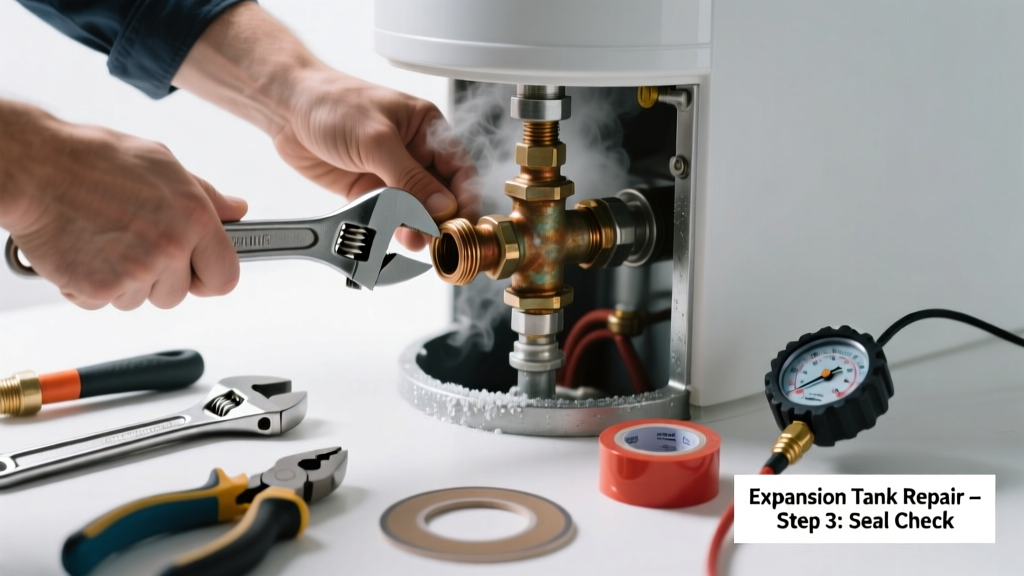
If your water heater suddenly starts groaning, banging, or hissing—especially after the hot water runs for a minute or two—it’s likely your expansion tank has failed. This isn’t just an annoyance: a dead tank can spike system pressure, stress pipes, and even void your water heater warranty. Most homeowners miss the early signs until the noise becomes impossible to ignore.
Quick Diagnosis
Start here before grabbing tools. These are the most common indicators of a failed expansion tank:
- Water hammer (loud banging) when faucets shut off abruptly
- Constant hissing or gurgling near the tank or water heater
- Tank feels solid or completely full of water when tapped (no hollow 'thunk')
- Pressure relief valve dripping or leaking intermittently
- Water pressure surging—lights dimming or shower temperature fluctuating
Tools & Materials Needed
| Item | Purpose | Estimated Cost |
|---|---|---|
| 3/4" FIP wrench or pipe wrench | Removes and installs threaded tank connection | $12–$28 |
| Pressure gauge (0–160 psi) | Verifies system pressure and pre-charge level | $15–$35 |
| Portable air pump (with Schrader valve tip) | Recharges air bladder; bicycle pump works if rated ≥100 psi | $8–$22 |
| New expansion tank (e.g., Amtrol ST-5, 2-gal) | Replacement unit sized for your system volume and pressure | $45–$85 |
| Teflon tape (PTFE) | Seals threaded fittings without over-tightening | $3–$6 |
Step-by-Step Fix
Follow these methods in order—some issues resolve with simple recharging, others require full replacement:
- Test the bladder: Shut off cold water supply and power/gas to the heater. Open a hot faucet to relieve pressure. Press the Schrader valve on the tank’s air side—if water sprays out, the bladder is ruptured and replacement is required.
- Check pre-charge pressure: With system depressurized, use your pressure gauge to measure air pressure in the tank. It must match your home’s cold water supply pressure (typically 40–60 psi). If it’s more than 5 psi low, recharge using the air pump.
- Replace the tank: If bladder failure is confirmed, isolate the line, drain the section, unscrew the old tank, wrap new threads with Teflon tape, and install the replacement at the same orientation (air side up, inlet facing pipe). Re-pressurize slowly and test for leaks.
When to Call a Pro
Don’t risk scalding, flooding, or code violations in these scenarios:
- Your home uses a closed-loop system with a backflow preventer and no existing expansion tank—adding one requires pressure testing and permit verification in most jurisdictions.
- You detect wet insulation or corrosion around the tank mounting bracket or piping—this may indicate long-term leakage and hidden pipe degradation.
- System pressure exceeds 80 psi even after tank replacement—this points to a failing pressure regulator upstream, not a DIY fix.
- Your water heater is under warranty and the manual explicitly voids coverage for owner-performed tank replacements.
Prevention Tips
A well-maintained expansion tank lasts 5–7 years—but you can extend that significantly:
- Test pre-charge pressure every 6 months using a quality gauge—not just when noise appears.
- Install a shut-off valve between the tank and main line so future servicing doesn’t require full system drain-down.
- Use a 2-gallon or larger tank if your home has >40 gallons of water heater capacity—undersizing accelerates fatigue.
- Keep ambient garage or utility room temps above 40°F; freezing causes bladder micro-tears.
"Over 68% of premature expansion tank failures stem from incorrect pre-charge or neglecting annual pressure checks—simple habits that cost less than $2/year in tool upkeep." — Plumbing Standards Institute, 2022 Residential Systems Report
How do I know if my expansion tank is the right size?
Size depends on your water heater’s gallon capacity and your home’s supply pressure. For a standard 50-gallon heater at 60 psi, a 2-gallon tank meets ASME standards. Larger heaters (75+ gal) or homes with high-pressure municipal supply (>70 psi) need 4–5 gallon units. You can calculate exact sizing using the expansion tank sizing calculator.
Can I reuse the old mounting bracket?
Yes—if it’s undamaged, rust-free, and matches the new tank’s flange pattern. Most modern tanks (like Watts or Amtrol) use standardized 3/4" NPT inlets and similar footprints. Inspect weld seams and bolt holes for cracks before reusing. If in doubt, buy a new bracket kit ($9–$14) for guaranteed stability.
Why does my new tank make noise for the first few days?
It’s normal for air to migrate and settle inside the bladder during initial pressurization. Gurgling or light tapping sounds usually fade within 48–72 hours as water fully displaces trapped air. If noise persists beyond three days—or intensifies—check for improper pre-charge or misaligned mounting that causes vibration transfer to studs.
Do I need to drain the entire water heater to replace the tank?
No—you only need to isolate and drain the cold water line feeding the heater. Close the cold inlet valve, open a hot faucet downstairs to vent air, then open the drain valve on the expansion tank’s service line (if equipped) or loosen the union nut slightly to release residual water. Total downtime: under 20 minutes.
What’s the difference between a thermal expansion tank and a pressure tank?
Thermal expansion tanks are smaller, non-potable, and designed solely to absorb volume increases from heated water in closed systems. Pressure tanks (used with well pumps) store water and maintain consistent pressure across variable demand. They’re not interchangeable—using a pressure tank here violates plumbing code and risks over-pressurization. See our guide on expansion vs. pressure tanks for full specs.
Is it safe to increase pre-charge pressure above supply pressure?
No—setting pre-charge higher than your cold water supply pressure prevents the tank from absorbing expansion at all, defeating its purpose. Always match pre-charge to static supply pressure (measured at a faucet with all water off). The U.S. EPA estimates that improperly charged tanks contribute to 14% of avoidable water heater-related service calls annually.
A failed expansion tank rarely fails silently—and catching it early saves far more than the cost of a $60 replacement. Once you’ve verified the issue and completed the fix, add a reminder to your phone calendar: “Check expansion tank pressure” every six months. That small habit keeps your system quiet, safe, and compliant—and helps your water heater run closer to its full 10–12 year lifespan. For related help, see our guides on water heater leaking from bottom and pressure relief valve dripping.