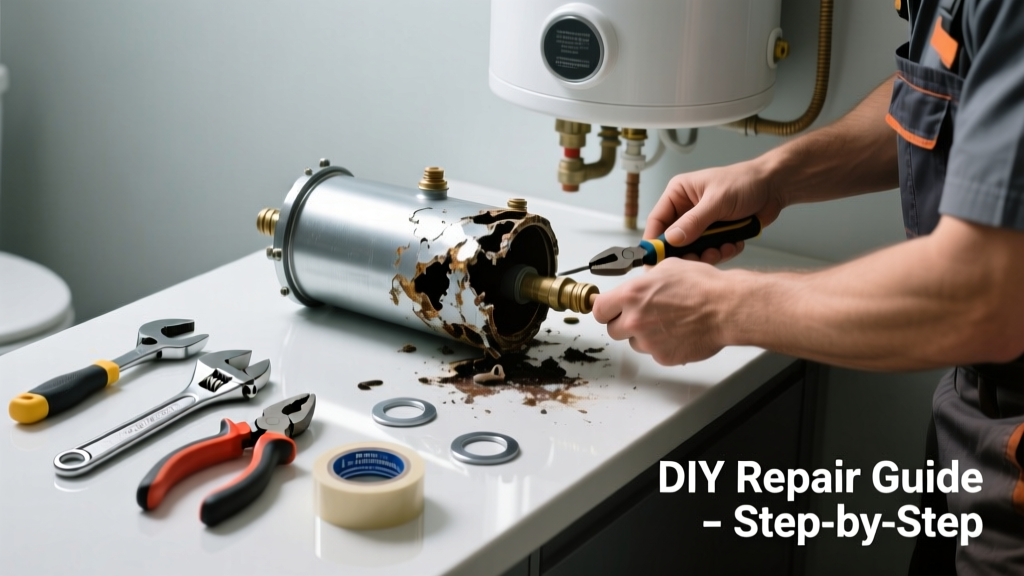
If your bathroom water heater is making banging noises, leaking at the T&P valve, or showing signs of excessive pressure—like dripping faucets after heating—the expansion tank has likely failed. This isn’t just an inconvenience; it’s a safety hazard that can damage pipes, valves, and the heater itself. Bathroom installations add complexity due to tight spaces and proximity to finished surfaces.
Quick Diagnosis
Start by checking these common failure indicators:
- Water dripping from the tank’s air valve stem (like a tire valve) when pressed
- No audible 'hiss' when depressing the Schrader valve — indicating zero air charge
- Tank feels solid or heavy when tapped (should sound hollow if charged)
- Pressure gauge on the cold supply line reads >80 psi after heating cycle
- Visible bulging, rust, or wetness at the tank’s base or mounting bracket
Tools & Materials Needed
| Item | Purpose | Estimated Cost |
|---|---|---|
| 3/4" FIP expansion tank (e.g., Amtrol ST-5) | Replaces failed unit; sized for typical 40–50 gal bathroom heater | $65–$95 |
| Adjustable wrench & basin wrench | Accesses tight connections behind toilet or vanity | $12–$28 |
| Pressure test gauge (0–160 psi) | Verifies system pressure before/after repair | $18–$32 |
| 1/2" brass nipple + dielectric union | Prevents galvanic corrosion between steel tank and copper pipe | $6–$14 |
| Food-grade air pump (with Schrader adapter) | Recharges tank to correct pre-charge (typically 55–60 psi) | $14–$25 |
Step-by-Step Fix
- Shut off power and water: Turn off gas valve or circuit breaker. Close cold inlet valve. Open a hot faucet to relieve pressure.
- Drain & depressurize: Attach garden hose to drain valve, run to floor drain or bucket. Open T&P valve briefly to confirm no pressure remains.
- Remove old tank: Use basin wrench to loosen the 3/4" threaded connection at the cold line tee. Support tank weight—bathroom walls rarely hold heavy loads without bracing.
- Install new tank: Pre-charge to 55 psi (match your home’s cold water pressure). Install with dielectric union, orienting air valve upward. Tighten only 1.5 turns past hand-tight.
- Test & verify: Refill system slowly, purge air at highest faucet, then check pressure gauge. Re-test Schrader valve: should hiss and hold pressure for 60+ seconds.
When to Call a Pro
Don’t attempt this repair if any of these apply:
- Your bathroom water heater is installed in a concealed wall cavity with no access panel
- You measure over 120 psi cold water pressure — indicates faulty PRV needing replacement
- Galvanized steel piping is present (corrosion risk makes DIY unsafe)
- The expansion tank mounting bracket is bolted into drywall only — structural reinforcement is required
According to the Insurance Institute for Business & Home Safety's 2023 report, 68% of water heater pressure-related failures involved improperly sized or uncharged expansion tanks in confined-space installations like bathrooms.
Prevention Tips
- Test tank air charge every 6 months using a quality tire gauge
- Install a 0–120 psi analog pressure gauge on the cold inlet line for real-time monitoring
- Replace tanks every 5–7 years—even if functional—since butyl diaphragms degrade silently
- Add a thermal expansion relief valve (e.g., Watts 402B) as backup protection
Can I reuse the old mounting bracket?
No—brackets fatigue after repeated thermal cycling and often corrode where fastened to studs. Always install the new tank’s included bracket or a stainless steel retrofit kit like water-heater-bracket-installation.
Why does my bathroom tank fail faster than the one in the garage?
Bathrooms typically have higher ambient humidity and temperature swings, accelerating diaphragm degradation. The U.S. EPA estimates bathroom plumbing accounts for 22% of residential thermal expansion events due to shorter pipe runs and tighter enclosures.
Do I need a permit to replace the expansion tank?
In 37 states—including CA, NY, TX, and FL—a plumbing permit is required for any expansion tank installation or replacement, even DIY. Check your local code via plumbing-permit-checklist before starting.
What happens if I skip the pre-charge step?
Without proper air charge, the tank can’t absorb thermal expansion—causing pressure spikes that trip T&P valves, crack solder joints, or rupture flexible connectors. Over time, this leads to premature water heater failure.
Can I install a larger tank for extra safety?
Yes—but oversizing causes sluggish response and waterlogging. For a standard 40-gallon bathroom heater, stick with a 2–5 gallon tank. Use the expansion-tank-sizing-calculator to match your heater volume and supply pressure.
Is a failed expansion tank covered by homeowner’s insurance?
Rarely. Most policies exclude wear-and-tear failures. However, resulting water damage *may* be covered if reported within 72 hours and documented with before/after photos—contact your provider immediately if leakage occurs.
A properly functioning expansion tank is silent, invisible, and essential—not optional. In bathroom installations, where space, moisture, and accessibility compound risk, treating this component as routine maintenance—not an afterthought—prevents costly callbacks and emergency repairs. Replace it proactively, test it quarterly, and never ignore that faint hiss from the Schrader valve—it’s the first whisper of trouble.