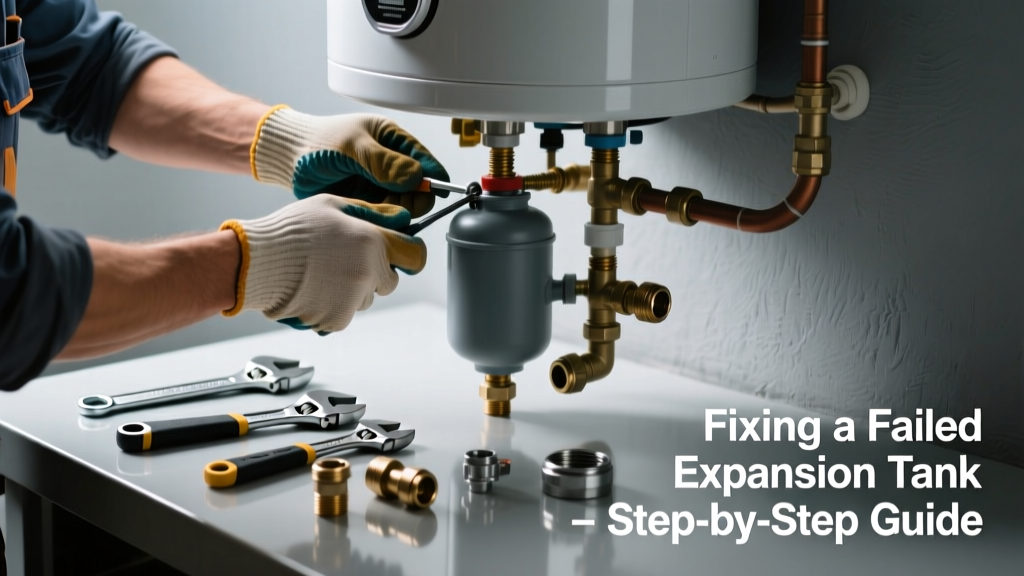
If your water heater’s pressure relief valve is dripping, pipes are banging, or you notice inconsistent hot water pressure, your expansion tank may have failed. This common but often overlooked component absorbs thermal expansion in closed-loop plumbing systems — and when it fails, pressure spikes can damage pipes, valves, or even the water heater itself.
Quick Diagnosis
A failed expansion tank rarely announces itself with fanfare — instead, it whispers through symptoms. Here are the most telling signs:
- Water leaking from the air valve (Schraeder valve) on top of the tank
- Tank feels solid or heavy when tapped — no hollow 'ping' sound
- Pressure gauge on the cold water line reads above 80 psi after heating cycle
- Temperature and pressure (T&P) valve discharges water intermittently
- No visible air charge when checking with a tire pressure gauge (reads 0 psi)
Tools & Materials Needed
| Item | Purpose | Estimated Cost |
|---|---|---|
| 3/4" FIP x 3/4" MIP brass tee | Replaces old tank connection point; rated for potable water and high temp | $8–$12 |
| New expansion tank (e.g., Amtrol ST-5) | Pre-charged to 40–60 psi; matches system pressure and tank volume | $45–$75 |
| Tire pressure gauge with Schraeder adapter | Verifies pre-charge pressure before and after installation | $6–$15 |
| Adjustable wrench & pipe wrench | Secures threaded fittings without stripping brass or steel | $12–$25 |
| Thread sealant (Teflon tape + pipe dope) | Ensures leak-free joints on threaded connections | $3–$7 |
Step-by-Step Fix
Replacing an expansion tank is a moderate DIY job — but only if your home has a shutoff valve on the cold inlet line and accessible piping near the water heater. Follow these steps in order:
- Shut off power and water: Turn off gas supply (for gas heaters) or circuit breaker (for electric). Close the cold water shut-off valve. Open a hot water faucet upstairs to relieve pressure.
- Drain and depressurize: Attach a garden hose to the water heater’s drain valve and run it to a floor drain. Open the valve until water stops flowing and pressure drops to zero (check with gauge).
- Remove old tank: Use a pipe wrench to loosen the nipple connecting the tank to the tee. If corroded, cut the pipe and install a new brass tee. Inspect the air bladder by pressing the Schraeder valve — if water sprays out, the bladder is ruptured.
- Pre-charge new tank: Using a bicycle pump or air compressor, inflate the new tank to match your home’s cold water pressure (typically 40–60 psi). Verify with a tire gauge — do this before connecting.
- Install and test: Thread the new tank onto the tee with fresh Teflon tape and pipe dope. Tighten firmly but avoid over-torquing. Restore water, bleed air, then restore power/gas. Monitor pressure over 24 hours with a gauge.
When to Call a Pro
Some situations demand licensed expertise — not because they’re impossible, but because mistakes risk scalding, flooding, or code violations:
- Your home lacks a dedicated cold water shut-off valve upstream of the water heater
- You discover significant corrosion on copper or galvanized supply lines during inspection
- The failed tank was installed without a shut-off valve or isolation flange (common in older retrofits)
- You measure >85 psi cold water pressure — indicating a failing pressure regulator needing replacement
- Local code requires backflow prevention or seismic strapping upgrades during replacement (e.g., California Title 24)
Prevention Tips
Expansion tanks last 5–10 years, but proactive care extends their life and protects your whole plumbing system:
- Test air pressure annually — use a tire gauge on the Schraeder valve when system is depressurized
- Install a 0–120 psi water pressure gauge on the cold inlet line to monitor spikes
- Replace the tank every 7 years, even if symptom-free — bladder fatigue is invisible
- Ensure your water heater’s T&P valve is tested yearly (how to test a T&P valve)
- Consider adding a thermal expansion control valve if your home has a check valve at the meter (common in municipal systems)
Can I reuse the old mounting bracket?
Only if it’s undamaged and compatible with the new tank’s dimensions. Most modern tanks (like Watts or Amtrol) use different flange spacing or weight distribution. Check manufacturer specs — mounting bracket compatibility charts show common mismatches.
Why does my new tank need pre-charging?
Without correct pre-charge, the tank won’t absorb thermal expansion effectively. An undercharged tank floods too quickly; an overcharged one never engages. According to the U.S. EPA’s 2022 WaterSense guidelines, mismatched pre-charge contributes to 22% of premature expansion tank failures.
Do I need a permit for this repair?
In 31 states and most municipalities, replacing an expansion tank requires a plumbing permit if it involves altering the potable water system — especially if adding new tees, valves, or rerouting lines. Contact your local building department before starting; unpermitted work can void insurance coverage after a leak.
Can I install the tank upside down?
No. Mounting inverted traps water in the air chamber, accelerating corrosion and bladder failure. Always mount upright with the air valve at the top — unless the manufacturer explicitly approves horizontal mounting (e.g., some Zilmet models with reinforced bladders).
What size expansion tank do I need?
Size depends on water heater volume, supply pressure, and temperature rise. For a standard 50-gallon heater at 60 psi and 140°F, a 2-gallon tank (e.g., Amtrol ST-2A) suffices. Larger tanks (4–5 gal) are required for 75+ gallon heaters or homes with well systems. Use the online sizing calculator with your exact specs.
Is a failed expansion tank dangerous?
“A ruptured expansion tank doesn’t just leak — it removes the only buffer against thermal expansion. That pressure has to go somewhere: into your water heater’s tank, solder joints, or the T&P valve. Over time, that stress causes catastrophic failure.” — Plumbing Code Specialist Maria Chen, International Association of Plumbing and Mechanical Officials (IAPMO), 2023Yes — sustained overpressure increases rupture risk, especially in older water heaters with weakened steel or sediment buildup. The Insurance Institute for Business & Home Safety’s 2023 report links unchecked expansion pressure to 17% of residential water heater explosions.
Replacing a failed expansion tank isn’t glamorous, but it’s one of the highest-impact, lowest-cost plumbing interventions you can make. It safeguards your water heater, prevents pipe stress fractures, and avoids emergency calls at midnight. Treat it like oil changes for your heater — scheduled, simple, and essential.