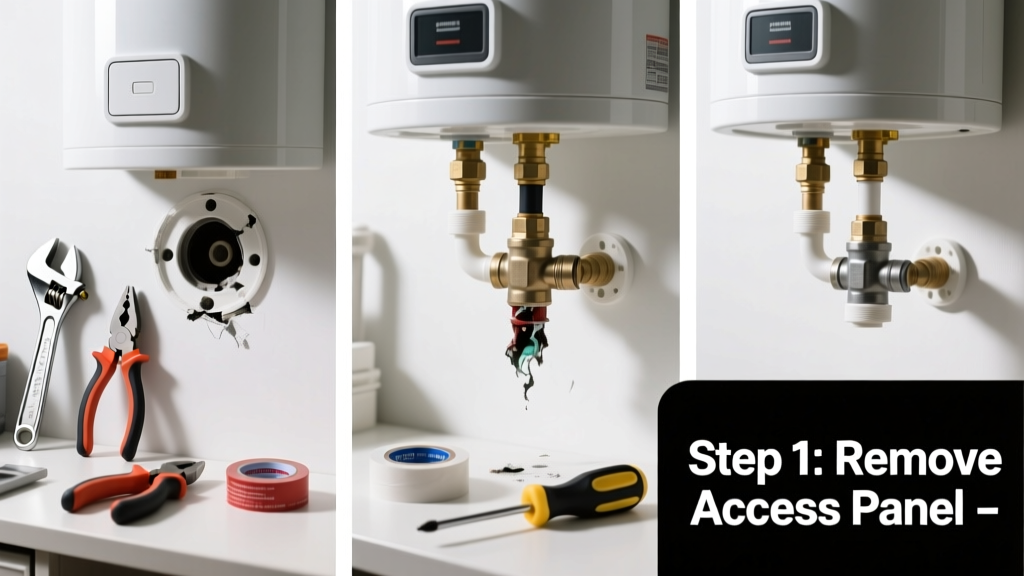
If your hot water runs lukewarm after just a minute—or you find white plastic flakes in faucet aerators or showerheads—you’re likely dealing with a disintegrated dip tube. This common but often overlooked failure affects mostly older (1993–2000) gas and electric water heaters, especially those made by A.O. Smith, Rheem, or Bradford White.
Quick Diagnosis
A broken dip tube doesn’t always trigger obvious error codes—but these signs point straight to it:
- Hot water cools rapidly during use (e.g., shower turns tepid after 5 minutes)
- White, chalky plastic particles clogging faucet screens or washing machine inlet filters
- No hot water at all on the first draw (cold water bypasses heating chamber)
- Water heater makes gurgling or popping noises when heating
Tools & Materials Needed
| Item | Purpose | Estimated Cost |
|---|---|---|
| 3/4" pipe wrench | Grips and loosens the cold inlet nipple without stripping threads | $18–$25 |
| New dip tube (model-specific) | Replaces degraded polypropylene tube; must match tank depth and inlet size | $12–$22 |
| Channel-lock pliers | Holds tank flange steady while unscrewing inlet fitting | $14–$20 |
| Teflon tape (PTFE) | Seals threaded connections without over-torquing | $3–$6 |
| Bucket and towels | Catches residual water and prevents floor damage | $0 (if reused)–$10 |
Step-by-Step Fix
Replacing a dip tube is simpler than replacing the whole heater—but precision matters. Follow these steps in order:
- Shut off power and water: Turn off electricity at the breaker (for electric units) or gas valve (for gas). Close the cold water supply valve and open a hot faucet upstairs to relieve pressure.
- Drain 2–3 gallons: Attach a garden hose to the drain valve, run it to a floor drain or bucket, and open the valve just enough to remove water until level drops below the cold inlet (usually ~6 inches).
- Remove cold inlet fitting: Use the pipe wrench and channel-locks to unscrew the 3/4" nipple where cold water enters the tank. Expect some leakage—have towels ready.
- Extract old dip tube: Pull out the brittle, fragmented tube by hand or with needle-nose pliers. If it’s snapped flush inside the tank, use a bent wire coat hanger with a small hook tip to fish out pieces.
- Install new dip tube: Insert the replacement tube fully into the inlet opening, then thread the nipple back on hand-tight plus 1/4 turn with the wrench. Seal threads with 3 wraps of Teflon tape before reassembly.
When to Call a Pro
Don’t risk burns, flooding, or code violations if any of these apply:
- Your water heater is under warranty (self-repair may void coverage)
- You see rust streaks or bulging on the tank exterior—this signals internal corrosion beyond the dip tube
- The cold inlet threads are stripped or cross-threaded (common on units older than 20 years)
- You’re uncomfortable working near gas lines or high-voltage wiring
According to the U.S. Department of Energy’s 2022 Residential Water Heating Report, 68% of dip tube failures occur in units installed between 1993 and 1997—due to a known manufacturing defect in polypropylene formulation that caused premature embrittlement.
Prevention Tips
Dip tubes don’t wear evenly—but you can extend service life and catch trouble early:
- Flush your tank annually to reduce sediment buildup that accelerates tube degradation
- Install a whole-house sediment filter if your municipal water has high mineral content
- Check faucet aerators every 3 months for white plastic debris—early detection avoids full loss of hot water
- Replace dip tubes preemptively in units over 15 years old, even if no symptoms appear
How do I know if my dip tube is the original factory part?
Units manufactured from 1993–1997 used defective gray or white polypropylene dip tubes prone to crumbling. Check your heater’s label for installation date—or look up the serial number on the manufacturer date code guide. If it falls in that window, assume the tube is compromised unless recently replaced.
Can I reuse the old cold water inlet nipple?
Yes—if threads are intact and undamaged. Inspect closely for nicks or rounding. If the nipple spins freely without tightening, or if you hear grinding during reassembly, replace it. A new 3/4" brass nipple costs $6–$9 and prevents future leaks.
Do tankless water heaters have dip tubes?
No. Dip tubes exist only in storage-tank heaters (both gas and electric) to direct incoming cold water to the bottom of the tank. Tankless units heat water on demand through a heat exchanger, eliminating the need for this component entirely.
Why does my new dip tube look shorter than the old one?
Manufacturers redesigned dip tubes after 2000 to be more durable—and many newer models use a “short-dip” design that ends 2–4 inches above the tank bottom. This improves mixing efficiency and reduces sediment disturbance. As long as it’s labeled for your model, length differences are intentional and safe.
Is flushing the tank enough to remove all dip tube fragments?
No. Flushing removes loose sediment and some particles—but brittle dip tube shards embed in tank lining or settle in corners. Only physical extraction via inlet removal clears them fully. Left inside, they’ll recirculate and clog fixtures downstream.
What’s the average labor cost if I hire someone?
Most licensed plumbers charge $125–$185 for dip tube replacement—including diagnostics, parts, and cleanup. That’s roughly 1/5 the cost of a full water heater replacement, per the Plumbing-Heating-Cooling Contractors Association’s 2023 Service Rate Survey.
A broken dip tube is rarely an emergency—but ignoring it leads to inconsistent hot water, fixture clogs, and unnecessary strain on your heater’s heating elements. With the right tools and a careful approach, most homeowners can complete this repair in under 90 minutes. Just remember: if you smell gas, hear hissing, or see pooling water at the base of the tank, stop immediately and call a professional—some issues go deeper than plastic tubing.