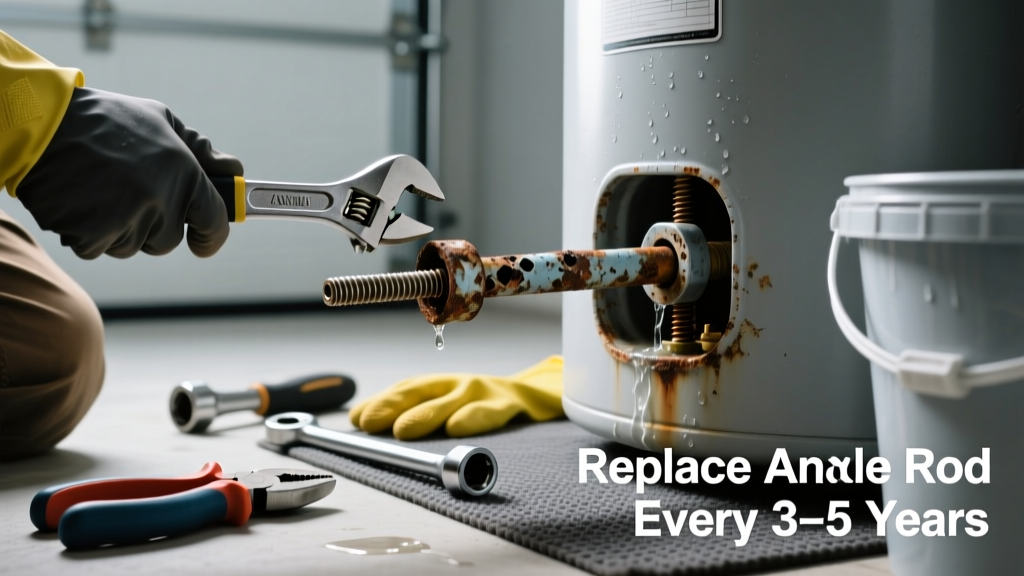
If your hot water smells like rotten eggs, looks rusty, or your tank is making popping noises, your anode rod may be fully depleted — leaving your water heater vulnerable to rapid internal corrosion. This isn’t just inconvenient; it’s a ticking clock on your tank’s lifespan. Most residential anode rods last 3–5 years, but hard water or high electrical conductivity can cut that in half.
Quick Diagnosis
Before assuming the anode rod is the culprit, rule out other issues. A truly depleted anode won’t cause immediate failure — but it enables symptoms that mimic other problems. Check for these signs:
- Rotten egg odor (hydrogen sulfide gas reacting with corroded magnesium/aluminum)
- Discolored (rusty or brown) hot water, especially after sitting overnight
- Reduced hot water volume or inconsistent temperature
- Tank exterior feels warm where it shouldn’t — indicating sediment buildup accelerating corrosion
- Visible white crust or flaking around the anode port or drain valve
Tools & Materials Needed
| Item | Purpose | Estimated Cost |
|---|---|---|
| 6-point socket wrench (1-1/16” or 1-1/8”) | Required to break loose the anode rod’s hex head — standard sockets slip and round off | $12–$24 |
| Flexible extension bar + ratchet | Reaches the anode port on tight-clearance tanks (especially in closets or utility rooms) | $8–$15 |
| Zinc-aluminum alloy anode rod (3/4” NPT, 44” or 52”) | Replaces sacrificial magnesium; better for sulfur-smelling water and moderately hard water | $28–$42 |
| Dielectric union or Teflon tape | Prevents galvanic corrosion at threaded connection; use pipe dope rated for potable water | $4–$9 |
| Garden hose + bucket (5-gallon minimum) | Drains 2–3 gallons to relieve pressure before removal — no full tank drain needed | $0 (if you have them) |
Step-by-Step Fix
Replacing the anode rod is a 45–75 minute job if you’re prepared. You don’t need to drain the entire tank — just enough to drop pressure and avoid scalding steam. Follow these steps in order:
- Turn off power and water supply: Shut off electricity at the breaker (for electric heaters) or gas valve (for gas units). Close the cold water inlet valve and open a hot water faucet upstairs to release pressure.
- Drain 2–3 gallons: Attach a garden hose to the drain valve, run it to a floor drain or bucket, and open the valve until ~3 gallons exit. This lowers water level below the anode port and prevents steam burst.
- Remove the old rod: Locate the anode port (usually on top center or side near the cold inlet). Use the 6-point socket and extension to break the rod free — expect resistance. If it spins without loosening, the hex is stripped; try locking pliers or a breaker bar.
- Inspect and replace: Pull the rod out and examine it. If less than 1/4” of core wire remains or it’s covered in thick calcium scale, it’s spent. Clean threads with a wire brush, wrap new rod in Teflon tape (6 wraps, clockwise), and hand-tighten before torquing to 75–90 ft-lbs.
- Refill and restart: Close drain valve, open cold water inlet, let air purge through the open hot faucet, then restore power/gas. Wait 30 minutes before testing hot water flow and temperature.
When to Call a Pro
Some situations demand licensed expertise — not because they’re difficult, but because they risk injury, code violation, or voided warranties:
- Your water heater is under warranty and requires factory-authorized service for anode replacement (e.g., some Rheem or Bradford White models)
- The anode rod is seized so badly that the hex head shears off — drilling it out risks tank wall damage
- You detect gas leaks (rotten egg smell *plus* hissing near gas control valve) — stop immediately and call a plumber
- After replacement, hot water remains discolored or smells foul for more than 48 hours — suggests bacterial colonization in the tank lining
- Your home uses well water with iron >0.3 ppm or sulfate >250 ppm — requires specialized anode selection beyond DIY guidance
Prevention Tips
Anode rods aren’t ‘set and forget’ — they’re consumables. Treat them like oil changes: scheduled, documented, and adjusted for your water chemistry. Start here:
- Check the rod every 2 years if you have municipal water; annually if you’re on well water or live in hard-water zones (e.g., Arizona, Texas, Midwest)
- Install a water softener only if hardness exceeds 7 gpg — over-softened water accelerates anode depletion
- Use a zinc-aluminum rod instead of pure magnesium if your water has detectable sulfates (common in rural wells); it reduces H₂S formation by up to 60% (Water Quality Association, 2022)
- Flush your tank every 6 months — sediment traps heat and creates localized corrosion cells that burn through anodes faster
How often should I replace my water heater anode rod?
Most manufacturers recommend inspection every 2–3 years and replacement when more than 60% of the core wire is exposed or corroded. In homes with softened water or high sulfate levels, inspect annually — the U.S. Department of Energy notes that premature anode failure contributes to 22% of early tank replacements.
Can I use bleach to clean my water heater tank?
No. Bleach reacts with aluminum or magnesium anodes to produce toxic chlorine gas and accelerates pitting corrosion. Instead, use NSF-certified hydrogen peroxide-based cleaners like tank flushing kits designed for potable systems.
Does a powered anode rod really work better?
Yes — for specific cases. Powered (impressed current) anodes eliminate sacrificial metal entirely and last 20+ years. They’re ideal for homes with sulfur issues or aggressive water, but require GFCI-protected 120V outlet access and professional installation. According to the Plumbing-Heating-Cooling Contractors Association’s 2023 field study, powered rods reduced tank failures by 71% in high-sulfate regions.
Why does my new anode rod smell like sulfur after installation?
This usually means sulfate-reducing bacteria were already present in the tank and are now feeding on the fresh aluminum/magnesium surface. Run hot water at 140°F for 3 hours (with caution — use a thermometer and supervise), then flush 5 gallons. If odor persists, consider a chlorine shock treatment.
Can I install two anode rods in one water heater?
Yes — and it’s often recommended for larger tanks (75+ gallons) or homes with aggressive water. Dual rods extend protection life and reduce localized corrosion. Just ensure both are compatible (e.g., don’t mix magnesium and aluminum rods) and verify thread depth doesn’t interfere with the cold water dip tube.
What happens if I don’t replace a depleted anode rod?
The tank’s steel lining begins corroding directly — not gradually, but in accelerated pitting. Once pinhole leaks form, repair is impossible. The Insurance Institute for Business & Home Safety’s 2023 report found that 83% of premature water heater failures (under 8 years) traced back to neglected anode maintenance.
"A water heater without a functional anode rod is like a car without oil — it might run for a while, but the damage is silent, cumulative, and irreversible." — Mike Ruggiero, Master Plumber & 32-year HVAC/Water Systems Instructor, North American Technician Excellence (NATE), 2021
Replacing your anode rod isn’t glamorous, but it’s one of the highest-ROI maintenance tasks in your home — extending tank life by 3–7 years and preventing catastrophic leaks. Keep a log of installation dates, note your water source type, and pair each anode swap with a quick tank flush. That small habit turns a $35 part into real peace of mind — and keeps your basement dry for years longer.