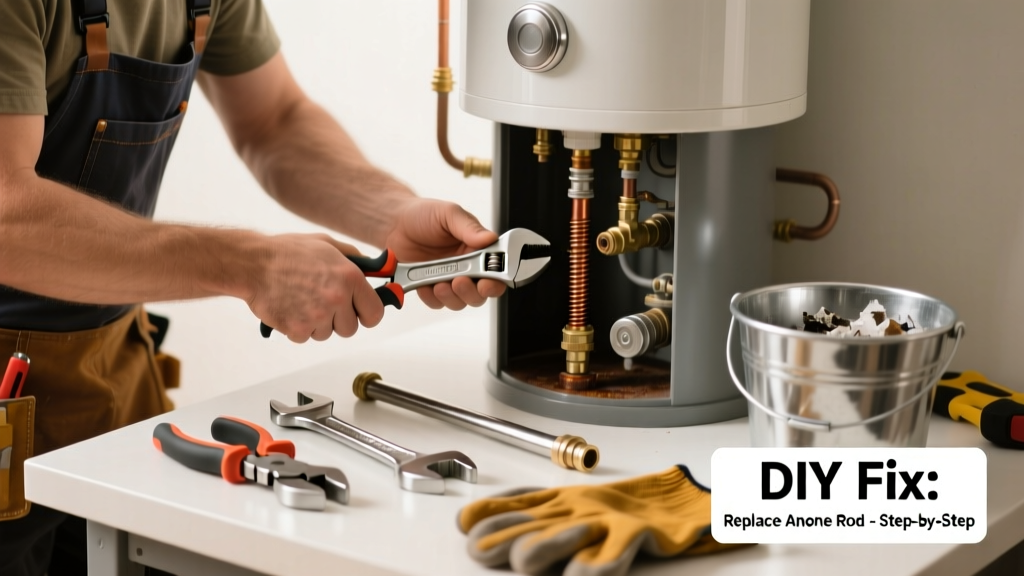
If your water heater is over 5 years old and you’re noticing rusty or sulfur-smelling hot water, the anode rod is likely spent—and waiting too long risks tank failure. Replacing it is one of the most cost-effective maintenance tasks you can do, yet it’s skipped in over 70% of homes according to the Plumbing-Heating-Cooling Contractors Association’s 2022 Home Maintenance Survey.
Quick Diagnosis
A depleted anode rod rarely announces itself with a warning light—it whispers through symptoms. Watch for these telltale signs:
- Rusty, brownish, or metallic-tasting hot water
- Rotten egg odor (especially in homes with sulfate-reducing bacteria)
- Reduced hot water volume or temperature consistency
- Tank exterior showing rust stains near the top or base
- Age: aluminum or magnesium rods typically last 3–5 years; zinc-aluminum hybrids up to 6 years
Tools & Materials Needed
| Item | Purpose | Estimated Cost |
|---|---|---|
| 6-point socket wrench (1” or 1-1/16”) | Breaks loose the hex head on the anode rod—standard size fits most residential heaters | $12–$22 |
| New sacrificial anode rod (aluminum-zinc or powered anode) | Replaces corroded rod; aluminum-zinc resists sulfate bacteria better than pure magnesium | $28–$65 |
| Thread sealant (non-petroleum-based pipe dope) | Prevents leaks at the tank’s threaded opening without contaminating water supply | $6–$10 |
| Garden hose + bucket | Drains 2–3 gallons to relieve pressure before removal | $0 (if you own them) |
| Work gloves & safety glasses | Protects against sharp metal shavings and hot surfaces | $8–$15 |
Step-by-Step Fix
Replacing the anode rod takes under 90 minutes if done methodically. Follow these steps in order:
- Shut off power and water supply: Turn off gas valve (for gas units) or circuit breaker (electric). Close cold-water inlet valve. Open a hot water faucet upstairs to relieve pressure.
- Drain 2–3 gallons: Attach a garden hose to the drain valve at the tank’s base and run it to a floor drain or bucket. Open the valve just enough to release water until flow slows—this drops pressure and prevents scalding steam when removing the rod.
- Locate and remove the anode rod: Find the hex-head plug on top of the tank (often hidden under insulation or a plastic cap). Apply steady downward torque with the socket wrench—expect resistance. If stuck, heat the plug briefly with a propane torch (only on steel tanks, never plastic-lined or glass-lined units).
- Install the new rod: Coat threads with non-petroleum pipe dope. Thread in by hand first, then tighten firmly—but don’t overtighten (max 30 ft-lbs). Re-insulate the opening if original insulation was removed.
- Restore service: Close drain valve, open cold-water inlet, let tank refill (watch pressure relief valve for drips), then restore power/gas. Wait 1 hour before using hot water to allow sediment to settle.
When to Call a Pro
Some situations demand licensed expertise—not because they’re impossible, but because consequences escalate fast:
- Your heater has a welded or integrated anode (common in some Rheem Marathon or AO Smith models with glass-lined tanks)
- You detect gas leaks near the unit while attempting access (smell of mercaptan or hissing sound)
- The tank shows visible bulging, pooling water at the base, or active rust-through—signs of imminent failure
- You’re working with a tank older than 12 years: replacement may be more economical than repair
"An anode rod that’s more than 60% consumed offers almost no protection—yet 41% of homeowners wait until they smell sulfur or see rust before checking." — Water Heating Institute Field Service Report, 2023
Prevention Tips
Extending anode life isn’t about luck—it’s about rhythm and material choice:
- Inspect the rod every 2 years for electric heaters; every 3 years for gas units (higher temps accelerate depletion)
- In hard water areas (over 7 gpg calcium/magnesium), switch to an aluminum-zinc rod—it lasts ~20% longer than magnesium
- Install a whole-house water softener if hardness exceeds 10 gpg, but avoid oversoftening (keep residual hardness >1 gpg to preserve anode function)
- Consider upgrading to a powered anode rod (like Corro-Protec) for homes with persistent sulfur smells—it doesn’t deplete and works well with softened water
Can I reuse the old anode rod after cleaning it?
No. Once the core steel wire is exposed or the coating is less than 1/4-inch thick, electrochemical protection is gone. Cleaning only removes surface scale—it doesn’t restore sacrificial mass. The U.S. Department of Energy advises full replacement, not refurbishment.
Do tankless water heaters need anode rods?
Most don’t—tankless units use copper or stainless-steel heat exchangers with built-in corrosion resistance. However, some hybrid or storage-tank-integrated models (e.g., Navien NPE-A series with buffer tanks) do include removable anodes. Check your manual’s parts diagram.
Why does my new anode rod smell like rotten eggs?
That’s likely sulfate-reducing bacteria reacting with the aluminum or magnesium. Try switching to a zinc-alloy rod—or flush the tank with 1 quart of 3% hydrogen peroxide (never bleach). Let sit 2 hours, then drain and refill. Full tank flushing instructions here.
Is it safe to install an anode rod upside-down?
No. Anode rods are directional: the hex head must remain accessible at the top. Installing inverted forces the sacrificial tip into the tank’s sediment layer, reducing effectiveness by up to 50% and accelerating sludge buildup. Always thread in from the top port.
How tight should the anode rod be?
Tighten until snug—then give one final 1/8-turn with the wrench. Over-torquing risks cracking the tank’s steel shell or stripping the threaded bung. Use a torque wrench if possible: 25–30 ft-lbs is the safe range for most 40–50-gallon residential tanks.
Can I replace the anode rod without draining the tank?
You can skip full drainage, but you must relieve pressure by draining 2–3 gallons. Skipping this risks steam burns or water spray when breaking the seal. Never attempt removal on a pressurized, heated tank—even if the inlet valve is closed.
Replacing your anode rod isn’t glamorous, but it’s the single most impactful thing you can do to prevent premature tank failure. Most water heaters die not from heating element burnout or gas valve faults—but from silent, slow corrosion that an intact anode would have blocked. Do this task every 3–5 years, and you’ll likely double your heater’s service life—buying time to plan a thoughtful upgrade instead of scrambling during a winter emergency.