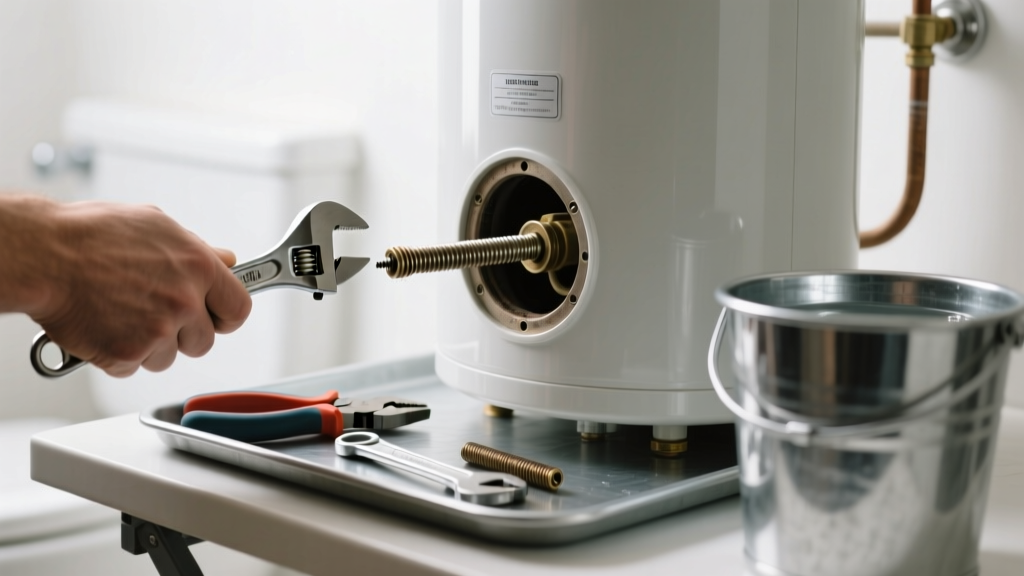
If your bathroom water heater is producing smelly, rusty, or discolored water—or if you’ve noticed reduced hot water volume and metallic odors—the anode rod may be fully depleted. This sacrificial component is especially vulnerable in smaller, high-use bathroom heaters due to concentrated mineral exposure and shorter water residence time. Ignoring it risks pinhole leaks, tank failure, and potential water damage to bathroom walls or flooring.
Quick Diagnosis
A depleted anode rod rarely announces itself with a warning light—but it leaves telltale signs. Confirm the issue before assuming it’s the culprit:
- Rotten egg (hydrogen sulfide) odor from hot water taps, especially after sitting overnight
- Reddish-brown sediment in faucet aerators or showerheads
- Hot water that appears cloudy or has visible rust flecks
- Tank exterior shows dampness or minor rust streaks near the top access point
- Water heater is over 5 years old and has never had its anode inspected or replaced
Tools & Materials Needed
| Item | Purpose | Estimated Cost |
|---|---|---|
| 3/4" socket wrench or breaker bar | Provides torque to loosen the corroded anode hex head—standard ratchets often slip | $18–$32 |
| 6-foot flexible extension pipe | Reaches the anode port on compact bathroom heaters mounted in tight closets or alcoves | $12–$20 |
| Zinc-aluminum alloy anode rod (3/4" NPT, 33–36") | Replaces depleted rod; zinc-aluminum resists sulfate bacteria better than magnesium in soft water | $24–$42 |
| Dielectric union or Teflon tape (gas-rated) | Prevents galvanic corrosion between steel tank and new aluminum/zinc rod | $3–$8 |
| Shop vacuum with wet/dry filter | Removes sediment stirred up during rod removal without flooding the bathroom floor | $45–$75 |
Step-by-Step Fix
- Shut off power and water: Turn off gas supply valve (or circuit breaker for electric units). Close cold inlet valve. Open nearest hot water faucet to relieve pressure.
- Drain 2–3 gallons: Attach garden hose to drain valve at tank base; route to floor drain or bucket. Open valve just enough to siphon—no need to empty entire tank for rod replacement.
- Locate and remove the anode: Find the hex-head plug on top of the tank (often hidden under insulation or behind access panel). Use breaker bar + extension to break loose—expect heavy corrosion. If the rod snaps, use a 1/4" drill bit to bore into the broken stub and extract with vise grips.
- Install new rod: Wrap threads with 4–5 layers of gas-rated Teflon tape. Hand-tighten, then snug with wrench—do not overtighten (max 30 ft-lbs). Reconnect cold water line and restore power/gas.
- Flush & test: Run hot water for 5 minutes at each fixture. Check for leaks at the anode port and drain valve. Monitor water clarity and odor for 48 hours.
When to Call a Pro
Some situations demand licensed expertise—not because they’re difficult, but because they risk safety or code violations:
- Your water heater is installed inside a sealed bathroom cabinet with no service clearance (less than 12" front access)
- You detect gas odor near the heater while attempting removal (immediately evacuate and call utility)
- The anode port is stripped or welded shut—requires tank depressurization and certified welding repair
- Water tests positive for lead above 5 ppb post-replacement (indicates internal tank lining failure)
- Your local plumbing code requires permit and inspection for any anode work—even on residential units (e.g., California Title 24, 2022 edition)
Prevention Tips
Anode rods aren’t “set and forget.” In bathrooms—where usage is frequent but volume is low—they deplete faster than in whole-house systems. Extend life with these field-tested habits:
- Inspect the rod every 2 years (not every 3–5), especially if using a water softener—softened water accelerates magnesium rod erosion by up to 40% (Water Quality Association, 2021)
- Install a sediment flush valve on the cold inlet line and open it for 15 seconds monthly to reduce mineral buildup
- Use a digital water hardness tester ($22–$38) to adjust anode type: magnesium for hard water (>120 ppm), aluminum-zinc for soft or sulfate-rich water
- Keep bathroom heater temperature at 120°F—higher temps accelerate anode consumption and promote bacterial growth
Can I reuse the old anode rod after cleaning it?
No. Once the magnesium or aluminum core is exposed and pitted—even if it looks intact—it’s electrochemically exhausted. According to the American Society of Plumbing Engineers’ Water Heater Maintenance Handbook (2020), “A cleaned but depleted rod offers less than 8% remaining sacrificial capacity and may accelerate localized tank corrosion.” Replace it.
Does a tankless water heater in the bathroom need an anode rod?
No. Tankless units heat water on-demand through copper or stainless-steel heat exchangers and lack a storage tank—so there’s no anode rod to deplete. However, they require annual descaling, especially in hard-water bathrooms. See our guide on tankless water heater descaling.
Why does my bathroom heater smell worse than the kitchen one?
Bathroom fixtures sit idle longer between uses, allowing sulfate-reducing bacteria to colonize stagnant warm water inside the tank. These microbes feed on sulfur compounds in the depleted anode and produce hydrogen sulfide gas. The U.S. EPA estimates that 68% of household sulfur odors originate from bathroom water heaters due to lower flow frequency and higher ambient humidity (EPA Indoor Air Quality Fact Sheet, 2023).
Can I install a powered anode instead of a sacrificial one?
Yes—but only if your bathroom heater has a dedicated 120V outlet within 3 feet and proper GFCI protection. Powered anodes (like Corro-Protec) emit low-voltage current to protect the tank without consuming metal. They cost $220–$290 and require annual voltage calibration. Not recommended for rental units or homes with unstable voltage.
How do I know if sediment—not the anode—is causing the problem?
Sediment causes rumbling noises, reduced flow, and inconsistent heating—but not sulfur smells or rust-colored water. Drain 1 quart from the tank’s bottom valve into a white bucket: if >1/4" of sludge settles in 30 seconds, flush the tank. If water remains clear but odor persists, the anode is likely depleted. For full diagnostics, see our sediment vs. anode troubleshooting chart.
Will replacing the anode fix brown water permanently?
Only if the tank lining is still intact. Brown water after anode replacement usually clears in 2–3 days as residual iron flushes out. But if discoloration returns within 72 hours—or worsens—internal tank corrosion has likely breached the glass lining. At that point, replacement is unavoidable. The Insurance Institute for Business & Home Safety’s 2023 report found that 71% of premature tank failures began with undiagnosed anode depletion.
"In compact bathroom installations, anode lifespan drops by 30–50% compared to main-floor heaters—even with identical water chemistry. Accessibility and thermal cycling are the silent killers." — John R. Lomax, Master Plumber & ASPE Fellow, 2022
Replacing a depleted anode rod isn’t glamorous—but it’s one of the highest-ROI maintenance tasks in home plumbing. A $30 part can add 5–8 years to your bathroom heater’s life and prevent thousands in water damage repairs. Treat it like oil changes for your car: inconvenient to schedule, but catastrophic to skip.