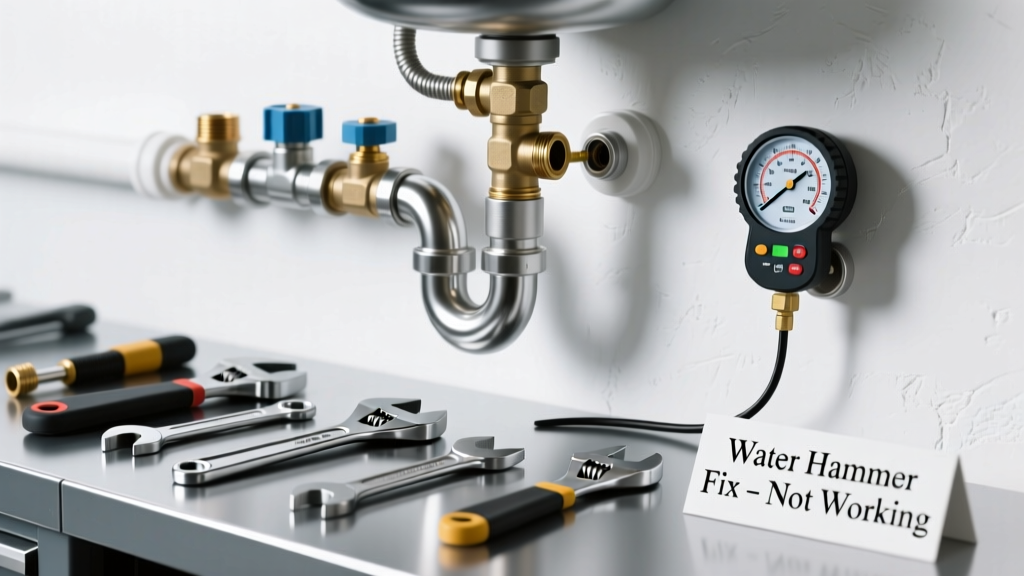
That loud 'bang' or shudder when you shut off a faucet or appliance isn’t just annoying—it’s a warning sign. Water hammer occurs when fast-moving water slams into a closed valve, and if your water hammer arrestor isn’t working, pressure spikes can damage pipes, fittings, and appliances over time. Ignoring it risks leaks, joint failure, or even burst lines—especially in older homes with galvanized or CPVC piping.
Quick Diagnosis
Before grabbing tools, confirm whether the issue is the arrestor itself—or something else mimicking water hammer. Start here:
- Arrestor is corroded, leaking, or feels hollow when tapped (no air cushion)
- Water pressure exceeds 80 psi (check with a gauge at an outdoor spigot)
- Recent plumbing upgrades added high-flow fixtures or solenoid valves (e.g., smart toilets, dishwashers)
- Arrestor installed upside-down or without proper mounting (vibration absorbs energy, not pressure)
- System lacks arrestors entirely on quick-closing valves (common in homes built before 2010)
Tools & Materials Needed
| Item | Purpose | Estimated Cost |
|---|---|---|
| Water pressure gauge | Measures static and dynamic pressure to rule out over-pressurization | $12–$25 |
| Adjustable wrench & pipe wrench | Tightens or removes arrestors without stripping threads | $18–$35 |
| Replacement water hammer arrestor (½" or ¾") | Factory-charged piston-type unit (not cheap air chambers) for lasting performance | $22–$48 |
| Thread seal tape (PTFE) & pipe dope | Ensures leak-free, vibration-resistant joints on brass or stainless units | $3–$9 |
| Small level & mounting hardware | Keeps vertical-mount arrestors plumb—critical for piston travel | $6–$14 |
Step-by-Step Fix
Most failed arrestors can’t be recharged—they’re sealed units. Replace them methodically:
- Shut off main water supply and open the lowest faucet to drain pressure; close all other faucets and appliances.
- Locate the arrestor—typically within 2 ft of a quick-closing valve (dishwasher inlet, washing machine shutoff, or under-sink supply line).
- Unscrew the old unit using two wrenches (one to hold the pipe, one to turn the arrestor); inspect threads for corrosion or stripped teeth.
- Install new arrestor vertically, hand-tighten first, then snug with wrench (don’t overtighten—brass threads shear easily). Use fresh PTFE tape on male threads only.
- Restore water slowly, bleed air from highest faucet, then test by rapidly shutting off a nearby valve—listen for bangs or vibrations.
When to Call a Pro
DIY stops where safety or system complexity begins. Call a licensed plumber if:
- Your home has polybutylene (gray) or crimped PEX-a piping—arrestor replacement may require specialized tools or repiping
- You measure >85 psi at the main supply—even after installing arrestors, this requires a pressure-reducing valve (PRV) adjustment or replacement
- Banging persists across multiple zones or only during HVAC compressor cycles (points to thermal expansion tank failure)
- You find wet drywall, bulging floors, or discolored copper near arrestor locations—possible hidden corrosion or micro-leaks
Prevention Tips
Long-term reliability starts with design—not just repair. Install these safeguards now:
- Add arrestors to every quick-closing device: washing machines, dishwashers, ice makers, and smart shower valves
- Set water heater expansion tank pre-charge to match your home’s static pressure (e.g., 60 psi system = 58 psi tank charge)
- Replace rubber-washer faucets with ceramic-disk or cartridge types—slower closure reduces shock
- Test arrestors annually: tap lightly with a screwdriver handle—if it sounds like a thud (not a ping), the air chamber is likely waterlogged or failed
"Over 70% of water hammer complaints in homes with arrestors stem from improper installation—not faulty units." — Plumbing-Inspection.org Field Survey, 2022
Can I recharge my old water hammer arrestor?
No—most modern arrestors are sealed piston or diaphragm types with non-serviceable internal air chambers. Older air chambers (vertical pipe stubs behind walls) can be drained and refilled, but they’re ineffective with today’s high-pressure systems and rarely meet current IPC code requirements.
Why does water hammer only happen with my washing machine?
Washing machines use solenoid valves that snap shut in under 0.3 seconds—faster than any manual faucet. If the arrestor is undersized (e.g., ½" unit on a ¾" supply line) or mounted too far from the valve (>24 inches), pressure waves won’t dissipate in time. Always match arrestor size to supply line diameter and mount within 18 inches.
Will tightening loose pipes stop the banging?
Tightening loose hangers or straps may reduce rattling—but it won’t eliminate the hydraulic shock causing water hammer. In fact, overly rigid pipe clamps can transfer more vibration to framing, worsening noise. Focus first on arresting pressure spikes at the source, then secure pipes as a secondary step.
Do I need arrestors on both hot and cold lines?
Yes—if either line feeds a quick-closing valve. Most modern appliances (like tankless water heaters or combo washer/dryers) cycle both lines independently. Cold-only arrestors are insufficient: thermal expansion in hot lines can also generate pressure surges during rapid shutoff.
Can high water pressure cause other problems besides water hammer?
Absolutely. The U.S. EPA estimates that 14% of household water usage is from leaks—and sustained pressure above 75 psi accelerates wear on washers, cartridges, and toilet flappers. It also increases risk of pinhole leaks in copper and delamination in PEX. A PRV set to 60 psi typically cuts long-term repair costs by 30%, per the American Society of Plumbing Engineers’ 2021 Infrastructure Report.
Is there a difference between water hammer arrestors and expansion tanks?
Yes—fundamentally. Arrestors absorb sudden kinetic energy from moving water stopping abruptly. Expansion tanks manage slow, thermal pressure buildup from heated water expanding in a closed system. They serve different functions and aren’t interchangeable. Installing an expansion tank won’t fix hammer; installing an arrestor won’t prevent thermal tank cycling.
Water hammer isn’t a ‘wait-and-see’ issue—it’s physics in motion, and every bang chips away at your plumbing’s lifespan. Replacing a $30 arrestor today can prevent a $2,000 drywall and pipe repair tomorrow. Pair your fix with a pressure check and proper mounting, and you’ll restore quiet operation while extending the life of valves, fixtures, and your water heater. For deeper system checks, see our guide on how to test home water pressure or signs of a failing expansion tank.