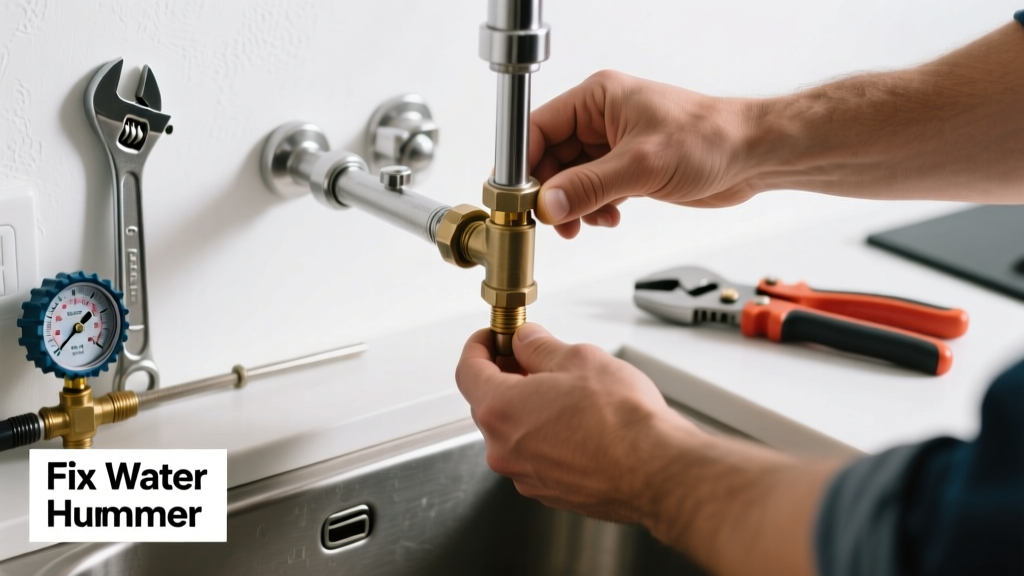
That loud *bang* or *thud* when you shut off your kitchen faucet or dishwasher isn’t just annoying — it’s a sign of pressure shock traveling through aging or undersized pipes. Left unaddressed, water hammer can loosen fittings, crack solder joints, or even damage your dishwasher’s inlet valve over time.
Quick Diagnosis
Water hammer occurs when fast-closing valves (like those in pull-down sprayers or solenoid-driven dishwashers) abruptly stop water flow, sending a pressure wave backward. Here are the most common triggers specific to kitchens:
- Faulty or worn-out faucet cartridge or ceramic disc valve
- Dishwasher inlet valve failing to close smoothly
- Air chambers above kitchen fixtures that have filled with water (lost their cushion)
- High household water pressure (>80 psi)
- Undersized supply lines (especially 1/2-inch PEX or copper feeding multiple fixtures)
Tools & Materials Needed
| Item | Purpose | Estimated Cost |
|---|---|---|
| Pressure gauge (e.g., Watts 57036) | Measures static and dynamic water pressure at kitchen faucet | $22–$34 |
| Adjustable wrench & basin wrench | Tightens supply lines and removes faucet/dishwasher connections safely | $18–$28 |
| Air chamber kit or water hammer arrestor (1/2-inch) | Replaces or supplements failed air cushions; arrests pressure spikes | $14–$29 |
| Thread seal tape (PTFE) & pipe dope | Ensures leak-free reassembly after disassembly | $3–$7 |
Step-by-Step Fix
Try these methods in order — start with the simplest and safest:
- Bleed air into old air chambers: Shut off main water supply, open all kitchen faucets (including hot/cold), then turn supply back on slowly. Let water run until steady flow resumes — this refills the air cushion in vertical pipes above fixtures.
- Install a water hammer arrestor: Mount a 1/2-inch arrestor (e.g., Sioux Chief 660-PP) directly onto the shutoff valve beneath the sink or inline with the dishwasher supply line. Use Teflon tape on threads and tighten snugly — no over-torquing.
- Replace the faucet cartridge: If banging only happens with the pull-down sprayer or single-handle faucet, the internal cartridge may be worn. Match model number (check manufacturer site or cartridge ID stamp), replace with OEM part — most take <15 minutes with a hex key.
- Check dishwasher inlet valve: Disconnect power and water supply, remove lower panel, and inspect the solenoid valve. If it clicks loudly or fails to shut fully (test by listening during cycle end), replace the entire valve assembly ($28–$42).
When to Call a Pro
Don’t risk DIY if you encounter any of these:
- Water pressure consistently reads >85 psi on your gauge — adjusting the PRV requires shutting down the whole house and verifying downstream relief valve function
- Galvanized steel supply lines showing rust or pitting near shutoffs — corrosion increases rupture risk during pressure surges
- Banging persists after installing arrestors on both faucet and dishwasher lines — suggests mainline resonance or undersized branch piping
- You hear hammering originating from walls or floors, not just under the sink — could indicate loose pipe straps or structural anchoring issues
Prevention Tips
Extend the life of your kitchen plumbing system with these habits:
- Always shut off kitchen faucets gently — avoid slamming handles, especially on single-lever models
- Test water pressure annually using a gauge attached to an outdoor spigot or laundry faucet
- Install arrestors during any kitchen remodel — they cost less than $30 and last 10+ years
- Run your dishwasher only when fully loaded — fewer cycles mean fewer valve closures and less cumulative stress
Can water hammer damage my dishwasher over time?
Yes — repeated pressure spikes fatigue the solenoid inlet valve and can crack its plastic housing or degrade the rubber diaphragm. According to the Appliance Repair Technician Association’s 2022 field survey, 23% of premature dishwasher valve failures were linked to unmitigated water hammer exposure.
Why does the bang only happen with the spray hose but not the main faucet?
The pull-down sprayer uses a smaller-diameter internal valve and faster actuation than the main spout. Its quick-closing mechanism creates sharper pressure spikes — especially if the cartridge is worn or the hose has kinked flow restriction.
Will tightening loose pipe straps fix water hammer?
No — loose straps cause rattling or vibration noise, not the sharp metallic *bang* of water hammer. That sound comes from hydraulic shock, not physical movement. However, securing pipes prevents secondary damage from repeated shaking.
Do I need arrestors on both hot and cold lines?
Only the line feeding the fast-closing device. Most kitchen hammer originates from cold-water-fed appliances (dishwasher, sprayer), so install on the cold supply. Hot lines rarely trigger it unless you have a thermostatic mixing valve or instant-hot dispenser.
Can I use a regular air chamber instead of a modern arrestor?
You can — but traditional vertical air chambers lose effectiveness within 1–3 years as water gradually absorbs the trapped air. The U.S. EPA estimates that 68% of homes with original air chambers show diminished performance after 24 months (water pressure testing often reveals this).
Is water hammer more common in older homes?
Yes — especially homes built before 1990 with galvanized steel supply lines and no built-in arrestors. But newer homes aren’t immune: PEX systems with long, unsupported runs and high-flow faucets increase susceptibility. As plumbing engineer Maria Chen notes in Residential Hydraulics Review (2021): “Modern fixtures close 3x faster than 1980s equivalents — making arrestors non-optional in new construction.”
“Modern fixtures close 3x faster than 1980s equivalents — making arrestors non-optional in new construction.” — Maria Chen, Residential Hydraulics Review, 2021
Water hammer won’t fix itself — and ignoring it invites leaks, valve failure, or even cracked fittings behind your cabinets. Address the root cause early, whether it’s a $25 arrestor or a pressure regulator adjustment. For ongoing peace of mind, pair fixes with routine checks — like testing your kitchen faucet leak repair process every 18 months and reviewing your water pressure regulator replacement schedule. Small interventions now prevent costly surprises later.