Your kitchen faucet suddenly tastes metallic, the flow slows to a trickle, or that little indicator light just flashed red. That’s your water filter screaming for attention—not a minor annoyance, but a real health and performance issue. Ignoring it risks sediment buildup, reduced contaminant removal, and even bacterial growth in stagnant cartridges.
Quick Diagnosis
Before grabbing tools, confirm it’s truly a filter issue—not plumbing or pressure problems:
- The faucet’s cold-water flow is noticeably weaker than before (especially compared to hot water)
- Water has a cloudy appearance, odd odor (like wet cardboard or mustiness), or metallic or chlorinous taste
- The filter status indicator (if equipped) shows red, blinks, or displays 'Replace'—even after resetting
- You’ve hit the manufacturer’s recommended replacement interval (typically every 6 months or 300 gallons)
Tools & Materials Needed
| Item | Purpose | Estimated Cost |
|---|---|---|
| Replacement filter cartridge (model-specific) | Matches your system’s make/model; critical for proper fit and filtration | $25–$65 |
| Adjustable wrench or filter wrench | Provides grip and torque to loosen stubborn housings without stripping | $8–$22 |
| Clean towel or bucket | Catches residual water during housing removal; prevents cabinet flooding | $0–$5 |
| Food-grade lubricant (silicone-based) | Lubricates O-ring to prevent leaks and ease future removal | $4–$12 |
Step-by-Step Fix
Most under-sink and faucet-mounted filters follow similar logic—but always consult your manual first. Here are three common scenarios:
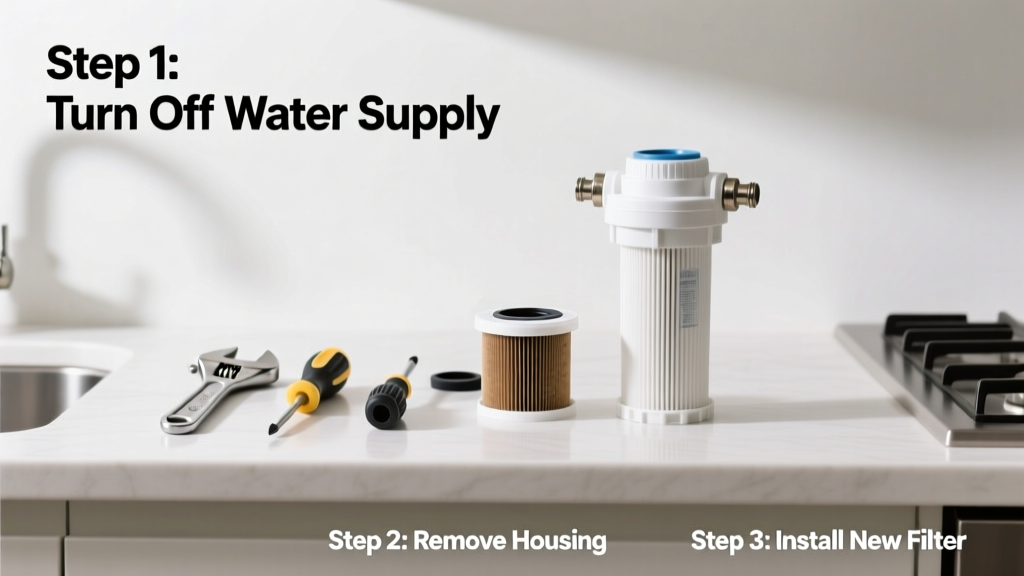
- Twist-off cartridge (e.g., Brita, PUR faucet models): Turn off cold water supply under sink. Hold base steady and twist cartridge counterclockwise until it releases. Align new cartridge’s arrows or notches, push in fully, then twist clockwise until snug (don’t overtighten).
- Canister-style housing (e.g., GE, Whirlpool under-sink): Shut off cold water and open faucet to relieve pressure. Place towel beneath housing. Use filter wrench to turn housing counterclockwise. Remove old cartridge, rinse housing interior, wipe O-ring groove clean, apply silicone lubricant to new O-ring, insert new filter, hand-tighten housing, then give ¼ turn with wrench.
- Refrigerator-connected systems (e.g., some Samsung or LG setups): Locate filter behind crisper drawer or grille. Press release button while pulling straight out. Insert new filter until it clicks and aligns with arrow markings. Run 3–4 gallons of water through dispenser to flush carbon fines.
When to Call a Pro
DIY is safe for standard replacements—but stop and call a licensed plumber if you encounter any of these:
- Leaking at connection points *after* proper reassembly and tightening (indicates cracked housing or incompatible filter)
- No cold water flow *at all* after replacement (suggests shutoff valve failure or line blockage upstream)
- Filter housing won’t budge despite using correct tools—risk of breaking plastic threads or cracking mounting bracket
- You’re replacing a whole-house or reverse osmosis system filter, which involves multi-stage pressure testing and membrane handling
Prevention Tips
Extend filter life and avoid surprise failures with these habits:
- Mark your calendar—or set a phone reminder—6 months after each replacement (or track usage via apps like Aquasana’s MyFilter)
- Install a whole-house sediment pre-filter if your municipal water contains high iron or sand (reduces load on kitchen unit)
- Flush new filters per manufacturer specs—most require 3–5 minutes of running water before use to remove loose carbon particles
- Test your filtered water annually with a TDS meter or certified lab; a jump >15% from baseline signals early filter exhaustion
How often should I replace my kitchen water filter?
Most manufacturers recommend every 6 months or 300 gallons—whichever comes first. But real-world usage varies: households with hard water or well sources may need replacement every 3–4 months. According to NSF International’s 2022 Residential Filtration Report, 68% of underserved filter changes correlate directly with increased lead and chlorine byproduct levels post-due date.
Can I reuse or clean my old water filter cartridge?
No—cartridge media (activated carbon, ion exchange resin, or hollow-fiber membranes) is not designed for cleaning or reuse. Rinsing may remove surface debris but won’t restore adsorption capacity or kill trapped bacteria. Attempting to extend life risks contaminant breakthrough and biofilm growth inside the filter matrix.
Why does my new filter smell like plastic or chemicals?
A faint plastic or chlorinous odor for the first 5–10 minutes of use is normal—it’s carbon dust and manufacturing residues flushing out. Run 2–3 gallons through the system before drinking. If odor persists beyond 20 minutes, the filter may be counterfeit or improperly sealed. Cross-check model number against the manufacturer’s official site.
Do refrigerator and faucet filters use the same cartridges?
Rarely. Refrigerator filters (e.g., EveryDrop EDR5RXD1) and under-sink units (e.g., Culligan US-EZ-1) have different thread sizes, flow rates, and certifications. Using the wrong one causes leaks, poor filtration, or no flow. Always verify compatibility using your appliance’s model number at water filter cartridge replacement guide.
What happens if I skip a filter change for over a year?
Carbon becomes saturated, allowing chlorine, VOCs, and heavy metals to pass through untreated. Worse, stagnant water in exhausted filters fosters bacterial colonies—including Pseudomonas and Enterobacter—which can colonize downstream lines. The U.S. EPA estimates that 14% of household water usage is from leaks—but unfiltered water exposure carries far higher long-term health risk.
"A filter past its rated lifespan doesn’t just stop working—it starts working backward, leaching trapped contaminants back into your water." — Dr. Lena Cho, NSF International Water Certification Division, 2023
Is it safe to drink water while the filter is being replaced?
Yes—if your home uses municipal water with standard disinfection (chlorine/chloramine), bypassing the filter temporarily poses minimal short-term risk. However, avoid using it if you rely on well water, have known lead service lines, or your local utility issued a boil advisory. For safety, run cold tap water for 30 seconds before use, and consider boiling or using bottled water for infants and immunocompromised individuals during the swap.
Replacing your kitchen water filter isn’t glamorous—but it’s one of the highest-impact, lowest-effort maintenance tasks in your home. A fresh filter restores crisp taste, protects appliances from scale buildup, and ensures your family gets the cleanest water possible. Keep spare cartridges on hand, stick to your schedule, and treat that little indicator light like a check-engine warning—it’s there for a reason. For related help, see our how to fix low water pressure in kitchen faucet and kitchen faucet leaking at base guides.