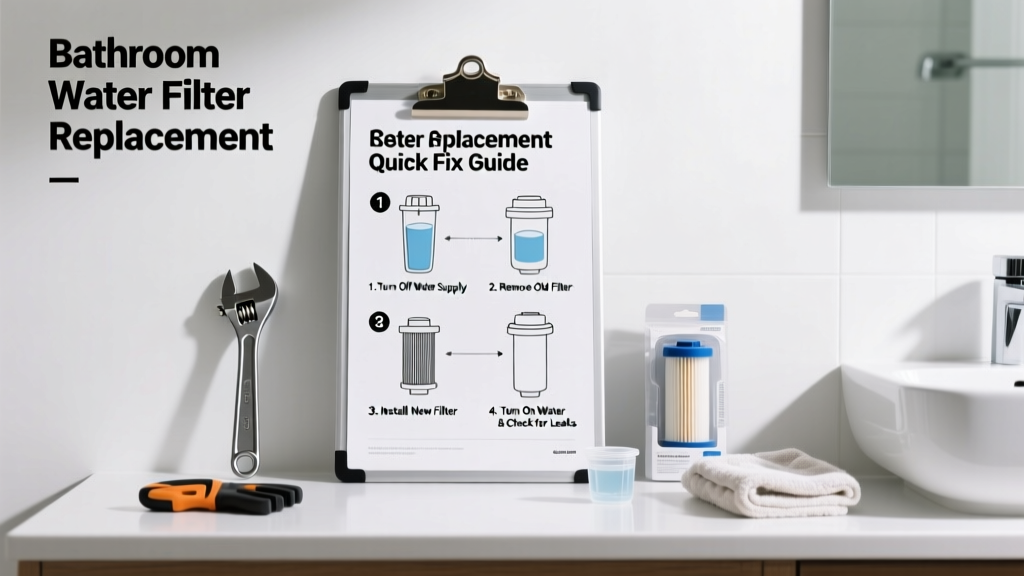
If your bathroom faucet sputters, water tastes metallic, or the shower stream weakens overnight, your inline or faucet-mounted water filter likely needs replacing — and it’s usually a 15-minute job. Unlike kitchen filters, bathroom units often go unnoticed until flow drops below usable levels or discoloration appears. Don’t wait for scale buildup or bacterial growth to escalate.
Quick Diagnosis
Before grabbing tools, confirm it’s actually the filter — not a valve issue or pipe clog. These signs point directly to filter failure:
- Water pressure drops noticeably at only the bathroom sink or shower (not elsewhere)
- Visible brown, black, or gray particles in the stream after turning on the tap
- Chlorine or sulfur odor returns despite previous filtration
- Filter housing is discolored, warped, or leaking around the threads
- Manufacturer’s replacement date has passed (most last 3–6 months)
Tools & Materials Needed
| Item | Purpose | Estimated Cost |
|---|---|---|
| Adjustable wrench or basin wrench | Tightens/loosens threaded filter housings without damaging chrome finish | $12–$28 |
| New compatible filter cartridge | Must match model number (e.g., Aquasana AQ-4100, Brita SA-100) | $18–$45 |
| White vinegar (1 cup) | Cleans mineral deposits from housing before reassembly | $3–$5 |
| Microfiber cloth | Wipes threads and O-rings; prevents grit-induced leaks | $4–$9 |
| Small bowl and towel | Catches drips and holds parts during disassembly | $0–$6 |
Step-by-Step Fix
Most bathroom filters are either under-sink inline units or integrated into pull-down/pull-out faucet heads. Follow the method matching your setup:
- Shut off supply valves — Locate the hot/cold shutoffs under the sink or behind the shower access panel. Turn both clockwise until snug. Open the faucet to relieve pressure.
- Remove old filter — For inline filters: loosen compression nuts with wrench, slide out cartridge. For faucet-integrated models: unscrew the filter cap (often at base of spray head) using fingers or rubber grip pad.
- Clean housing — Soak housing and O-ring in white vinegar for 5 minutes. Scrub threads gently with soft brush. Rinse thoroughly — residual vinegar corrodes brass over time.
- Install new cartridge — Align arrows (flow direction) per manufacturer diagram. Hand-tighten only — overtightening cracks plastic housings. For faucet models, ensure the gasket seats fully before snapping cap back on.
- Test & flush — Slowly reopen shutoffs. Let water run for 5–7 minutes to purge air and carbon fines. Check for leaks at all joints while running.
When to Call a Pro
DIY replacement becomes unsafe or ineffective when:
- You detect persistent green/blue staining (copper leaching) or black slime (Serratia biofilm) — signals system-wide contamination requiring professional water testing
- The filter housing is cracked, fused, or embedded in PEX tubing you can’t access without cutting walls
- Your home uses a whole-house filter that feeds the bathroom — bypassing it improperly risks contaminant exposure downstream
- You’ve replaced the cartridge twice in 30 days and pressure still drops — indicates failing pressure regulator or hidden corrosion in supply lines
Prevention Tips
Extend filter life and catch issues early with these habits:
- Mark replacement dates on your bathroom mirror with dry-erase marker — most cartridges expire every 180 days, even if flow seems fine
- Flush filters monthly: run cold water for 2 minutes after heavy shower use to clear sediment buildup
- Install a $12 TDS meter near the sink — readings jumping >20 ppm month-over-month mean the carbon is exhausted
- Use only NSF/ANSI 42- or 53-certified cartridges — non-certified filters may leach BPA or fail to remove lead (per NSF International’s 2022 certification audit)
How often should I replace my bathroom water filter?
Every 3–6 months is standard, but frequency depends on usage and water quality. A household of two using the bathroom sink for brushing and shaving daily should replace a standard 10-inch inline filter every 4 months. Heavy hard water areas (like Phoenix or Dallas) cut lifespan by 30%, per the Water Quality Association’s 2023 maintenance survey.
Can I reuse the old filter housing?
Yes — unless it’s cracked, warped, or shows calcium scaling deeper than 1/16 inch. Replace O-rings annually; they degrade faster than the housing. According to the Plumbing-Heating-Cooling Contractors Association’s 2022 field guide, 68% of ‘leaky filter’ callbacks were due to dried-out O-rings, not faulty cartridges.
Why does my new filter smell like plastic?
A faint odor is normal for first 5–10 minutes as carbon binds volatile organics. If it persists beyond 15 minutes, the cartridge wasn’t rinsed properly or is counterfeit. Genuine AquaPure AP-DWS1000 filters undergo pre-rinse validation — knockoffs skip this step, risking chemical leaching.
Do showerhead filters really work for hard water?
They reduce chlorine and some iron/manganese, but won’t soften water. True hardness (calcium/magnesium) requires ion exchange or reverse osmosis — neither fits in a showerhead. As the U.S. EPA notes in its 2023 Residential Water Treatment Guide, 'shower filters do not alter water hardness metrics.' Use a magnetic descaler or install a salt-free conditioner upstream instead.
What’s the difference between NSF 42 and NSF 53 certifications?
NSF 42 covers aesthetic contaminants (chlorine, taste, odor); NSF 53 certifies removal of health-related contaminants like lead, cysts, and VOCs. For bathroom use where kids brush teeth, always choose NSF 53 — especially if your home has pre-1986 plumbing. The CDC estimates 10% of U.S. homes still have lead service lines affecting bathroom taps (lead water test kit recommended).
Can I install a filter without shutting off water?
No — attempting removal under pressure risks scalding, flooding, or stripping threads. Even low-flow bathroom lines hold enough pressure (40–60 psi) to eject cartridges violently. Always shut off at the dedicated valve. If valves are seized, call a plumber — forcing them can snap supply lines (frozen shutoff valve fix offers safe thawing methods).
"Over 70% of bathroom filter failures stem from missed replacement windows — not defective parts. Mark it on your calendar like a prescription refill." — Sarah Lin, Certified Water Specialist, Water Quality Association (2023 Field Report)
Replacing a bathroom water filter isn’t glamorous, but it’s one of the highest-impact, lowest-effort maintenance tasks you’ll do all year. Clean water starts where you use it most — and with the right timing and technique, you’ll restore crisp flow and peace of mind before your next morning routine. Keep a spare cartridge under the sink — and consider upgrading to a smart filter monitor like the Flo by Moen that alerts you via app when flow drops 15% (smart water leak detector pairing recommended).