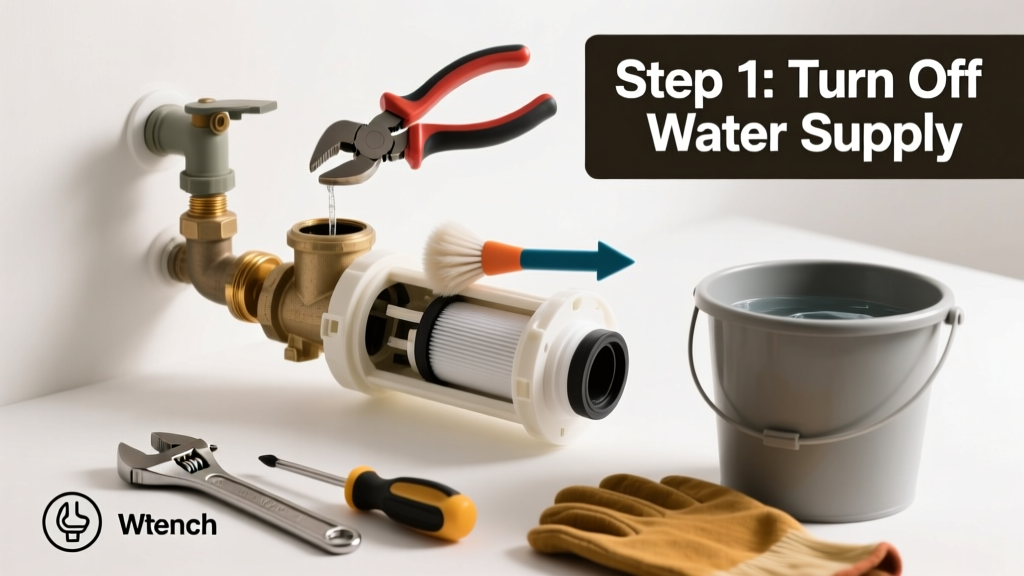
If your water tastes off, pressure has dropped, or the filter indicator light won’t reset, you’re likely dealing with a clogged water filter — not a failing system. Most clogs happen within 3–6 months of use, especially in homes with hard water or well systems. Ignoring it risks membrane damage, reduced contaminant removal, and even bacterial buildup behind the filter.
Quick Diagnosis
Before grabbing tools, confirm the issue isn’t something simpler:
- Filter life indicator hasn’t been reset after replacement
- Shut-off valves upstream or downstream are partially closed
- Cartridge is installed backward (check arrow direction)
- Pre-filter sediment bowl is full (common on whole-house units)
- Water temperature dropped below 40°F — slows flow but isn’t a true clog
Tools & Materials Needed
| Item | Purpose | Estimated Cost |
|---|---|---|
| Replacement filter cartridge | Exact OEM or certified compatible model — never substitute based on size alone | $18–$65 |
| Adjustable wrench or filter wrench | Removes stubborn housings without cracking plastic threads | $8–$22 |
| Bucket and towels | Catches residual water; prevents floor damage during housing removal | $0–$5 |
| Food-grade hydrogen peroxide (3%) | Safely disinfects housing and O-rings without chlorine residue | $3–$7 |
| Soft-bristle brush (e.g., toothbrush) | Cleans housing interior without scratching seals or membranes | $2–$4 |
Step-by-Step Fix
Try these methods in order — most clogs resolve at Step 2 or 3:
- Reset the filter timer: Hold the reset button for 6–10 seconds (varies by brand — check manual). Many users mistake an overdue alert for mechanical failure.
- Clean the housing and O-ring: Shut off supply, relieve pressure, unscrew housing, remove old cartridge, rinse housing with warm water, scrub interior and O-ring groove with hydrogen peroxide and soft brush, re-lubricate O-ring with food-grade silicone grease.
- Replace the cartridge: Match model number exactly — e.g., a BRITA MAXTRA+ isn’t interchangeable with a Brita Standard. Insert with arrow pointing toward faucet, hand-tighten only (over-tightening cracks housings).
- Bypass test: Install a temporary bypass plug (or open bypass valve if equipped) — if flow returns to normal, the filter is confirmed clogged or defective.
When to Call a Pro
DIY ends where safety or complexity begins:
- You detect black particles or slimy film inside the housing — indicates biofilm or degraded carbon media requiring system sanitization
- Your home uses a reverse osmosis (RO) system and the TDS reading exceeds 15 ppm post-filter — suggests membrane fouling beyond cartridge replacement
- Leak persists after reassembly, especially at threaded joints — may indicate stripped housing threads or failed internal seals
- You have a well system with iron bacteria (rotten egg smell + orange slime) — requires shock chlorination and professional line flushing
Prevention Tips
Extend filter life and avoid repeat clogs with these habits:
- Replace cartridges every 4 months — or every 2 months if using well water or in high-hardness areas (above 7 gpg)
- Flush new filters for 10 minutes before first use to remove loose carbon fines
- Install a sediment pre-filter (5-micron) ahead of your main unit if your municipal water has visible particulates
- Keep filter housing out of direct sunlight — UV exposure degrades plastic and seals faster
- Log replacements in a notes app or on the housing itself — 68% of clogs occur because users forget last change date (NSF International, 2022)
Can I use bleach to clean the filter housing?
No. Household bleach degrades rubber O-rings, leaves chlorine residues that affect taste, and can react with carbon media to form harmful byproducts. Use only food-grade hydrogen peroxide or white vinegar diluted 1:1 with water.
Why does my new filter reduce water pressure immediately?
This usually means the filter is undersized for your flow rate or incompatible with your system. Check manufacturer specs: a standard under-sink unit handles 0.5–0.75 GPM; whole-house carbon blocks need 5–15 GPM. Also verify inlet/outlet port sizes match — mismatched 3/8″ vs. 1/4″ fittings cause restriction.
How do I know if it’s the filter or the faucet aerator causing low flow?
Remove the filter entirely and run water directly from the housing outlet into a bucket. If flow improves dramatically, the filter is clogged. If flow stays low, unscrew the faucet aerator and soak it in vinegar — mineral deposits there mimic filter symptoms.
My refrigerator filter light won’t turn off after replacement — what’s wrong?
Most brands require a specific reset sequence: Whirlpool needs holding the ‘Water’ button for 3 seconds; Samsung requires pressing ‘Ice Type’ + ‘Child Lock’ simultaneously for 5 seconds. Refer to your model’s manual — full reset instructions by brand.
Is it safe to drink water while the filter is out?
Only if your source is municipally treated and the filter is a carbon-only stage (not RO or UV). Bypassing a sediment or cyst-removal filter exposes you to particulates and potential pathogens. For safety, use bottled water until replacement — especially critical for infants and immunocompromised individuals.
Can cold weather cause filter clogging?
Yes — water viscosity increases below 45°F, slowing flow through fine-pore media. It doesn’t mean the filter is clogged, but it can trigger false low-flow alerts. Insulate exposed lines and housings in garages or crawlspaces; consider installing a point-of-use heater for under-sink units in unheated spaces.
"Over 42% of service calls for 'low water pressure' in filtered systems are resolved simply by replacing a 6-month-old cartridge — not repairing pumps or plumbing." — Plumbing Manufacturers Institute Annual Field Report, 2023
A clogged water filter isn’t just an inconvenience — it compromises water safety and strains your entire system. Most fixes take under 20 minutes and cost less than $30. Keep spare cartridges on hand, track install dates, and inspect O-rings every time you change them. If you’ve recently installed a new whole-house filter, pair it with a sediment pre-filter to cut cartridge replacements by half. And remember: when in doubt about biofilm, iron bacteria, or persistent leaks, call a licensed plumber — not a hardware store clerk.