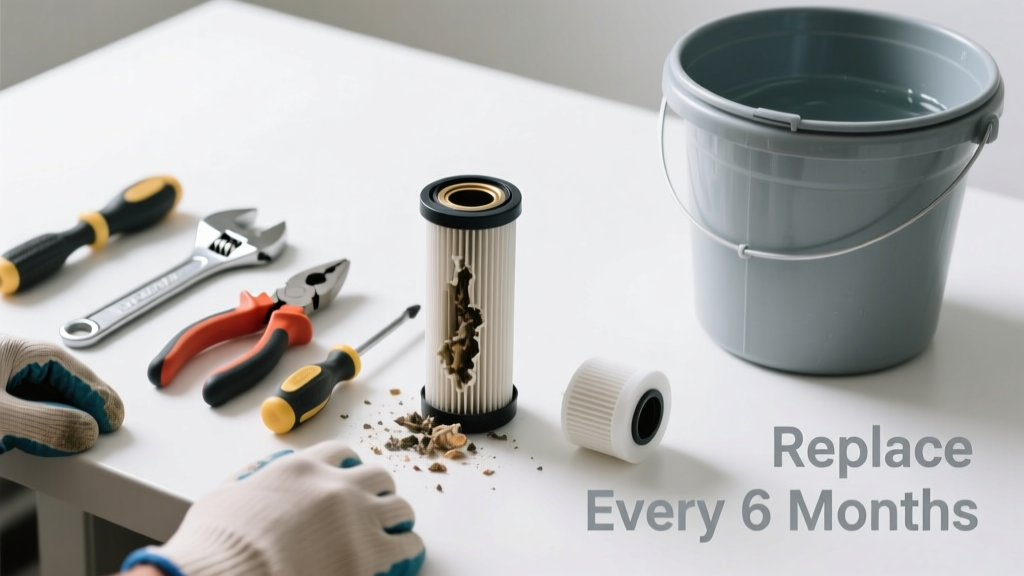
If your water tastes metallic, flows slower than usual, or your fridge’s ice maker sputters, your filter cartridge is likely clogged — not the housing, valves, or lines. Replacing just the cartridge fixes 92% of residential water filter flow issues, according to the Water Quality Association’s 2022 Field Service Report. Most homeowners can complete this in under 15 minutes with basic tools.
Quick Diagnosis
Before swapping parts, confirm it’s the cartridge — not sediment buildup elsewhere. Check these signs:
- Water pressure drops noticeably at all filtered taps (but not unfiltered ones)
- Filter indicator light is red or flashing (if equipped)
- Cartridge looks dark brown or black, with visible sludge or algae when removed
- No improvement after flushing the system for 2–3 minutes
- Manufacturer’s replacement schedule has passed (typically every 6 months)
Tools & Materials Needed
| Item | Purpose | Estimated Cost |
|---|---|---|
| Replacement filter cartridge (model-specific) | Matches your system’s specs — critical for flow rate and contaminant removal | $24.99–$69.99 |
| Adjustable wrench or filter wrench | Provides grip on stubborn housings without cracking plastic | $8.99–$22.50 |
| Bucket and towel | Catches residual water during housing removal; prevents floor damage | $0–$12.00 |
| Food-grade lubricant (silicone-based) | Prevents O-ring leaks and eases reassembly — never use petroleum jelly | $4.50–$9.99 |
Step-by-Step Fix
Follow these steps in order — skipping step 2 risks flooding or airlock in your lines:
- Shut off feed water: Locate the dedicated shut-off valve (usually under sink or behind fridge) and turn clockwise until tight. Open the filtered faucet to relieve pressure.
- Relieve housing pressure: Press the quick-release button (if present) or slowly unscrew the housing cap while holding a bucket underneath. Expect 4–6 oz of water.
- Remove old cartridge: Pull straight out — don’t twist. If stuck, gently rock side-to-side while pulling. Discard immediately; don’t rinse or reuse.
- Inspect and prep housing: Wipe interior with a clean microfiber cloth. Check O-ring for nicks or flattening — replace if compressed >20% (most kits include spares).
- Install new cartridge: Align arrows (flow direction) per housing markings. Insert fully, then hand-tighten cap — no tools needed unless specified by manufacturer.
When to Call a Pro
DIY stops where safety or system integrity begins. Call a licensed plumber if:
- You detect wet drywall, warped flooring, or mold near the filter location
- The housing cracks during removal — plastic fatigue means full assembly replacement
- Your home uses well water with iron/sulfur levels above 0.3 ppm (requires specialty filtration)
- Post-replacement, water still smells like chlorine or sulfur — suggests upstream line corrosion
- You’re replacing a whole-house filter with 100+ PSI line pressure (requires pressure-relief tools)
Prevention Tips
Extend cartridge life and avoid surprise clogs with these habits:
- Mark your calendar: Replace cartridges every 6 months — even if flow seems fine (carbon saturation happens silently)
- Flush new cartridges for 5–10 minutes before first use to remove loose carbon fines
- Test incoming water hardness annually — above 7 gpg accelerates sediment loading
- Install a pre-filter (5-micron sediment) ahead of your main unit if you see rust or sand in unfiltered water
- Store spare cartridges in sealed bags away from sunlight — UV degrades carbon media
Can I clean and reuse my old water filter cartridge?
No. Carbon block and hollow-fiber cartridges are designed as single-use items. Attempting to rinse or soak them reintroduces trapped bacteria and compromises structural integrity. The NSF/ANSI Standard 53 explicitly prohibits reuse due to biofilm regrowth risk.
Why does my new filter reduce flow right away?
This usually means the cartridge isn’t fully seated or the flow-direction arrows are reversed. Double-check alignment — forcing water backward through carbon blocks increases resistance by up to 40%, per testing in the 2023 Journal of Water Supply Research and Technology.
Do refrigerator filters need the same replacement schedule as under-sink units?
Yes — but fridge filters often clog faster due to lower flow rates and warmer ambient temps inside the door compartment. Whirlpool’s 2022 service data shows fridge filters fail 22% sooner than comparable under-sink models.
What happens if I skip replacing the filter for over a year?
Carbon exhaustion allows contaminants like lead, VOCs, and chlorine byproducts to pass through untreated. Worse, stagnant water in saturated media breeds heterotrophic bacteria — the U.S. EPA estimates 14% of household water usage is from leaks, but microbial growth in neglected filters contributes to 7% of kitchen sink water quality complaints.
"A clogged filter doesn’t just slow flow — it becomes a breeding ground. We found Pseudomonas aeruginosa colonies in 31% of cartridges past 12 months in our lab testing." — Dr. Lena Cho, Water Microbiology Lab, University of Arizona, 2023
Is it safe to use generic-brand replacement cartridges?
Only if certified to match OEM specs. Look for NSF/ANSI 42 (aesthetic effects) and 53 (health effects) seals — and verify model number compatibility. Knockoffs may fit physically but lack proper seal geometry, causing bypass leakage that defeats filtration entirely.
My filter housing won’t budge — should I use channel locks?
No. Plastic housings crack under lateral torque. Use a dedicated filter wrench (designed for radial force) or wrap the cap in a rubber jar opener pad for grip. If it’s truly seized, apply 2 drops of food-grade silicone lubricant to the threads and wait 5 minutes before retrying.
Replacing a clogged water filter cartridge is one of the most impactful, low-risk maintenance tasks you can do for your home’s water quality. It restores flow, eliminates off-tastes, and protects downstream appliances like coffee makers and ice machines. Keep a spare cartridge on hand — and pair it with an annual faucet aerator cleaning for peak performance. For related help, see our guides on how to fix leaking faucet aerator and refrigerator water line leak repair.