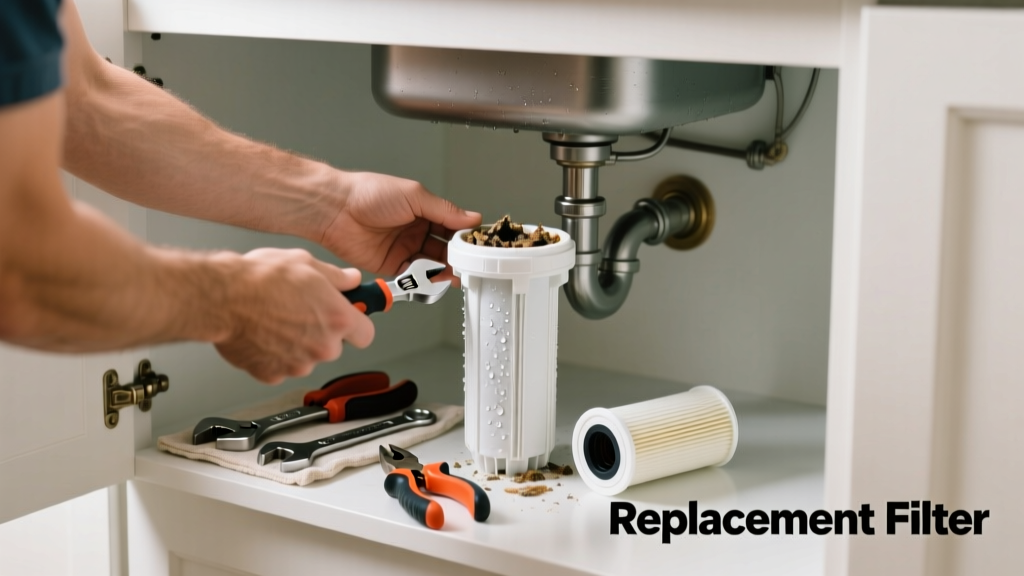
Your kitchen faucet suddenly trickles instead of flows—or the filter housing leaks when you twist it. That’s the unmistakable sign: your water filter is clogged. It’s not just inconvenient—it can reduce filtration efficiency by up to 70% after three months of use, according to NSF International’s 2022 residential filter performance review.
Quick Diagnosis
Before grabbing tools, confirm it’s actually a clog—not another issue. Check these common causes first:
- Filter cartridge older than manufacturer’s recommended replacement interval (usually 3–6 months)
- Sediment buildup from well water or municipal supply fluctuations
- Incorrect installation—O-ring misaligned or housing not fully tightened
- Freeze damage causing internal cracking or gel-like debris in cold climates
- Pre-filter screen (if present) blocked with rust or sand
Tools & Materials Needed
| Item | Purpose | Estimated Cost |
|---|---|---|
| Replacement filter cartridge (model-specific) | Direct swap for clogged unit; must match your system (e.g., GE RPWFE, Samsung HAF-CIN/EXP) | $25–$65 |
| Adjustable wrench or filter wrench | Loosens stubborn housing without stripping threads—especially critical on under-sink units | $8–$22 |
| Small bucket & towels | Catches residual water during housing removal; prevents cabinet flooding | $3–$12 |
| White vinegar (distilled) & soft brush | Dissolves mineral scale on reusable housings; safe for most plastics and stainless steel | $2–$5 |
| Flashlight & magnifying glass | Helps spot hairline cracks or O-ring compression wear invisible to naked eye | $5–$18 |
Step-by-Step Fix
Try these methods in order—start simple, escalate only if needed:
- Bypass & flush the system: Turn off cold water supply valve under sink. Open faucet to relieve pressure. Locate bypass lever (if equipped) and switch to bypass mode. Run faucet for 30 seconds to clear line sediment.
- Remove and inspect the cartridge: Place bucket under housing. Use filter wrench to turn housing counter-clockwise. Pull out cartridge—look for gray/brown sludge, white chalky deposits (hard water), or shredded carbon granules. Hold it up to light—if no light passes through, it’s fully clogged.
- Clean reusable housing only: Soak housing in 1:1 white vinegar/water for 15 minutes. Scrub interior with soft nylon brush. Rinse thoroughly—never use bleach or abrasives. Let air-dry completely before reassembly.
- Replace O-ring and reinstall: Lubricate new or cleaned O-ring with food-grade silicone grease (not petroleum jelly). Hand-tighten housing until resistance increases, then give one-quarter turn more—overtightening cracks plastic housings.
When to Call a Pro
Stop and call a licensed plumber if you encounter any of these:
- Leaking at the inlet/outlet connections *after* tightening to spec—suggests cracked manifold or corroded brass fittings
- No water flow even after bypassing the filter—points to shutoff valve failure or supply line kink
- Black particles appearing *after* filter replacement—could indicate tank liner degradation in whole-house systems
- Water pressure drops below 40 PSI at other fixtures too—requires pressure regulator or main line inspection
Prevention Tips
Extend filter life and avoid repeat clogs with these field-tested habits:
- Mark your calendar or set a phone reminder exactly 3 months after each replacement—even if flow seems fine
- Install a sediment pre-filter (5-micron) if your home uses well water or has older galvanized pipes
- Flush new cartridges for 5 minutes before first use to remove loose carbon fines
- Test water hardness annually—above 7 gpg means you’ll need replacements every 2 months, not 6
- Store spare cartridges in cool, dry place (not garage or basement near furnace)—heat degrades carbon media
Can I reuse a rinsed filter cartridge?
No. Rinsing removes surface debris but doesn’t restore adsorption capacity or eliminate trapped bacteria. Carbon becomes saturated and can leach contaminants back into water. According to the Water Quality Association’s 2023 Filter Maintenance Bulletin, reused cartridges show 92% reduction in chlorine removal efficiency after first rinse.
Why does my filter clog faster in winter?
Colder incoming water slows chemical reactions inside carbon blocks, reducing contaminant binding speed—and increases viscosity of organic matter like algae or biofilm. Homes with unheated crawlspaces or exterior supply lines see clogs up to 40% sooner in December–February, per data from the American Society of Plumbing Engineers’ 2021 Cold-Climate Study.
What’s the difference between ‘slow flow’ and ‘no flow’?
Slow flow usually means partial clogging—replace cartridge and check O-ring seal. No flow suggests either a fully blocked cartridge *or* a stuck flow restrictor (common in refrigerator-connected filters) or closed inline valve you missed. Always verify shutoff valve position first.
Can hard water cause rapid filter clogging?
Absolutely. Calcium and magnesium carbonate precipitate inside carbon pores, especially above 120°F or in high-pH water. The U.S. Geological Survey found homes in limestone-rich regions (e.g., Indiana, Tennessee) average 3.2 filter changes per year versus 1.8 nationally.
Is it safe to run hot water through the filter?
No. Most carbon block and hollow-fiber filters are rated for ≤100°F max. Hot water degrades binding agents, releases trapped contaminants, and warps seals. Running hot water through them voids warranties and risks sudden housing rupture.
How do I know which replacement filter I need?
Look for the model number stamped on the old cartridge (e.g., 'FQSVF' or 'ADQ74753401'). Cross-reference it with your fridge or faucet brand’s official parts page—not third-party listings. Misfit filters cause bypass leaks or reduced contact time. For help identifying yours, see our water filter model number guide.
"A clogged filter isn't just slow—it's a contamination risk. Once carbon pores are saturated, lead and VOCs pass straight through." — Dr. Lena Cho, NSF International Water Filtration Certification Director, 2023
Regular filter maintenance isn’t about convenience—it’s about ensuring what comes out of your tap stays as clean as the label promises. Replace on schedule, inspect seals yearly, and treat your filter like the frontline defense it is. If you’ve recently replaced yours and still notice odd tastes or odors, check your kitchen faucet leaking at base or refrigerator water line leak—those often share the same supply path and compound symptoms.