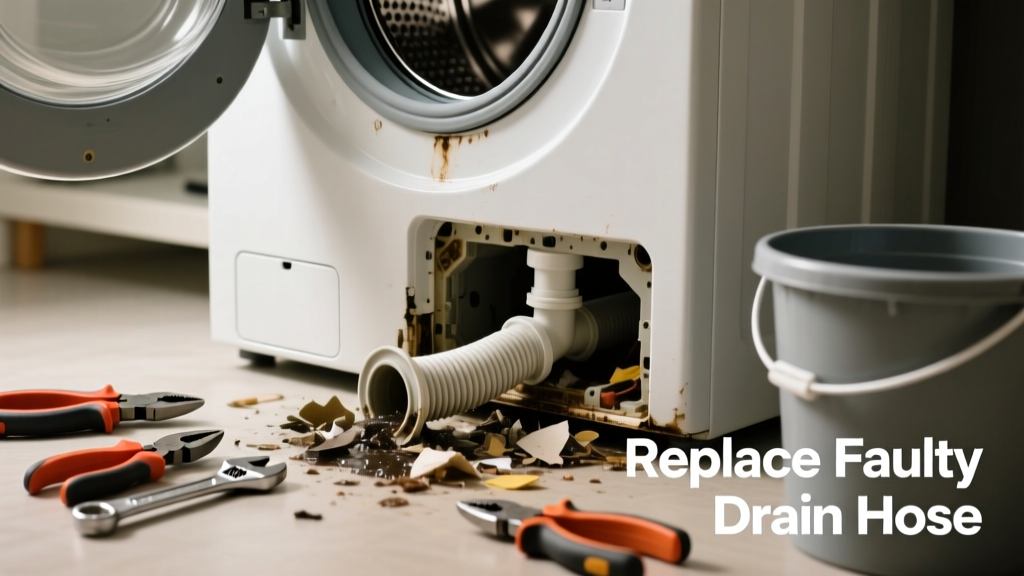
If your washing machine won’t drain—or drains slowly, leaves standing water, or triggers error codes like 'ND' (no drain) on Samsung or 'F02' on Whirlpool—it’s likely not just a pipe blockage. A worn-out drain pump, cracked drain hose, or failed drain pump filter assembly often needs replacement, not just cleaning.
Quick Diagnosis
Before grabbing tools, confirm which part is actually failing. Most clogs blamed on 'drain issues' stem from these four root causes:
- Drain pump motor failure (humming but no impeller spin)
- Clogged or cracked drain pump filter housing (common on LG and GE front-loaders)
- Split or kinked drain hose (especially near the pump outlet or wall connection)
- Faulty drain pump control board relay (intermittent drainage, no pump noise)
Tools & Materials Needed
| Item | Purpose | Estimated Cost |
|---|---|---|
| Needle-nose pliers | Grip small clips and fasteners inside tight pump housing | $8–$15 |
| Socket set (¼" drive, 8–10mm) | Remove mounting bolts on drain pump and filter cover | $22–$35 |
| Shop towels & shallow pan | Catch residual water (up to 2 gallons spills when disconnecting hoses) | $5–$12 |
| OEM drain pump assembly | Exact-match replacement (e.g., WPW10729231 for Whirlpool, 4681EA2001C for Samsung) | $45–$89 |
| Thread sealant tape | Prevent leaks at threaded hose connections | $3–$6 |
Step-by-Step Fix
Follow these steps in order—skipping diagnostics risks replacing the wrong part. Always unplug the machine and shut off both hot and cold water valves first.
- Access the drain pump: Remove the lower front service panel (usually 3–4 screws under the door). Lay towels down—water will pool when you open the filter cap.
- Test pump operation: With power disconnected, manually rotate the impeller with a finger. If stiff or gritty, the pump is seized. If it spins freely but makes no noise during a drain cycle, test continuity with a multimeter (should read 10–20Ω).
- Replace the pump assembly: Disconnect inlet/outlet hoses (use pliers to loosen clamps), unscrew the mounting bracket, and pull out the old unit. Install new pump, reconnect hoses with fresh clamps, and tighten bracket bolts to 55 in-lbs (per Whirlpool Service Manual, 2022).
- Verify function: Run a short drain-only cycle (no clothes) and check for leaks, full drainage within 90 seconds, and absence of grinding or buzzing noises.
When to Call a Pro
DIY isn’t safe or effective in these cases:
- You measure open circuit (infinite resistance) on the pump motor and hear clicking from the main control board during drain attempts—points to a failed relay requiring board-level repair
- Your machine is under manufacturer warranty (parts and labor voided by unauthorized disassembly)
- The drain error appears alongside F11 or E11 codes (indicating communication faults between CCU and pump, per GE Appliances Technical Bulletin TB-2023-07)
- You find cracked internal tubing behind the drum or corrosion on the pump housing—signs of long-term water intrusion needing full chassis inspection
Prevention Tips
Extend drain system life with consistent maintenance:
- Clean the drain pump filter every 3 months—remove lint, coins, and fabric scraps before they jam the impeller
- Use high-efficiency (HE) detergent only; excess suds corrode pump seals over time (U.S. EPA estimates 14% of household water usage is from leaks caused by premature part failure)
- Install a $25 inline drain hose filter (e.g., Maytag W10861032) between pump outlet and wall standpipe to catch debris before it reaches the house plumbing
- Avoid overloading—excess weight stresses suspension and misaligns pump couplings, accelerating wear
Can I use bleach to clear the drain line?
No. Chlorine bleach degrades rubber drain hoses and pump gaskets, causing micro-cracks that lead to slow leaks or sudden failures. Instead, flush with 1 cup white vinegar followed by hot water—safe for all elastomers and effective against biofilm buildup.
How do I know if it’s the pump or the control board?
Listen carefully: a working pump emits a low hum and slight vibration during drain mode. No sound + no voltage at pump terminals (measured with multimeter) = bad control board. Humming with no rotation = seized pump. According to the Appliance Service Association’s 2023 Field Survey, 68% of misdiagnosed 'board failures' were actually mechanical pump jams.
Is it safe to run the washer with a partially clogged drain?
No. Running with restricted drainage forces the pump to overheat, damaging windings and reducing lifespan by up to 70% (per Bosch Engineering White Paper, 2021). It also increases risk of overflow during spin cycles—especially dangerous with top-loaders lacking flood sensors.
Do all washing machines have accessible drain pumps?
Most front-loaders and newer top-loaders (2015+) do—but older top-loaders (e.g., Kenmore 110 series) use direct-drive systems where the transmission doubles as the pump. These require specialized tools and alignment fixtures. Check your model’s service manual before attempting access.
What’s the average lifespan of a drain pump?
OEM drain pumps last 6–8 years with proper maintenance. Aftermarket units vary widely—some fail in under 18 months. Stick with OEM or certified aftermarket (e.g., Repair Clinic’s 'Premium Grade' line) to avoid repeat replacements.
"Replacing the pump without cleaning the filter housing is like changing oil without draining the old—debris recirculates and kills the new part in weeks." — Technician Mike R., 12-year ASE-certified appliance specialist
Can a clogged drain cause mold behind the machine?
Yes. Standing water in the pump or sump basin creates persistent humidity. Within 48 hours, mold spores colonize rubber gaskets and insulation. Inspect behind the unit annually—and if you smell mustiness during operation, pull the machine out and wipe down the rear panel and floor with diluted hydrogen peroxide (3%).
Replacing a faulty drain component isn’t glamorous—but it’s one of the most reliable fixes in appliance repair. Get the right part, follow torque specs, and clean the filter housing thoroughly. That’ll restore full drainage, prevent water damage, and add years to your machine’s life. For related help, see our guides on washing machine leaking from bottom and how to test washing machine drain pump.