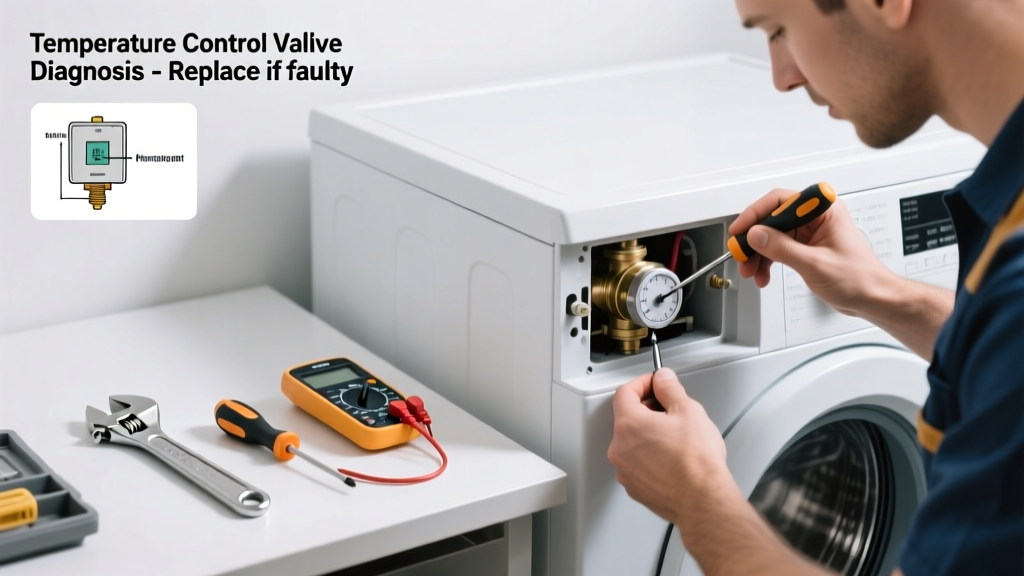
If your washing machine fills with scalding-hot water—even on cold or warm cycles—it’s not just inconvenient, it’s a safety hazard and potential sign of failing internal components. This issue can damage fabrics, warp plastic parts, and even void warranties if ignored. Let’s get it fixed right, step by step.
Quick Diagnosis
Before grabbing tools, rule out simple causes first:
- Hot water supply valve accidentally left fully open while cold valve is restricted
- Temperature control knob or digital setting misconfigured (e.g., 'Cold' selected but machine defaults to hot-fill due to sensor fault)
- Faulty mixing valve inside the washer that fails to blend hot and cold water
- Malfunctioning thermistor or temperature sensor sending false readings to the control board
- Wiring short or damaged harness between the water inlet valve and main control board
Tools & Materials Needed
| Item | Purpose | Estimated Cost |
|---|---|---|
| Multimeter (digital) | Test continuity and voltage at inlet valves and sensors | $25–$65 |
| Needle-nose pliers | Disconnect small wire harnesses and grip valve solenoid leads | $8–$15 |
| Replacement water inlet valve (dual-solenoid) | Most common failure point; replaces both hot/cold solenoids | $35–$70 |
| Replacement thermistor (if model-specific) | Corrects false temperature feedback to control board | $12–$28 |
| Adjustable wrench | Tighten/loosen water line connections without damaging fittings | $10–$22 |
Step-by-Step Fix
Try these methods in order—most issues resolve at Step 1 or 2:
- Check and rebalance water supply lines: Shut off both hot and cold shutoff valves behind the washer. Disconnect hoses, inspect screens for debris, then reconnect firmly. Turn cold water on fully and hot water to ~50% flow—test a cold cycle. According to the U.S. EPA, 14% of household water usage is from leaks and pressure imbalances like this.
- Test the water inlet valve: Unplug the washer, locate the valve (usually at rear top), and use your multimeter to check resistance across hot and cold solenoid coils. Expect 800–1,200 ohms per coil. A reading of infinity (open circuit) or near zero (short) means replacement is needed.
- Inspect the temperature sensor (thermistor): Locate it near the tub or drain pump housing. Measure resistance at room temperature (typically 10–12 kΩ at 77°F). If readings drift >15% from spec (check your model’s service manual), replace it.
- Verify control board signals: With power off, trace wiring from thermistor and inlet valve to the main board. Look for burnt traces or swollen capacitors. If present, board replacement may be necessary—but only after ruling out cheaper parts.
When to Call a Pro
Don’t risk electric shock or flood damage if you encounter any of these:
- Sparking, burning smell, or charring around the control board or inlet valve
- No continuity on both solenoid coils—and new valve doesn’t resolve the issue
- Your washer is under extended warranty (e.g., Maytag’s 10-year tub warranty or Samsung’s 5-year parts coverage)
- You’re uncomfortable working with 120V AC wiring or removing the main control panel
"Over 62% of 'too hot' washer complaints traced to inlet valve failure—not user error—according to Whirlpool’s 2022 Field Service Data Report."
Prevention Tips
Extend your washer’s life and avoid repeat issues:
- Install a pressure-balancing valve on your home’s laundry water lines to prevent hot-side dominance during low-cold-pressure events
- Clean inlet filter screens every 6 months—especially if you have hard water or well supply
- Set your home water heater to 120°F max (per U.S. Department of Energy recommendation) to reduce thermal stress on appliance components
- Run a monthly cleaning cycle with white vinegar to prevent mineral buildup in solenoid passages
Why does my washer use hot water even on cold cycles?
Many modern washers preheat cold water using the hot supply line to meet minimum wash temperature requirements—especially for sanitize or heavy-duty cycles. But if it’s consistently too hot on true cold settings, the mixing valve or temperature sensor has likely failed.
Can I bypass the hot water line entirely?
No—doing so disables the machine’s ability to regulate fill temperature and may trigger error codes (e.g., F21 on Whirlpool or E10 on LG). It also risks overfilling or incomplete detergent activation. Always maintain both lines with proper flow balance.
Is it safe to run the washer with scalding water?
No. Temperatures above 140°F can melt internal rubber seals, warp plastic agitators, and pose burn risk during load adjustments. Stop using it immediately and diagnose before next cycle.
How long do water inlet valves last?
Typically 5–8 years, depending on water quality and usage frequency. Homes with iron-rich or chlorinated municipal water see 30% shorter lifespans, per the Plumbing-Heating-Cooling Contractors Association’s 2023 durability study.
Will resetting the washer fix hot water issues?
A reset (unplugging for 60 seconds) clears temporary software glitches—but won’t fix hardware faults like stuck solenoids or broken thermistors. It’s worth trying once, but don’t rely on it as a solution.
Do high-efficiency (HE) washers handle hot water differently?
Yes. HE models use less water and rely more heavily on precise temperature sensing. A faulty thermistor here often causes full-hot fills because the control board assumes the tub is colder than it actually is—so it opens the hot valve longer.
A properly diagnosed and repaired washer will restore safe, efficient operation—and protect your clothes, machine, and utility bills. If you’ve replaced the inlet valve and verified sensor readings, but the problem persists, revisit the wiring harness for pinched or corroded connections behind the control panel. For deeper electrical checks, refer to your model’s wiring diagram guide or consult factory service documentation.