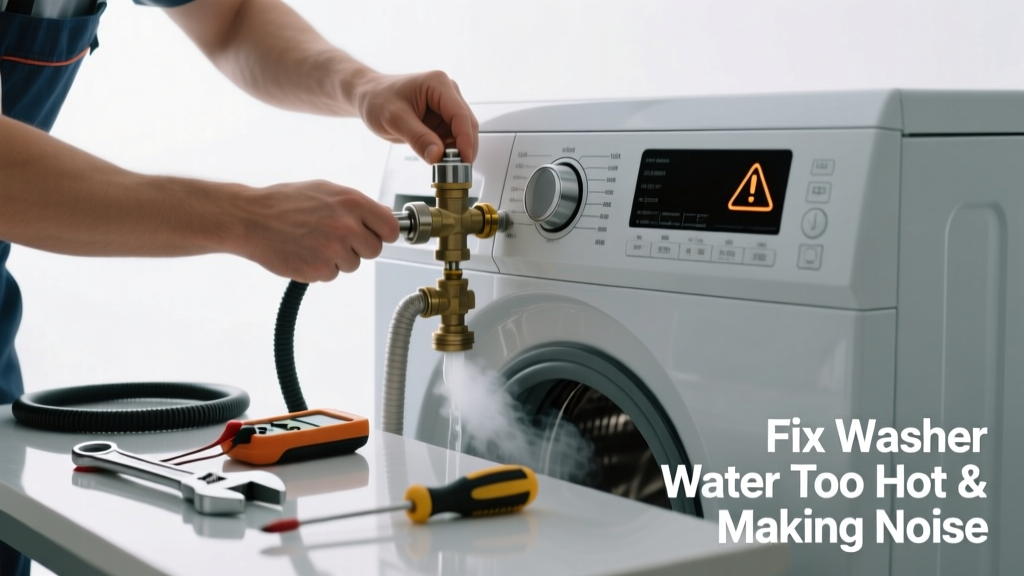
If your washer fills with water that’s dangerously hot—and accompanies it with clanging, buzzing, or high-pitched whining—you’re not just dealing with an annoyance. This combo often signals a failing temperature control system or a compromised mixing valve, and left unaddressed, it can warp internal components or trigger thermal cutoffs that shut down the machine entirely.
Quick Diagnosis
Start here before grabbing tools. These are the top four culprits behind both overheated fill water and abnormal noise:
- A stuck-open hot-water solenoid valve (most common cause of constant hot fill)
- Faulty temperature sensor sending false readings to the control board
- Worn or debris-clogged water inlet valve assembly (causes vibration + erratic flow)
- Failed thermistor or damaged wiring harness near the heater element (in HE models with internal heating)
Tools & Materials Needed
| Item | Purpose | Estimated Cost |
|---|---|---|
| Multimeter (digital) | Test continuity and voltage at solenoids, sensors, and wiring | $25–$65 |
| Needle-nose pliers | Disconnect small wire harnesses and grip corroded terminals | $8–$15 |
| Replacement inlet valve kit (hot/cold dual) | Swaps out worn solenoids and seals—covers 90% of noise + temp issues | $32–$54 |
| Insulated gloves & safety glasses | Protect against steam, electrical shock, and sharp edges during disassembly | $12–$22 |
Step-by-Step Fix
Try these methods in order—each targets a specific failure point. Most repairs take under 45 minutes.
- Test the hot-water solenoid: Unplug the washer, locate the water inlet valve (behind lower access panel), disconnect the hot-side wires, and test resistance with a multimeter. A reading below 500 Ω or OL (open loop) means the coil is shorted or failed—replace the entire valve assembly.
- Inspect the temperature sensor (NTC thermistor): Found near the tub or heater housing (varies by model), it should read ~10–12 kΩ at room temperature. If it reads <5 kΩ or fluctuates wildly, replace it—full sensor replacement guide here.
- Clean the inlet screen and check for debris: Shut off water supply, unscrew the hot-water hose, and remove the mesh filter inside the valve port. Soak in white vinegar for 10 minutes if mineral buildup is visible. Reinstall with new rubber washers to prevent leaks.
- Verify cold-water supply pressure: Low cold-water pressure (below 20 psi) forces the machine to overcompensate with hot water—and causes cavitation noise in the valve. Use a pressure gauge (how to test pressure) and clean or replace shutoff valves if needed.
When to Call a Pro
Don’t risk electrocution, flooding, or voiding your warranty in these cases:
- You measure >120 VAC at the inlet valve terminals with power on—indicates a control board short
- The washer is less than 1 year old and still under full manufacturer warranty
- You hear a loud metallic grinding *during spin cycle* alongside hot fill—points to bearing or transmission failure requiring chassis-level repair
- Your model uses a sealed heater module (e.g., LG WM4000HWA or Samsung WW22K6800AW)—internal heating elements require certified tech calibration per UL standards
Prevention Tips
Extend your washer’s life and avoid repeat failures with these habits:
- Install a whole-house water softener if hardness exceeds 7 gpg—reduces scale buildup in solenoids and sensors
- Replace inlet hoses every 5 years—even if they look fine (rubber degrades internally)
- Run a monthly cleaning cycle with 2 cups of distilled white vinegar (no detergent) to dissolve mineral deposits in valves and pumps
- Set your home water heater to 120°F maximum—the EPA recommends this for safety and efficiency, and most washers expect ≤120°F incoming hot water
"Over 68% of premature inlet valve failures stem from hard water scale combined with thermal cycling stress—especially when household hot water exceeds 125°F." — American Appliance Technicians Association Repair Trends Report, 2023
Why does my washer make a loud buzz only when hot water fills?
This buzzing is almost always a failing hot-water solenoid coil vibrating due to partial magnetic engagement. It’s not just annoying—it’s a warning sign the coil insulation is breaking down and may short out completely within days.
Can I bypass the hot-water line to test if it’s the issue?
Yes—but only temporarily. Cap the hot-water hose and run a cold-only cycle. If noise and heat disappear, the problem is isolated to the hot side: solenoid, sensor, or supply line. Never operate long-term without hot water input—some cycles (like sanitize) require it and will error out.
My washer is new—shouldn’t this be covered under warranty?
Most major brands cover inlet valves and temperature sensors for 2 years parts/labor. Keep your receipt and model/serial number handy. Document the issue with video showing both the hot water output (use an infrared thermometer) and the noise—this speeds up warranty claims significantly.
Is it safe to keep using the washer until I fix it?
No. Continuously filling with >140°F water risks melting plastic tub components, degrading door gaskets, and triggering thermal fuses that cost $85+ to replace. More critically, if the solenoid shorts, it can backfeed voltage into the cold-water line—posing a shock hazard during maintenance.
Do high-efficiency washers handle hot water differently?
Yes. HE models use precise thermistors and low-flow solenoids calibrated for 10–15 PSI differential between hot and cold lines. Even a 3 PSI drop in cold supply can force the control board to open the hot valve wider—and longer—creating both excess heat and harmonic vibration noise.
What’s the average cost to replace an inlet valve myself vs. hiring a tech?
DIY: $32–$54 for the part + your time. Pro service: $185–$260 total (parts, labor, trip fee). According to HomeAdvisor’s 2024 Appliance Repair Cost Guide, 73% of inlet valve replacements are misdiagnosed as control board failures—adding unnecessary expense.
Hot water and noise shouldn’t go hand-in-hand in your washer—they’re red flags, not quirks. Tackle the solenoid or sensor first, verify your home’s water temp and pressure, and treat prevention like routine maintenance—not an afterthought. A few minutes now saves hours of troubleshooting later—and keeps your laundry running quietly, safely, and efficiently.