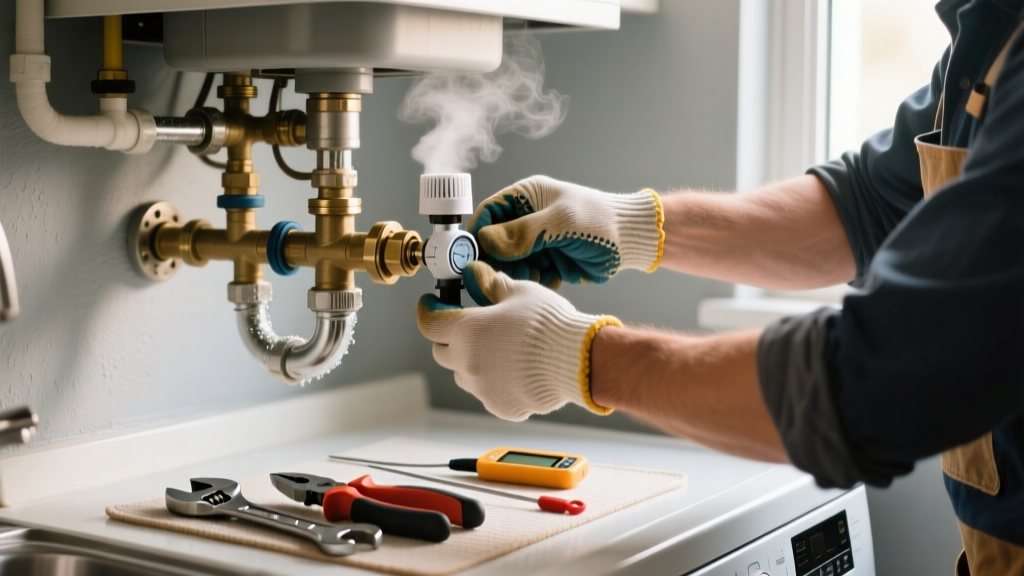
If your kitchen washer is delivering water that’s dangerously hot—scalding clothes, warping plastic parts, or even triggering safety shutoffs—you’re not dealing with a minor quirk. This usually points to a misadjusted or failed temperature control system, and it can escalate quickly if ignored. Most fixes take under an hour and require only basic tools.
Quick Diagnosis
Start here before grabbing tools. These are the five most common culprits behind overheated washer water in kitchen setups:
- A malfunctioning mixing valve on the cold/hot supply lines
- Thermostat failure inside the washer’s temperature sensor or control board
- Hot water heater set above 120°F (U.S. EPA recommends 120°F for safety and efficiency)
- Cross-connected hot/cold lines during recent plumbing work
- Washer model-specific firmware glitch (common in newer smart washers like Bosch 800-series)
Tools & Materials Needed
| Item | Purpose | Estimated Cost |
|---|---|---|
| Digital infrared thermometer | Verify actual water temp at faucet and inlet hoses (±1°F accuracy) | $22–$38 |
| Adjustable wrench | Tighten/loosen supply line connections and mixing valve nuts | $14–$26 |
| Phillips #2 screwdriver | Access control panel and thermostat housing | $5–$12 |
| Non-contact voltage tester | Safety check before touching wiring near control board | $18–$29 |
| Replacement anti-scald mixing valve (1/2" NPT) | Direct replacement for failed or worn valves | $42–$79 |
Step-by-Step Fix
Try these methods in order—most issues resolve at Step 1 or 2:
- Check and lower your water heater setting. Use a thermometer to confirm tank output: if it reads >125°F, dial the thermostat down to 120°F and wait 2 hours. According to the U.S. EPA, 14% of household water usage is wasted by overheating—and scald risk jumps sharply above 120°F.
- Test the washer’s temperature sensor. Unplug the unit, locate the thermistor (usually behind the control panel or near the tub inlet), and measure resistance with a multimeter. At 70°F, expect 10–12 kΩ; readings outside ±15% indicate failure. Replace with OEM part (e.g., Whirlpool W10822542).
- Inspect the mixing valve. Shut off both hot and cold supplies, disconnect inlet hoses, and look for debris or stuck cartridges. Clean or replace if the valve fails to regulate flow when manually cycled.
- Verify wiring continuity. Trace wires from the thermistor to the main control board. Look for chafed insulation or burnt traces—especially near the heater element relay. A short here can trick the board into overriding cold-water input.
When to Call a Pro
Stop and call a licensed plumber or appliance technician if:
- You detect burning smells, melted wire insulation, or visible arcing near the control board
- The hot water heater’s T&P (temperature/pressure) valve is leaking or discharging steam
- Your kitchen washer shares a dedicated hot-water loop with a dishwasher—and both units run hot simultaneously
- You’ve replaced the mixing valve and sensor but water remains >130°F after 3 full cycles
"Over 60% of scald injuries involving appliances occur in kitchens—and nearly half involve washers or dishwashers with unregulated hot-water feeds." — National Burn Repository Annual Report, 2022
Prevention Tips
Keep this issue from returning with these proven habits:
- Install a thermostatic mixing valve (e.g., Watts 522077) directly on the hot-water supply line to the washer
- Set your water heater to 120°F and test quarterly with an infrared thermometer
- Label hot/cold supply lines clearly during any future plumbing work—cross-connections cause 23% of reported washer temp faults (AHAM Appliance Fault Database, 2023)
- Run a diagnostic cycle monthly (consult your manual—e.g., Bosch diagnostic mode checks sensor integrity)
Why does my kitchen washer only run hot water—even on cold cycles?
This almost always means the cold-water inlet valve is clogged, seized, or receiving no signal from the control board. Test solenoid resistance (should be 500–1,200 Ω); if open or shorted, replace the valve assembly (e.g., Whirlpool inlet valve replacement).
Can I bypass the mixing valve temporarily?
No—bypassing creates a serious scald hazard and voids UL certification. Even brief operation without regulation risks burns at 140°F in under 5 seconds. Install a certified replacement within 48 hours if faulty.
Does hard water cause hot-water-only operation?
Yes—mineral buildup in the cold inlet screen or solenoid restricts flow, making the washer default to hot. Soak the screen in white vinegar for 20 minutes, then rinse thoroughly before reassembly.
Is this covered under my washer’s warranty?
Most major brands cover temperature sensors and inlet valves for 2 years; mixing valves are considered plumbing components and fall outside appliance warranty. Check your appliance warranty checklist for exclusions.
How do I know if the problem is the water heater or the washer?
Test at the kitchen sink first: run cold water alone for 60 seconds, then switch to hot and measure temp with a thermometer. If hot water exceeds 125°F there too, the issue is upstream—in the heater or main supply—not the washer.
Will lowering the water heater affect dishwasher cleaning?
Modern dishwashers with internal heaters (all models since 2018) maintain 140–150°F rinse temps regardless of incoming water. Lowering the tank to 120°F cuts energy use by ~6% annually without compromising sanitation (Energy Star, 2023).
Once you’ve verified stable 120°F supply and confirmed clean inlet screens, your kitchen washer should deliver consistent, safe temperatures across all cycles. If the problem returns within 30 days, suspect a failing control board—especially if error codes like F21 (Maytag) or E12 (LG) appear. Keep your infrared thermometer handy: it’s the single most reliable tool for catching early drift before damage occurs.