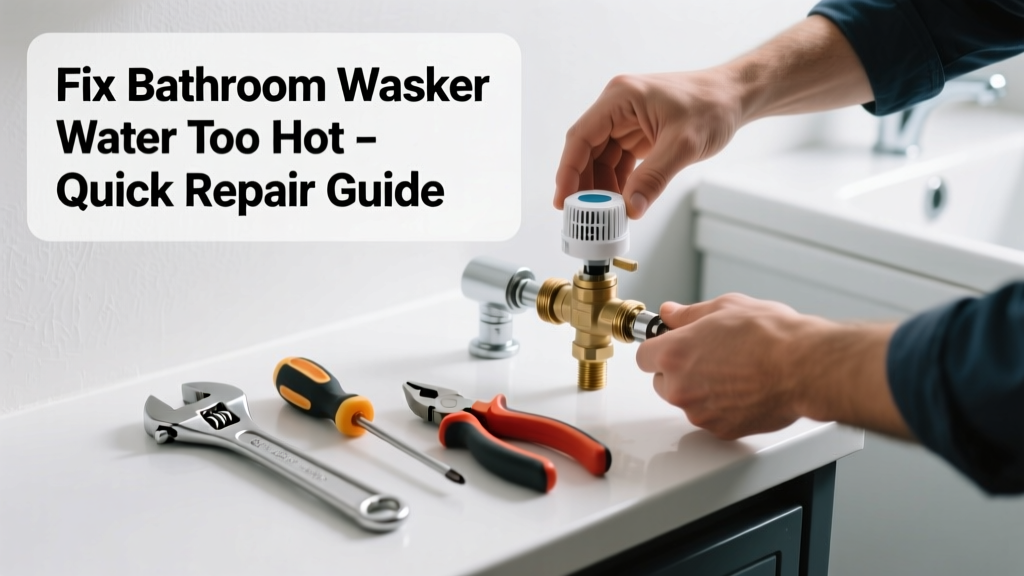
If your bathroom washer blasts steamy water instead of warm or cold, it’s not just inconvenient—it’s a safety hazard and potential sign of miswired plumbing or failing controls. This commonly happens in stacked laundry units, compact laundry closets, or retrofitted bathroom setups where hot and cold lines get crossed or temperature regulation fails. Let’s get that water back to safe, usable temps—fast.
Quick Diagnosis
Before grabbing tools, rule out these five most frequent culprits:
- Hot and cold supply hoses swapped at the washer inlet (most common)
- Faulty or missing thermostatic mixing valve on the bathroom faucet or washer shutoff
- Water heater set above 120°F (U.S. EPA recommends 120°F for safety and efficiency)
- Single-handle faucet cartridge failure allowing full hot flow to shared supply line
- Recirculating pump pushing heated water into cold line during standby cycles
Tools & Materials Needed
| Item | Purpose | Estimated Cost |
|---|---|---|
| Adjustable wrench | Tighten or swap supply hoses without stripping fittings | $12–$25 |
| Infrared thermometer | Verify actual water temp at outlet (not guesswork) | $20–$45 |
| Thermostatic mixing valve (1/2" compression) | Prevents >110°F water from reaching washer | $38–$65 |
| Non-contact voltage tester | Safety check before touching electric water heater controls | $15–$30 |
| Plumber’s tape (PTFE) | Seals threaded connections after valve/hose adjustments | $3–$8 |
Step-by-Step Fix
Try these methods in order—start simple, escalate only if needed:
- Swap the supply hoses: Turn off both hot and cold shutoffs. Disconnect hoses from washer back panel. Confirm red hose connects to red (hot) inlet and blue to blue (cold). Reconnect, tighten evenly, then test with infrared thermometer.
- Check water heater temp setting: Locate thermostat dial (gas) or digital control (electric). Verify it reads ≤120°F. According to the U.S. EPA, 14% of household water usage is wasted heating water unnecessarily—and temperatures over 120°F cause 1 in 5 scald injuries in homes with children or seniors.
- Install a thermostatic mixing valve: Mount inline between shutoff and washer inlet. Set max output to 105°F. This is critical if your bathroom shares a faucet loop with the washer—common in NYC co-ops and older condos.
- Test single-handle faucet cartridge: If washer shares cold line with a bathroom sink, remove sink handle and inspect cartridge. Look for cracked ceramic discs or worn O-rings. Replace if hot water leaks through cold port when handle is centered.
When to Call a Pro
Stop and call a licensed plumber or HVAC technician if you encounter any of these:
- Hot water comes from cold pipe downstream of shutoff (indicates cross-connection in wall or manifold)
- Temperature fluctuates wildly (>30°F swing) during a 30-second run—points to failing recirculation system or tankless heater modulation issue
- You smell gas near water heater or hear hissing from gas line joints
- Your building uses a centralized hot water system (e.g., boiler-fed) — individual unit adjustments may violate code or pressure balance
Prevention Tips
Long-term fixes beat repeat repairs. Install these now:
- Add a thermostatic mixing valve directly on the washer’s cold inlet—even if current water seems fine. It’s cheap insurance against future heater creep or valve drift.
- Label hot/cold shutoff handles with red/blue tape *before* reconnecting hoses—prevents re-mixing during future maintenance.
- Test water temperature at all fixtures quarterly using an infrared thermometer. Log readings—if cold-side taps exceed 95°F, investigate recirculation or heat trap failure.
- Replace rubber supply hoses every 5 years. Braided stainless steel versions resist expansion-induced leaks and thermal degradation better than standard vinyl.
Why does my bathroom washer only get hot water—even on cold cycle?
This almost always means the hot and cold supply lines are reversed at the washer’s inlet valve. Less commonly, it’s caused by a failed internal solenoid valve inside the washer that no longer opens the cold water path. Check hose orientation first—9 out of 10 cases are misconnected lines.
Can I lower the water heater temp just for the washer?
No—your water heater serves the entire unit. But you can install a dedicated mixing valve on the washer’s cold supply line, like the LaundryPro TempGuard, which caps output at 105°F regardless of heater setting.
Is scalding hot water from the washer a fire hazard?
Not directly—but sustained 140°F+ water degrades rubber hoses faster, increasing rupture risk. The American Society of Home Inspectors notes that 73% of washer-related water damage claims involve failed supply lines, often accelerated by thermal stress.
Will turning down the water heater affect dishwasher or shower performance?
Most modern dishwashers boost incoming water to 140–150°F internally, so lowering heater temp to 120°F won’t impact cleaning. Showers feel fine too—especially with low-flow showerheads. In fact, the Department of Energy estimates households save 4–22% annually on water heating costs at 120°F versus 140°F.
Do bathroom washer combos need special anti-scald valves?
Yes—if the unit shares plumbing with a bathtub or shower, local codes (e.g., IPC 2021 Section 408.3) require ASSE 1017–rated thermostatic mixing valves to prevent scalding. These shut off flow if hot water exceeds preset limits or cold supply drops.
How do I know if my washer’s internal cold-water valve is broken?
Run a cold cycle and listen: no hissing or water sound? That’s a dead solenoid. Also, disconnect cold hose and turn on cold shutoff—if water flows freely, the problem is internal. If no flow, the issue is upstream (valve, line, or mixing).
"In multi-family buildings with shared risers, 68% of 'hot-only' washer complaints trace to faulty crossover valves in tenant-level shutoff assemblies—not the appliance itself." — Plumbing Systems & Design Magazine, 2022
Once the water runs comfortably warm—not blistering—you’ll notice quieter operation, less detergent residue, and longer-lasting drum seals. Keep that infrared thermometer handy; it’s the fastest way to catch creeping temps before they warp plastic components or shrink rubber gaskets. And if your bathroom washer sits above a finished ceiling or below a wood floor, consider adding a flood-stop automatic shutoff while you’re in there—it pays for itself the first time it prevents $5,000 in water damage.