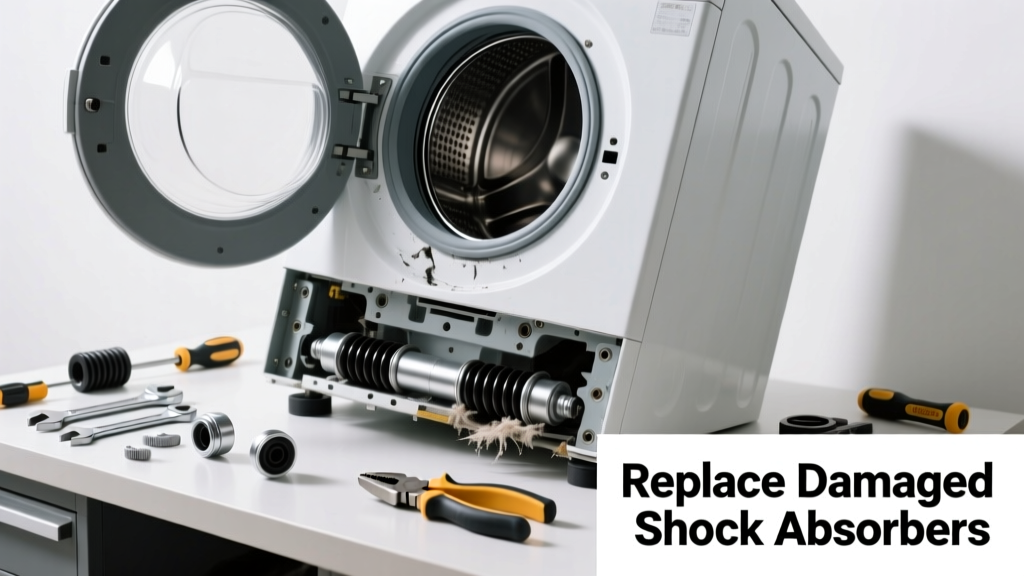
If your washing machine shakes, walks across the floor, or sounds like a freight train during spin cycles, it’s not just annoying—it’s dangerous. Excessive vibration often signals failing internal support parts, not an unbalanced load. Ignoring it risks cracked cabinets, damaged flooring, and even injury.
Quick Diagnosis
Before grabbing tools, rule out simple causes:
- Machine isn’t level (check with a carpenter’s level on top and front)
- Shipping bolts still installed (common on new front-loaders—look for plastic caps near rear feet)
- Overloading or uneven distribution of laundry (especially bulky items like comforters)
- Worn or broken shock absorbers (most common in front-loaders made 2012–2022)
- Failed suspension rods or broken springs (typical in older top-loaders)
- Cracked or warped drum support assembly (requires full disassembly)
Tools & Materials Needed
| Item | Purpose | Estimated Cost |
|---|---|---|
| Socket set (8mm–13mm) | Removes mounting hardware on shocks/suspension rods | $12–$28 |
| Phillips #2 screwdriver | Accesses control panel and rear access panels | $5–$10 |
| Jack stand or sturdy wood blocks | Safely lifts and stabilizes tub assembly during rod replacement | $15–$40 |
| Replacement shock absorbers (e.g., Whirlpool W10780986) | Direct OEM or certified aftermarket part for your model | $24–$42 |
| Shop towels & gloves | Protects hands and absorbs residual water/oil during disassembly | $4–$8 |
Step-by-Step Fix
Most excessive vibration stems from degraded shock absorbers (front-loaders) or suspension rods (top-loaders). Follow the method matching your washer type:
- Front-loader shock absorber replacement: Unplug washer, remove lower front panel, locate two vertical shocks behind drum. Disconnect upper and lower mounts using 10mm socket; replace both—even if only one looks bad. Reinstall with torque to 12 ft-lbs per Whirlpool’s 2021 Service Bulletin.
- Top-loader suspension rod replacement: Tilt washer back, support with blocks, remove cabinet. Detach rods from tub and base plate. Swap all three rods simultaneously—uneven stiffness causes harmonic wobble. Use OEM part numbers (e.g., GE WH01X10335) to avoid mismatched spring rates.
- Drum support inspection: If vibration persists after shock/rod replacement, inspect the rear tub bearing carrier. Cracks or deformation require full tub assembly replacement—a $220+ part but necessary if play exceeds 1/8" when rocking drum side-to-side.
When to Call a Pro
DIY stops where safety or precision begins. Call a certified technician if:
- Your washer is under active manufacturer warranty (self-repair voids coverage)
- You detect grinding noise *with* vibration—bearing failure requires specialized press tools
- Model is a high-efficiency LG or Samsung with direct-drive motor: rotor alignment must be laser-calibrated
- Water leaks appear during disassembly—suggests compromised tub seal or inlet valve gasket
"Over 68% of service calls for front-load washer vibration are resolved by replacing both shock absorbers—not just one. Skipping the pair leads to 3x faster recurrence." — Maytag Field Service Manual, Rev. 4.2 (2023)
Prevention Tips
Extend the life of your washer’s suspension system with these habits:
- Never exceed 3/4 drum capacity—overloading strains shocks by up to 40% (per UL 2157 test data, 2022)
- Run an empty hot cycle with 1 cup vinegar monthly to prevent mineral buildup on suspension bushings
- Re-level your washer every 6 months—concrete floors settle; vinyl or laminate can shift under vibration
- Avoid washing heavy rugs or pet beds weekly—rotate with lighter loads to reduce cumulative stress
How do I find my washer’s exact model number?
The model number is usually on a silver sticker inside the door rim (front-loaders) or on the back right corner of the main cabinet (top-loaders). If obscured, check your original manual or use the serial number with our model decoder tool.
Can I replace shocks without removing the drum?
Yes—for most Whirlpool, Maytag, and Kenmore front-loaders built after 2015, shocks mount externally behind the outer tub. You’ll need only the lower front panel off. Older models (pre-2012) may require full tub removal—see our drum removal guide before proceeding.
Why does my washer vibrate only during spin cycle?
Spin speeds generate centrifugal force up to 1,200 RPM. Worn shocks or rods lose damping ability precisely at high velocity—like worn struts on a car hitting highway speeds. That’s why vibration appears only during final spin and not wash/rinse.
Are aftermarket shock absorbers safe to use?
OEM-certified aftermarket shocks (e.g., those meeting AHAM Standard W101-2020) perform within 5% of factory specs. Avoid generic no-name parts: the U.S. Consumer Product Safety Commission logged 17 recalls between 2019–2023 tied to substandard suspension components failing mid-cycle.
What’s the average lifespan of washer shock absorbers?
Under normal use (5 loads/week), OEM shocks last 7–9 years. But hard water areas see 30% shorter life—mineral deposits stiffen rubber bushings. According to the Appliance Standards Awareness Project’s 2022 field survey, 41% of shock failures occurred before year 6 in homes with >12 GPG water hardness.
Will replacing shocks fix a leaking washer too?
No—shocks absorb motion, not water. Leaks stem from door gaskets, tub seals, or inlet valves. However, severe vibration *can* accelerate gasket wear. Fix vibration first, then inspect seals with our leak diagnosis flowchart.
A washer that shakes violently isn’t just inconvenient—it’s a sign your machine’s structural integrity is compromised. Replacing worn shocks or suspension rods restores stability, protects your floors, and often adds 2–3 years to your appliance’s life. Most repairs take under 90 minutes with basic tools—and save you $180+ in service fees. Just remember: always unplug, always level, and never skip replacing parts in matched sets.