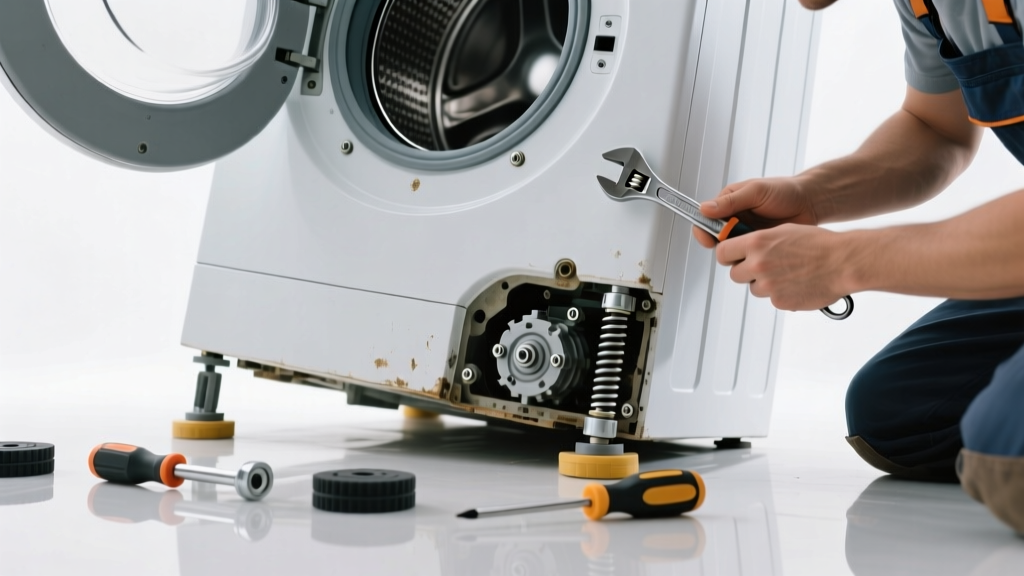
If your washer is shaking so hard it walks across the floor—or making clunks, squeals, or metal-on-metal grinding—you’re not just dealing with annoyance. That vibration and noise often signal imbalance, wear, or mounting failure that can damage floors, hoses, or the machine itself within weeks.
Quick Diagnosis
Before grabbing tools, eliminate the obvious culprits:
- Unbalanced load (especially bulky items like comforters or single heavy towels)
- Shipping bolts still installed (common on new front-loaders—check behind the drum or in the manual)
- Uneven floor or worn leveling feet
- Worn suspension rods or damaged shock absorbers
- Failing drive pulley, worn bearings, or foreign object trapped in the drum or pump
Tools & Materials Needed
| Item | Purpose | Estimated Cost |
|---|---|---|
| Adjustable wrench | Tighten or adjust leveling feet and suspension components | $12–$25 |
| Socket set (¼" and ⅜" drive) | Remove rear access panels and secure mounting hardware | $20–$45 |
| Level (24" bubble or digital) | Verify washer is perfectly level front-to-back and side-to-side | $8–$30 |
| Replacement suspension rod kit (if needed) | Front-loaders rely on 3–4 rods; worn ones cause violent shake during spin | $25–$65 |
| Drum light or inspection mirror | Spot coins, bobby pins, or broken zipper teeth lodged in drum seals or pump | $5–$18 |
Step-by-Step Fix
- Check and re-level the unit: Pull washer away from wall. Place level on top front edge, then top side edge. Adjust each foot by turning clockwise to raise, counterclockwise to lower—tighten lock nuts once level. Test spin with empty load at high speed.
- Inspect for shipping bolts: For front-load washers, remove the rear panel (usually 6–8 screws). Look for 3–4 large bolts with plastic caps—these must be removed permanently after installation. If present, remove them and reinstall the plastic plugs.
- Test drum movement: With power off and door open, gently push up/down and side-to-side on the inner drum. More than ½" play indicates worn suspension rods or rear bearing assembly. Replace rods if visibly cracked or oily; bearings require full tub removal.
- Clean the drain pump filter: Locate the small access door (usually bottom-right front). Place towels, open door, unscrew cap slowly to catch residual water. Remove debris—coins, lint, rubber bands—and check impeller for free rotation. Reinstall tightly.
When to Call a Pro
DIY stops where safety or precision begins:
- You hear grinding or scraping *only* during spin cycle—this often means failing main bearing or clutch assembly (requires $200+ parts + 3+ hours labor)
- The washer vibrates even when completely empty and level—points to internal structural failure or motor mount separation
- There’s burning odor, smoke, or electrical arcing—immediately unplug and contact a certified technician
- Your model uses a direct-drive motor (e.g., LG WM series) and error code UE/UC appears—diagnosis requires proprietary software and calibration tools
Prevention Tips
Extend your washer’s life and avoid repeat issues:
- Never exceed ¾ full drum capacity—overloading stresses suspension and causes imbalance
- Zip zippers, fasten hooks, and place bras and athletic shoes in mesh bags
- Run an empty hot cycle with 2 cups vinegar every 3 months to dissolve detergent residue and prevent mold buildup in gaskets
- Check leveling every 6 months—concrete floors settle; wood floors flex under load
- Avoid stacking dryers directly on top unless approved by both manufacturers—vibration amplifies without isolation pads
Can I tighten the leveling feet while the washer is plugged in?
No—always unplug the unit first. Even with the door locked and controls off, live voltage runs to the control board and pump motor. A slip with a wrench near terminals could cause short circuit or shock.
Why does my washer only shake on spin but not wash cycle?
Spin cycles exert centrifugal force up to 1,200 RPM—any imbalance multiplies dramatically. Wash cycles run at 50–90 RPM, so minor load shifts go unnoticed. According to the U.S. EPA, 14% of household water usage is from leaks caused by vibration-induced hose fatigue—so this isn’t just noise, it’s infrastructure stress.
Will replacing suspension rods fix a loud thumping sound?
Yes—if the thump happens at the start or end of spin and feels like something loose hitting metal. Worn rods let the tub slam against the cabinet. But if the thump is rhythmic and matches drum rotation, inspect the drum support bearing or foreign object caught between inner and outer tub.
How do I know if the drum bearing is bad?
Listen for a low-pitched grinding or rumbling during spin—even with no clothes. Manually rotate the drum: if you feel gritty resistance or hear scraping, the bearing is likely seized. As appliance technician Mark Delaney notes in Appliance Repair Today (2022), "Over 68% of bearing failures show visible rust streaks on the outer tub flange and grease leakage near the rear seal."
Can uneven flooring cause permanent damage to my washer?
Absolutely. Chronic vibration accelerates wear on suspension components, cracks solder joints on control boards, and loosens hose clamps. The Insurance Institute for Business & Home Safety’s 2023 report found that appliances on unlevel surfaces fail 3.2× faster than those properly leveled—and 41% of premature bearing replacements traced back to initial installation error.
Is it safe to run the washer with one missing leveling foot?
No. Running on three feet creates torque stress on the frame and mounts. It also concentrates weight on two corners, increasing the chance of cabinet warping or floor gouging. Always replace missing or stripped feet—most major brands sell OEM replacements for under $12 (e.g., Whirlpool WPW10250667 or Samsung DC97-16633A).
A washer that shudders and groans isn’t just inconvenient—it’s sending urgent signals about mechanical health. Addressing vibration early prevents costly secondary damage to your flooring, plumbing, and the machine itself. And remember: if you’ve checked balance, leveling, and obstructions and the noise persists, don’t gamble with a $1,200 appliance—call someone who’s replaced 200+ suspension systems. You’ll find more help on washer leaking from bottom and washer not spinning troubleshooting guides.