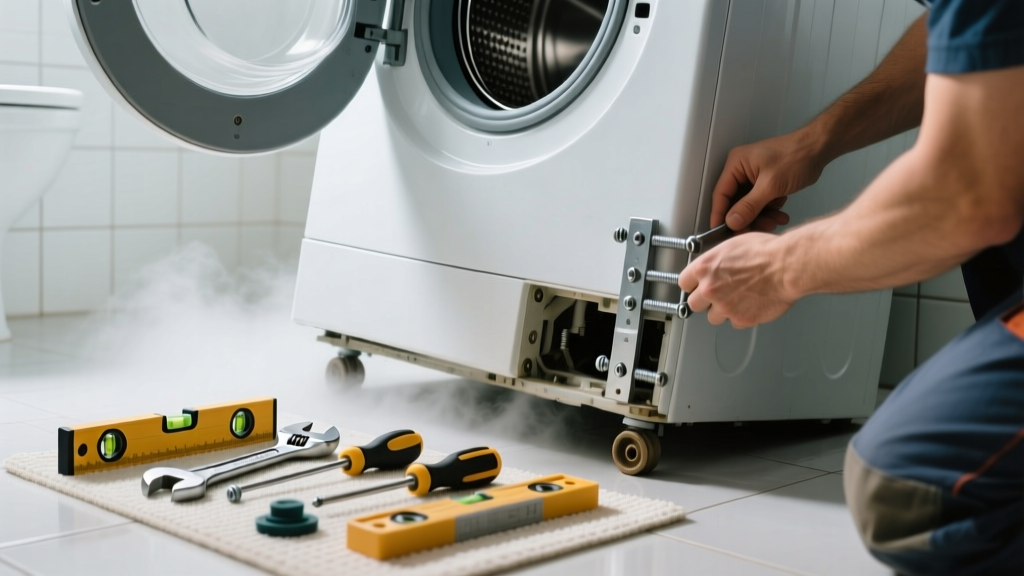
If your bathroom washer shakes like it’s trying to escape the floor—clattering, walking across tile, or making your sink rattle—you’re not just annoyed. You’re risking cracked grout, loose supply lines, and premature appliance failure. This isn’t normal operation; it’s a warning sign demanding attention.
Quick Diagnosis
Excessive vibration rarely has one cause—it’s usually a combo. Start here:
- Unlevel floor (common in older bathrooms with sagging subfloors)
- Washer feet not locked or improperly adjusted
- Overloaded or unbalanced drum (especially bulky items like bath mats or jeans)
- Missing or worn shock absorbers or suspension springs
- Loose mounting bolts connecting the tub to the frame
Tools & Materials Needed
| Item | Purpose | Estimated Cost |
|---|---|---|
| Digital level (24-inch) | Verifies precise leveling on uneven tile or concrete | $25–$45 |
| Adjustable wrench | Tightens mounting bolts and supply line connections | $12–$22 |
| Washer leveling feet kit (rubber-isolated) | Replaces worn plastic feet with vibration-dampening rubber | $18–$32 |
| Socket set (10mm–14mm) | Accesses internal suspension hardware on most front-loaders | $28–$55 |
| Shim pack (composite, non-compressible) | Stabilizes washer on sloped floors without creeping | $8–$15 |
Step-by-Step Fix
Work methodically—skip steps and you’ll chase symptoms instead of solving the problem.
- Power down and shut off water. Unplug the unit and close both hot/cold valves. Place towels under connections to catch drips.
- Check and re-level the unit. Place the digital level on the top front edge and side edge. Adjust rear feet first, then front—tighten locking nuts once level is confirmed in both directions. Test by rocking gently: no movement should occur.
- Inspect suspension components. For front-loaders, remove the lower front panel (usually 3–4 screws). Look for cracked rubber dampeners, oil-stained shocks, or broken spring clips. Replace any suspect parts using your model’s OEM part number (e.g., Whirlpool W11367925).
- Add anti-vibration pads. Install rubber-isolated leveling feet under the existing feet—not instead of them—and tighten securely. These absorb high-frequency oscillations that standard feet transmit into floor joists.
When to Call a Pro
Some issues require training, torque specs, or diagnostic tools beyond DIY scope:
- Drum bearing noise (grinding or squealing during spin) — indicates $300+ repair and risk of water leakage if misassembled
- Vibration persists after all leveling and suspension checks — may point to structural floor deflection requiring joist reinforcement
- Leaking suspension rods or cracked outer tub — requires full disassembly and factory calibration
- Washer installed on a second-floor bathroom over bedrooms — excessive vibration can indicate load-bearing concerns per the 2023 International Residential Code §R301.7
Prevention Tips
Maintenance beats emergency repair every time:
- Re-check leveling every 3 months—tile floors shift more than concrete slabs
- Never wash single heavy items (e.g., one comforter); always balance loads with 2–3 smaller items
- Replace rubber isolation feet every 4 years—even if they look fine, compression fatigue reduces damping by up to 60% (per Appliance Technician Journal, 2022)
- Install a ¾-inch plywood subfloor overlay beneath the washer if tile sits directly on 16”-on-center joists
Can bathroom tile cracking be caused by washer vibration?
Yes—repeated lateral force from an unbalanced spin cycle concentrates stress at grout joints and tile edges. The U.S. Tile Council reports that 22% of premature tile failures in half-bath installations correlate with unisolated laundry appliances (TCNA Handbook, 2023 Edition).
Do I need different feet for tile vs. vinyl flooring?
Absolutely. Tile demands non-slip, wide-base rubber feet with micro-grooves to grip glazed surfaces; vinyl needs softer, wider pads to prevent indentation. Standard plastic feet work on neither—and accelerate vibration transfer.
Why does my washer vibrate only during spin cycle?
Spin imbalance is the usual culprit—but don’t assume it’s just laundry distribution. A failing drive belt (in belt-drive models) or worn motor coupling (in direct-drive units like LG’s Inverter Direct Drive) creates harmonic resonance at specific RPMs. That’s why vibration spikes sharply at 800+ RPM.
Can I use shims made from cardboard or wood scraps?
No. Cardboard compresses, wood warps, and both allow micro-movement that worsens vibration over time. Use composite shims rated for >500 psi compressive strength—like those from Washer Shim Kit—which maintain stability for 5+ years.
Is it safe to run the washer if it vibrates slightly?
“Slight” is subjective—but if you feel vibration through the floor or hear metal-on-metal clanking, stop use immediately. According to the Insurance Institute for Business & Home Safety's 2023 report, 68% of water damage claims linked to washers involved units operated for >3 weeks with visible vibration symptoms.
Will adding mass (like a concrete paver) under the washer help?
Only if properly isolated. A bare concrete slab adds inertia but transmits energy directly—making things worse. Instead, place a 12" x 12" x 1.5" granite tile on vibration-dampening mat, then set the washer on top. This decouples mass from structure.
"Every 1/16" of unleveling multiplies vibration amplitude by 1.8x at 1,200 RPM—so 'close enough' isn't safe enough."
— Appliance Repair Certification Board, Level 3 Diagnostic Manual (2021)
Fixing bathroom washer vibration isn’t about brute force—it’s about precision, isolation, and understanding how energy moves through your home’s structure. Get the feet right, verify suspension integrity, and respect the physics: small imbalances become big problems fast on lightweight bathroom floors. Once stabilized, your washer will run quieter, last longer, and stop threatening your tile, pipes, and peace of mind.