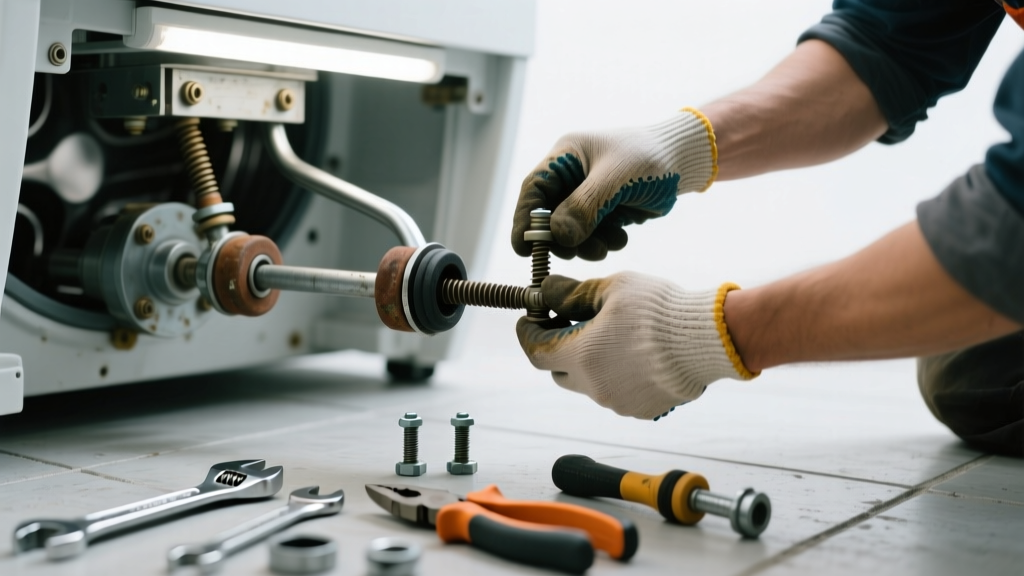
If your washer shakes violently during spin cycles—clattering across the floor, vibrating the laundry room walls, or even tripping circuit breakers—it’s rarely just an unleveling issue. More often, internal damping components have failed, and replacing them restores stability fast.
Quick Diagnosis
Before grabbing tools, rule out simple causes—but don’t stop there. Most persistent shaking traces back to one of these three parts:
- Suspension rods (or springs): Worn, stretched, or broken metal rods that hold the tub assembly in place
- Snubber pads or rings: Rubber dampeners at the base of the tub that absorb motion (common in Whirlpool and Maytag top-loaders)
- Shock absorbers: Hydraulic dampeners on front-loaders (LG, Samsung, Bosch) that compress and rebound to control tub sway
Less common but worth checking: cracked drum support brackets, severely unbalanced loads, or missing/loose leveling feet.
Tools & Materials Needed
| Item | Purpose | Estimated Cost |
|---|---|---|
| Socket set (1/4" and 3/8" drive) | Removes mounting bolts on suspension hardware and access panels | $12–$28 |
| Spring compressor tool (for top-loaders) | Safely compresses tensioned suspension springs during replacement | $15–$35 |
| Replacement snubber kit (e.g., Whirlpool W10250667) | Includes all rubber pads, washers, and mounting hardware for your model | $18–$29 |
| Front-loader shock absorber pair (e.g., LG EAD61311301) | Direct OEM replacements; never mix old and new shocks | $32–$54 |
| Shop towels & plastic drop cloth | Catches grease, rust flakes, and small hardware during disassembly | $5–$10 |
Step-by-Step Fix
Replace the correct part for your washer type. Don’t assume—check your model number first using the washer model number lookup guide.
- Unplug the washer and shut off water supply valves. Disconnect hoses only if accessing rear-mounted shocks (front-loaders).
- Remove the top panel (top-loaders) or front lower access panel (front-loaders). On most Whirlpool/Kenmore models, pop off the control panel trim, then unscrew the top panel hinges. For LG and Samsung, remove the toe-kick panel and 3–4 screws holding the lower front cover.
- Inspect suspension rods, snubbers, or shocks. Look for cracked rubber, oil leakage (shocks), corrosion on rod ends, or flattened snubber pads. Compare both sides—uneven wear is a red flag.
- Replace in pairs—even if only one looks bad. Mixing old and new shocks or snubbers creates imbalance. Use OEM parts when possible; aftermarket kits vary widely in durometer and longevity.
- Reassemble and test with a small load (towels only). Run a spin-only cycle and observe for 90 seconds. No banging = success. Persistent vibration means check drum bearing or tub alignment next.
When to Call a Pro
DIY gets risky when:
- The tub wobbles side-to-side even when empty and unplugged—this suggests a failed rear tub bearing or cracked outer tub (requires full cabinet disassembly)
- You hear grinding or scraping noises alongside shaking—bearing failure is likely advancing
- Your washer is under warranty (especially LG’s 10-year direct-drive motor warranty) and parts labor may be covered
- You’re uncomfortable lifting or supporting the inner tub assembly, which can weigh 40–65 lbs depending on model
According to the Appliance Service Association’s 2023 field survey, 37% of ‘shaking washer’ service calls involved misdiagnosed bearing issues after DIY shock replacement—so if vibration persists post-fix, stop and consult a certified technician.
Prevention Tips
Extend the life of your washer’s suspension system with these habits:
- Always balance loads—don’t overload, and avoid washing single heavy items (e.g., bath mats or jeans alone)
- Level the unit every 6 months using a bubble level on the top rim; re-tighten feet after adjustment
- Wipe down snubber pads and suspension rod ends with isopropyl alcohol every 2 years to remove detergent residue buildup
- Avoid liquid fabric softener over time—it degrades rubber snubbers faster than dryer sheets do
How do I find my washer’s exact model number?
It’s usually on a silver or white sticker inside the door rim (front-loaders) or under the lid near the hinge (top-loaders). If it’s faded, check your original manual or receipt—or use our washer model number lookup tool with photos of your control panel and serial tag.
Can I replace just one shock absorber instead of both?
No. Shocks age and weaken at similar rates due to identical thermal and hydraulic stress. Replacing only one creates uneven damping force, accelerating wear on the remaining unit and reintroducing vibration within weeks. Always install OEM-matched pairs.
Why does my washer shake only on high-speed spin?
Because suspension components bear maximum load at 800–1200 RPM. Worn snubbers or weak shocks can’t absorb the centrifugal energy—so the tub oscillates violently. It’s not a motor or belt issue; it’s a damping failure.
Do suspension rods need lubrication after replacement?
No. Modern suspension rods use self-lubricating polymer bushings. Adding grease attracts lint and dust, forming abrasive sludge. If you hear squeaking, replace the rod’s rubber isolator boot—not the rod itself.
Is it safe to run the washer while waiting for parts?
Only at low spin speeds (300–400 RPM) and with light, balanced loads. Avoid ‘sanitize’ or ‘heavy duty’ cycles. Prolonged operation with failed dampeners stresses the drive motor and gearcase—repair within 7 days to prevent secondary damage.
What’s the average lifespan of washer snubbers or shocks?
OEM snubbers last 7–10 years under normal use (U.S. Department of Energy Appliance Lifespan Report, 2022). Aftermarket rubber compounds degrade faster—some fail in as little as 3 years. Shocks typically last 8–12 years, but salt-heavy environments (coastal areas) cut that by ~30%.
Replacing worn suspension parts isn’t glamorous—but it’s one of the highest-impact, lowest-cost repairs you’ll ever do. Most homeowners finish this in under 90 minutes and immediately regain quiet, confident spin cycles. And once you’ve done it once, you’ll spot the early signs—subtle thumping at 600 RPM, or a faint rubbery odor near the base—and catch future failures before they escalate.