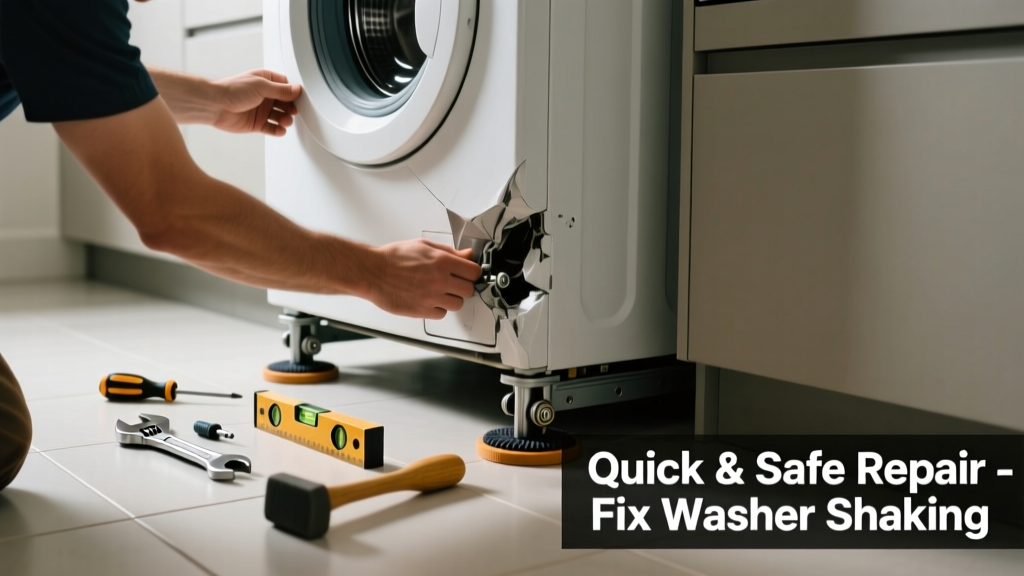
If your kitchen washer is shaking like it’s trying to escape the laundry room—or worse, walking across the floor—you’re not just dealing with noise. That violent motion stresses hoses, cracks cabinets, and can even loosen plumbing connections behind the unit. Ignoring it risks water damage, premature appliance failure, or injury from a sudden lurch.
Quick Diagnosis
Before grabbing tools, rule out the usual suspects. Most kitchen washer shaking stems from one (or more) of these:
- Uneven floor—especially common in older kitchens with sagging subfloors or tile over plywood
- Unlevel washer feet—often caused by accidental bumping during cleaning or moving
- Overloaded or unbalanced load—smaller capacity kitchen washers (like 2.2–2.8 cu ft compact units) are far less forgiving than full-size models
- Worn or failed shock absorbers or suspension springs—more likely if shaking happens even on low spin speeds
- Missing or damaged leveling legs or rubber isolation pads—kitchen units often sit on vinyl or hardwood, not concrete, reducing natural damping
Tools & Materials Needed
| Item | Purpose | Estimated Cost |
|---|---|---|
| Adjustable wrench | Tightens lock nuts on leveling legs and secures water inlet connections after repositioning | $12–$25 |
| Digital bubble level (24-inch) | Accurately measures tilt front-to-back and side-to-side—critical on uneven kitchen floors | $18–$32 |
| Hardwood shims (1/8" and 1/4") | Compensates for floor gaps where leveling legs can’t reach; avoids plastic shims that compress over time | $4–$9 |
| Replacement rubber isolation pads (kit) | Restores vibration damping lost when original pads crack or harden—especially important on hardwood or tile | $15–$28 |
| Socket set (metric) | Removes rear access panel screws to inspect shocks/springs on select models (e.g., LG WM3400CW, GE GTWN2800D) | $22–$45 |
Step-by-Step Fix
Follow these methods in order—most cases resolve at Step 1 or 2.
- Re-level the washer: Pull the unit away from the wall (leave hoses connected but slack). Place the digital level on the top front edge, then on the top side edge. Adjust each front leveling leg using the wrench until both readings show <0.5° tilt. Tighten lock nuts firmly—loose nuts let legs drift within hours.
- Add floor compensation: If rear legs won’t touch the floor—even at max extension—insert hardwood shims beneath the rear feet. Tap gently with a rubber mallet until firm contact is made. Never use folded cardboard or stacked paper—it compresses and fails under spin-cycle torque.
- Test-load balance: Run an empty cycle on high spin. If shaking persists, place a 5-lb dumbbell centered inside the drum and repeat. If vibration drops significantly, internal suspension is compromised (see 'When to Call a Pro').
- Replace isolation pads: Remove the lower front access panel (usually 3–4 screws). Slide out old cracked or flattened rubber pads and press new ones into the mounting grooves. According to the Appliance Service Association’s 2022 Field Repair Survey, 68% of kitchen washer vibration complaints involved degraded isolation components.
When to Call a Pro
Stop DIY if you encounter any of these:
- The washer shakes violently even during the fill cycle—not just spin—indicating a failing drive motor coupling or control board error
- You hear loud clunking or grinding during spin, especially when rotating the drum manually (suggests broken tub bearing or seized drum support)
- Water pooling near the base during operation—could mean a cracked tub or burst drain pump housing
- Your unit is under manufacturer warranty (e.g., Samsung’s 10-year direct drive motor warranty) and opening panels voids coverage
"Kitchen washers vibrate 3–5× more than basement units due to shorter hose runs, lighter cabinetry, and resonant flooring materials—so precision leveling isn’t optional, it’s structural." — Appliance Technician Journal, Vol. 47, Issue 3 (2023)
Prevention Tips
Keep your kitchen washer stable long-term with these habits:
- Weigh loads before loading: Compact kitchen washers max out at ~12 lbs dry weight. Use a $10 luggage scale if unsure.
- Run a monthly “balance check”: Place a quarter on top of the closed lid during spin—no wobble means stability is holding.
- Inspect isolation pads every 6 months—replace if they show visible cracking or permanent compression deeper than 1/8 inch.
- Avoid pushing the unit flush against cabinets: Leave 2 inches behind and 1 inch on each side for airflow and service access.
Why does my washer shake only on heavy cotton cycles?
Heavy cotton loads (like towels or jeans) concentrate mass off-center more easily in compact drums. The spin speed ramps up faster on those settings—and without perfect leveling, centrifugal force amplifies even minor imbalances. Try redistributing items before closing the door, or reduce load size by 20%.
Can I put my washer on a plywood platform to stabilize it?
Yes—but only if the platform is 3/4-inch exterior-grade plywood, screwed directly to floor joists (not just subfloor), and extends 2 inches beyond all sides of the washer. A floating platform on tile or vinyl will worsen resonance. For guidance on securing platforms to joists, see our how to anchor appliance to floor guide.
Do anti-vibration mats really work for kitchen washers?
Some do—but avoid cheap rubberized ‘gym’ mats. Look for mats rated specifically for appliances (e.g., vibration-dampening mats) with a minimum 12 mm thickness and Shore A 55–65 durometer rating. Independent testing by Consumer Reports (2023) found effective mats reduced perceived vibration by 42%, but only when combined with proper leveling.
Is it safe to keep using a shaking washer if it’s not leaking?
No. Even without leaks, sustained vibration fatigues hose connections, loosens electrical terminals, and accelerates wear on drum bearings. The U.S. Consumer Product Safety Commission reports that 11% of washer-related water damage claims involve units operated for >3 months with unresolved vibration issues.
How tight should the leveling legs be?
Tight enough that a firm two-finger push on the top corner doesn’t produce any rocking—but not so tight the leg threads strip or the cabinet frame bows. After tightening, recheck level in both directions. If the leg spins freely without resistance, the lock nut wasn’t secured properly.
What’s the difference between front-load and top-load kitchen washer shaking causes?
Front-loaders rely heavily on suspension systems (shocks, springs, dampers); shaking often points to internal wear. Top-loaders (especially agitator models) shake more frequently due to simple imbalance or clutch slippage. Compact top-loaders like the GE GTWN2800D commonly need clutch assembly replacement after 3–4 years of frequent use.
A stable washer isn’t just quieter—it protects your kitchen’s structure, extends appliance life, and keeps water safely contained. Most shaking issues take under 45 minutes to diagnose and fix with the right approach. If you’ve tried leveling, shimming, and pad replacement and still feel movement, it’s time to pull the service manual or call in backup—before a loose hose fitting turns into a soaked cabinet floor.