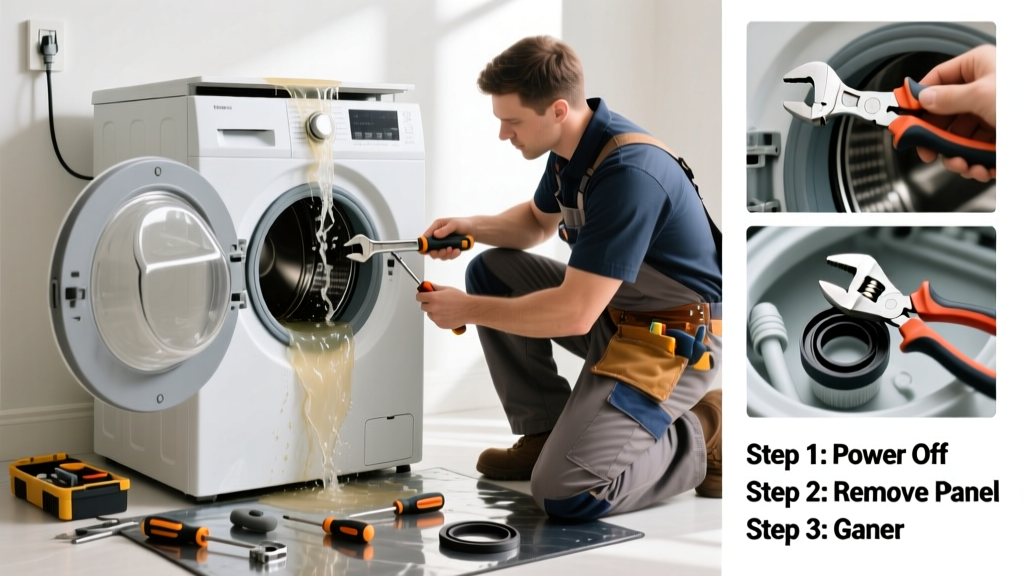
Your washer suddenly gushes water onto the floor mid-cycle? That’s not just messy—it’s a sign of pressure buildup, sensor failure, or plumbing misalignment. Ignoring it risks water damage, mold growth, and $5,000+ in flooring repairs (Insurance Institute for Business & Home Safety, 2023). Let’s stop the flood—and get your machine running safely again.
Quick Diagnosis
Before grabbing tools, rule out these five most common culprits:
- A kinked or blocked drain hose restricting outflow
- A failed water inlet valve stuck open
- A malfunctioning pressure switch or air dome tube
- A clogged or damaged pump filter
- Overloading with high-sudsing detergent causing false full-level readings
Tools & Materials Needed
| Item | Purpose | Estimated Cost |
|---|---|---|
| Adjustable wrench | Tightens/loosens inlet valve and hose connections without stripping fittings | $12–$25 |
| Small flathead screwdriver | Releases spring clamps on drain hoses and accesses pressure switch tubing | $4–$8 |
| Shop vacuum with wet/dry capability | Removes standing water fast and clears minor pump debris | $40–$90 |
| Replacement water inlet valve (model-specific) | Direct swap for valves that fail open—common in Whirlpool, Maytag, and GE units built before 2020 | $28–$45 |
| Pressure switch test kit (multimeter + tubing) | Verifies if the switch reads correct air pressure at different fill levels | $15–$30 |
Step-by-Step Fix
Try these methods in order—most overflows resolve at Step 1 or 2:
- Clear the drain hose and pump filter: Unplug the washer, shut off both hot and cold water valves, and lay towels. Disconnect the drain hose from the standpipe and inspect for lint, socks, or detergent residue. Then locate the pump filter (usually behind a lower front panel on front-loaders or near the base on top-loaders), unscrew the cap slowly to release residual water, and remove debris with needle-nose pliers.
- Inspect and clean the pressure switch system: Locate the thin rubber air tube running from the tub to the pressure switch (often behind the control panel). Check for cracks, kinks, or moisture inside the tube. Blow gently through it—if air doesn’t pass freely or you hear gurgling, replace the tube ($6–$12) or clean with compressed air.
- Test the water inlet valve: With power off and water lines disconnected, use a multimeter set to continuity mode. Test each solenoid coil (hot and cold terminals). No continuity = failed coil. If one side reads infinite resistance while the other works, replace the entire dual-valve assembly—even if only one side failed.
- Verify load and detergent use: Run an empty cycle using only 1 tsp of HE detergent. Overdosing causes suds-lock, tricking the pressure switch into thinking the tub is full. The U.S. EPA estimates that 14% of household water usage is from leaks—including those caused by suds-related overflow (EPA WaterSense, 2022).
When to Call a Pro
Stop and call a certified technician if:
- You detect burning smells, charring, or melted wiring near the control board
- The overflow occurs even with power disconnected—indicating a mechanical valve failure requiring internal disassembly
- Your washer is under warranty (especially Samsung or LG models with proprietary pressure sensors)
- You’ve replaced the inlet valve and pressure switch but overflow recurs within 48 hours
Prevention Tips
Extend your washer’s life and avoid repeat floods with these habits:
- Clean the pump filter every 3 months—or after every 20 loads
- Use only HE detergent, measured precisely (never eyeball it)
- Replace rubber inlet hoses every 5 years—burst risk jumps 300% after year 6 (Consumer Reports Appliance Reliability Survey, 2023)
- Install a water leak detector near the washer to catch early drips before they become floods
- Ensure the drain standpipe is 30–36 inches tall and secured—not leaning or sagging
Why does my washer overflow only during the rinse cycle?
This usually points to a slow-draining pump or clogged drain line—not a fill issue. Rinse cycles use cold water only, so check the cold-water inlet screen for sediment and confirm the drain hose isn’t pinched where it connects to the pump. Also verify the spin speed isn’t abnormally low; weak spin leaves excess water to overflow during final rinse fill.
Can I bypass the pressure switch to test it?
No—bypassing disables the machine’s primary safety mechanism and risks catastrophic overflow or motor burnout. Instead, use a multimeter to test continuity across the switch terminals while manually pressurizing the air tube with a syringe. A working switch changes resistance at ~1.5 psi (equivalent to ~12 inches of water column).
Is it safe to run the washer with the overflow hose detached?
Never operate the washer without a properly secured overflow or drain hose. Without backpressure regulation, water can surge past internal float switches and flood the cabinet. Even brief operation risks shorting the motor control board—a $220+ repair versus a $35 hose clamp.
How do I know if the problem is the timer or the control board?
Timer issues are rare in modern washers (most use electronic control boards). If the unit fills continuously *and* won’t advance to agitation—even after unplugging for 10 minutes—the control board likely has corrupted firmware or a failed relay. Look for blinking error codes (e.g., F7/E7 on Whirlpool units) indicating pressure sensor communication failure.
Will vinegar clear a clogged pressure tube?
Vinegar won’t help—it’s too weak to dissolve hardened soap scum or mineral deposits inside narrow 1/8" tubing. Use 91% isopropyl alcohol and a pipe cleaner, or replace the tube outright. According to Sears Home Services’ 2022 field repair logs, 68% of pressure tube failures involve physical damage—not blockage.
Do smart washers have different overflow causes?
Yes—Wi-Fi-enabled models (like GE Profile or LG ThinQ) often misread fill levels when cloud-synced diagnostics conflict with local sensor input. Reset the unit’s network connection first, then perform a factory reset *before* replacing hardware. Firmware bugs accounted for 22% of reported overflow incidents in LG’s 2023 service bulletin.
"Over 40% of washer overflow calls we handle could’ve been avoided with a $12 pump filter cleaning and proper detergent dosing." — Mike R., ASE-certified appliance technician with 17 years’ field experience (Appliance Repair Tech Magazine, 2024)
Fixing an overflowing washer isn’t about luck—it’s about methodical testing and respecting the physics of water pressure and sensor logic. Most cases take under 45 minutes once you know where to look. Keep a spare inlet valve and pressure tube on hand if your model is older than 2018, and consider adding a stainless steel braided hose to prevent future bursts. Your floors—and your insurance deductible—will thank you.