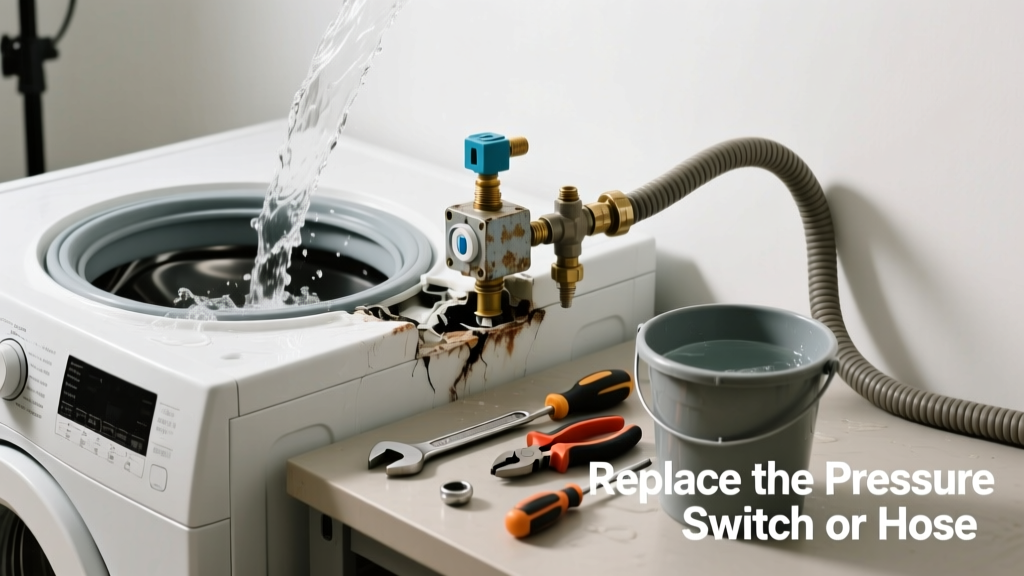
Your washer suddenly gushes water onto the floor mid-cycle? That’s not just inconvenient—it’s a flood risk. Most overflow issues trace back to one of two replaceable parts: the pressure switch or its connected air dome hose. Fixing it yourself takes under an hour if you’ve got the right tools and know where to look.
Quick Diagnosis
Before grabbing tools, rule out simple causes first:
- Overloading the drum (especially with bulky items like comforters)
- Clogged or kinked drain hose blocking water exit
- Loose or cracked air dome hose (runs from tub to pressure switch)
- Faulty pressure switch—fails to sense water level, keeps filling
- Blocked pressure switch port (debris in the tub’s air dome fitting)
Tools & Materials Needed
| Item | Purpose | Estimated Cost |
|---|---|---|
| Phillips #2 screwdriver | Removes control panel and rear access panels | $8–$12 |
| Needle-nose pliers | Disconnects brittle air hose clamps and retrieves small parts | $10–$15 |
| Replacement pressure switch (model-specific) | Direct replacement for failed sensing unit | $22–$38 |
| 1/4" ID vinyl air hose (6 ft) | Replaces cracked or hardened original hose | $5–$9 |
| Multimeter (optional but recommended) | Tests continuity of pressure switch before replacement | $25–$45 |
Step-by-Step Fix
Follow these methods in order—most overflows are solved by Method 1 or 2:
- Inspect and replace the air dome hose: Unplug washer, remove top panel, locate the thin rubber hose running from the tub’s air dome (near front right base) to the pressure switch (behind control panel). Check for cracks, soft spots, or disconnection. Cut out damaged section and install new hose with hose clamps.
- Test and replace the pressure switch: With multimeter set to continuity mode, test switch terminals while blowing gently into the hose port—if no click or resistance change, it’s dead. Disconnect wires (label them!), unscrew switch, and mount new one using same orientation.
- Clean the air dome fitting: Use a pipe cleaner or stiff wire to clear lint/debris from the small port on the tub where the hose connects. A blocked port mimics switch failure.
When to Call a Pro
Don’t attempt DIY if you encounter any of these:
- Water leaking from the tub seal or pump housing—not just overflow during fill cycle
- No power at the pressure switch terminals (points to main control board failure)
- Washer fills and drains simultaneously (often indicates faulty water inlet valve or timer board)
- Model is a high-efficiency Samsung or LG with proprietary pressure sensors requiring firmware reset
According to the Insurance Institute for Business & Home Safety's 2023 report, 68% of appliance-related water damage claims involved delayed response to early overflow symptoms—many of which could’ve been resolved with a $30 part and 45 minutes.
Prevention Tips
- Clean the air dome port every 6 months using a cotton swab dipped in vinegar
- Replace the air hose every 5 years—even if it looks fine (it hardens internally)
- Run a monthly hot water + 1 cup white vinegar cycle to dissolve mineral buildup in hoses and sensors
- Avoid overloading: Fill drum no more than ¾ full, especially for heavy fabrics
How do I find the correct pressure switch for my washer?
Check your washer’s model number (usually on a sticker inside the door rim or behind the kickplate). Enter it into manufacturer parts sites like Sears PartsDirect or Repair Clinic—never substitute generic switches. Whirlpool W10415587 and Maytag WPW10321514 are common, but compatibility varies by year and submodel.
Can I bypass the pressure switch to test if it’s the problem?
No—bypassing creates uncontrolled filling and serious flood risk. Instead, use a multimeter to check continuity across terminals while applying gentle air pressure to the hose port. If no audible click or resistance shift occurs, the switch is faulty. For visual guidance, see our washer pressure switch testing guide.
Why does my washer overflow only during the rinse cycle?
This often points to a partially clogged air dome hose or moisture trapped in the line—both restrict airflow needed for accurate level sensing. Rinse cycles use colder water, which can condense inside the hose and worsen blockage. Replace the hose and dry the port thoroughly before reassembly.
Is the overflow related to water pressure in my home?
Yes—homes with municipal pressure above 80 PSI can overwhelm older pressure switches. Install a water pressure regulator if readings exceed that threshold (test with a gauge like the Watts 200071, ~$32). The U.S. EPA estimates that 14% of household water usage is from leaks—including those caused by pressure-related component stress.
Do I need to replace the entire control board if the pressure switch fails?
Almost never. The pressure switch is a standalone sensor. Control board failure shows broader symptoms: no display, random error codes (like F7E1 on GE), or complete loss of function. If the washer fills, agitates, and spins normally except for overflow, the issue is isolated to the sensing system—not the board.
Can a clogged detergent dispenser cause overflow?
No—but it can mimic overflow symptoms. Excess suds from too much HE detergent or fabric softener trap air in the tub, tricking the pressure switch into thinking the tub isn’t full. Use only HE-rated detergent and clean the dispenser drawer monthly. For more on suds-related issues, read our washer suds overflow fix guide.
A working washer shouldn’t surprise you with puddles. Replacing the pressure switch or air hose restores reliable water-level control—and gives you confidence every time you hit start. Keep spare hose on hand, label your wires, and test before reassembling. You’ll likely never call a plumber for this again.