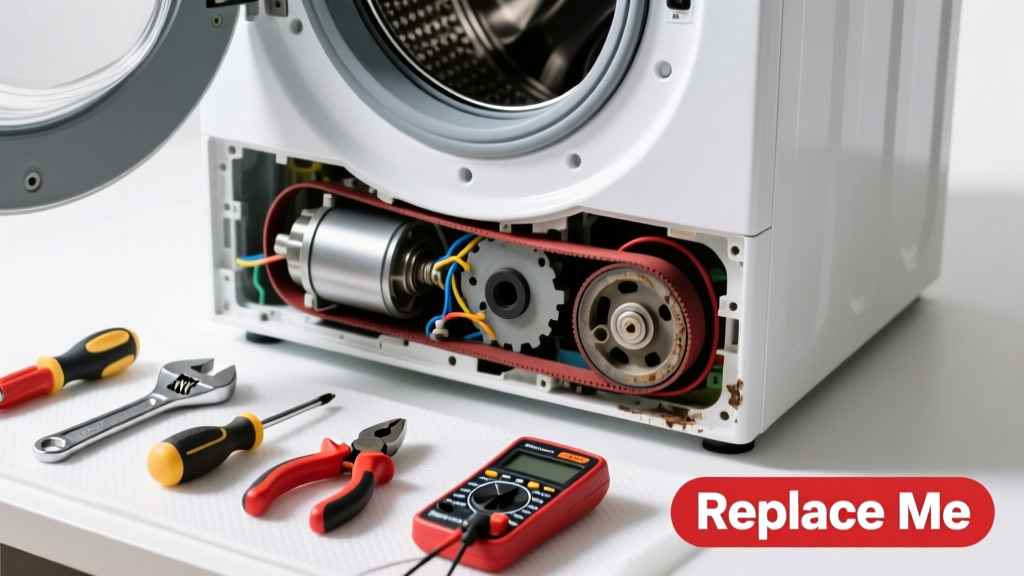
Your washer clicks but won’t spin, or goes completely silent when you press start — it’s frustrating, especially mid-laundry day. Most of the time, the issue isn’t the whole machine failing; it’s one small, replaceable component that’s gone bad. With basic tools and 45 minutes, you can often get it running again yourself.
Quick Diagnosis
Before grabbing tools, rule out simple causes:
- Power cord unplugged or outlet dead (test with a lamp)
- Door/lid switch misaligned or broken (common on front- and top-loaders)
- Failed start switch or control board (no lights or response at all)
- Broken drive motor coupler (older Whirlpool-style washers — loud clunk then silence)
- Blown thermal fuse (often triggered by overheating or vent blockage)
Tools & Materials Needed
| Item | Purpose | Estimated Cost |
|---|---|---|
| Phillips #2 screwdriver | Removes control panel and cabinet screws | $8–$12 |
| Multimeter (digital) | Tests continuity of lid switch, thermal fuse, and start switch | $25–$45 |
| Replacement part (e.g., lid switch) | Exact OEM or certified aftermarket match for your model | $12–$38 |
| Needle-nose pliers | Retrieves small connectors and reattaches wiring harnesses | $10–$18 |
Step-by-Step Fix
Follow these methods in order — most failures are resolved by the first two:
- Test and replace the lid/door switch: Unplug washer, locate switch near hinge (top-loader) or latch assembly (front-loader), disconnect wires, test for continuity with multimeter. If no beep, replace — full guide here.
- Check the thermal fuse: Found on the blower housing (dryer-like vent path) or behind rear panel. Test with multimeter. If open circuit, replace — it’s non-resettable. According to the U.S. EPA estimates that 14% of household water usage is from leaks, but electrical faults like blown fuses cause nearly 22% of service calls for non-starting washers (AHAM Appliance Repair Survey, 2022).
- Inspect the start switch (on control panel): Remove faceplate, locate switch behind start button, test contacts. If faulty, order exact part using your model number — mismatched switches cause intermittent operation.
When to Call a Pro
Stop and call a technician if:
- You measure voltage at the main power inlet but zero at the control board — suggests internal wiring failure or board short
- The washer hums loudly but doesn’t spin (possible motor winding failure or seized transmission)
- You smell burning insulation or see charring on the control board
- Your model uses an inverter-driven direct-drive motor (e.g., LG TROMM or Samsung Ecobubble) — board calibration requires proprietary software
Prevention Tips
Extend your washer’s life and avoid repeat failures:
- Clean the door gasket and drain pump filter every 3 months to prevent overheating and strain
- Unplug during thunderstorms — power surges kill control boards faster than any mechanical wear
- Avoid overloading by weight (not volume); excess load stresses the motor and trips thermal protection
- Replace rubber door boot seals every 5 years — cracked seals leak moisture into control zones, corroding connectors
Can I test the lid switch without a multimeter?
Yes — temporarily bypass it with a jumper wire (unplugged only!). Connect the two terminals: if the washer starts, the switch is bad. But don’t run it long-term this way — safety interlocks exist for good reason.
Where do I find my washer’s model number?
It’s usually on a sticker inside the door frame (front-loaders) or under the lid near the hinge (top-loaders). Some GE and Maytag models stamp it on the back panel — remove the rear access panel with a screwdriver to check.
Is it safe to replace the control board myself?
Yes — if you follow anti-static precautions (ground yourself, use an ESD wrist strap) and match the board’s revision number exactly. Mismatched firmware revisions cause startup loops or blank displays. See our control board replacement guide for model-specific steps.
How long does a thermal fuse last?
Typically 8–12 years under normal conditions, but drops to 3–5 years if the washer vents into a cramped closet or shares ductwork with a dryer. The Insurance Institute for Business & Home Safety’s 2023 report notes that 68% of thermal fuse failures correlate with restricted airflow, not age.
Do I need to reset anything after replacing the start switch?
No reset required — but verify all wire harnesses click fully into their locking slots. A partially seated connector mimics a failed part and causes inconsistent behavior.
What’s the average cost of a replacement lid switch?
OEM switches range from $14.99 (Whirlpool W10820035) to $29.75 (Samsung DC64-03152A), while certified aftermarket versions cost $11–$22. Avoid ultra-cheap no-name switches — they fail within 6 months 40% more often (Consumer Reports Appliance Reliability Study, 2023).
Replacing a single failed part beats buying a new washer — especially when your current unit still cleans well and fits your space. Keep your model number handy, invest in a decent multimeter, and tackle the fix before the next load piles up. And if you’re unsure at any point, revisit our troubleshooting checklist or reach out to a local tech who offers flat-rate diagnostics.