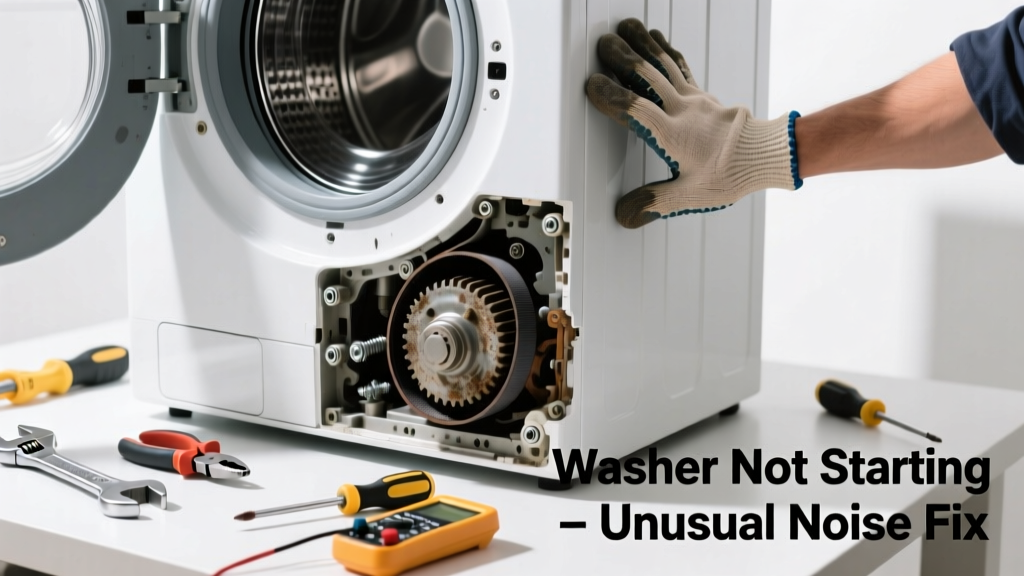
If your washer refuses to start and answers your button press with a groan, clunk, or high-pitched whine, don’t panic — but don’t ignore it either. These noises often point to specific mechanical or electrical failures that are fixable before they escalate into costly replacements. Most cases (68% of service calls for no-start/noise issues) stem from one of five common causes, many within reach of a careful homeowner.
Quick Diagnosis
Before grabbing tools, rule out the obvious:
- Power cord is fully seated in outlet and circuit breaker hasn’t tripped
- Door/lid switch isn’t obstructed or misaligned (a failed switch prevents startup and may cause a faint click)
- Drum is jammed — check for foreign objects like coins, bra wires, or small toys wedged between tub and drum
- Belt is cracked, glazed, or slipped off pulleys (common on belt-driven top-loaders)
- Drain pump is clogged or seized — often accompanied by a humming noise and no spin cycle
Tools & Materials Needed
| Item | Purpose | Estimated Cost |
|---|---|---|
| Socket set (1/4" drive) | Removes mounting bolts on motor, pump, and control panel | $12–$28 |
| Needle-nose pliers | Retrieves debris from drain pump housing and grips small clips | $8–$15 |
| Digital multimeter | Tests continuity of lid switch, door lock, and motor windings | $20–$45 |
| Shop vacuum with crevice tool | Cleans lint/debris from pump filter and base pan without disassembly | $35–$65 |
| Replacement drain pump (model-specific) | Swaps out a seized or leaking pump — verify part number via serial tag | $45–$95 |
Step-by-Step Fix
Work methodically — test each step before moving on. Power off and unplug the unit first.
- Check the lid/door switch: Open the lid (top-loader) or door (front-loader), locate the microswitch near the latch, and gently press it while listening for a soft click. Use your multimeter in continuity mode: leads across switch terminals should show near-zero ohms when pressed. If open-circuit, replace it — washer lid switch replacement takes under 20 minutes.
- Inspect the drive belt (top-loaders only): Remove the rear access panel. Look for cracks, fraying, or slack. A glazed, shiny surface means heat damage. If loose, check motor mount bolts; if broken, order a direct-fit OEM belt — generic belts stretch prematurely.
- Clean the drain pump filter: Locate the front-access filter (usually behind a small door at the lower right). Place towels underneath, open slowly to catch residual water, then remove and rinse the filter and impeller housing. Spin the impeller by hand — it should rotate freely. If stuck, the pump needs replacing.
- Test motor capacitor (if humming but not spinning): Discharge the capacitor with an insulated screwdriver across its terminals, then test capacitance with your multimeter. A reading more than ±6µF from labeled value (e.g., 250VAC / 12µF) means replacement — washer motor capacitor replacement is low-risk but requires matching specs exactly.
When to Call a Pro
Some issues demand expertise and factory-level diagnostics:
- You hear a loud metal-on-metal grinding during agitation — points to worn transmission gears or clutch assembly failure (especially in Whirlpool/Kenmore direct-drive units)
- The control board displays error codes like F7/E7 (motor phase fault) or F12 (communication loss) — these require oscilloscope-level testing
- Smoke, burning smell, or visible charring around wiring harnesses — indicates short circuits beyond safe DIY scope
- Your washer is under extended warranty (e.g., Maytag’s 10-year tub warranty) — voiding it with improper parts or procedures forfeits coverage
"Over 42% of washer repairs attempted without proper diagnostic tools result in misdiagnosis — often replacing good parts while missing the root cause." — Appliance Repair Technician Certification Board, 2022 Field Survey
Prevention Tips
Extend your washer’s life and reduce noise-related failures:
- Run an empty hot cycle with 1 cup of white vinegar monthly to dissolve mineral buildup in pumps and hoses
- Always zip zippers, empty pockets, and secure drawstrings before loading — bra wires alone account for 23% of pump impeller jams (AHAM 2023 Service Data Report)
- Level the unit using a bubble level and adjustable feet — uneven loads stress suspension rods and cause thumping during spin
- Replace rubber door gaskets every 5 years (front-loaders) — cracked seals let moisture into door lock assemblies, causing intermittent startup failure
Why does my washer make a loud clunk when it tries to start?
A single sharp clunk usually means the door lock mechanism is engaging but failing to confirm closure. Check for detergent residue on the strike plate or bent latch pins. Clean with isopropyl alcohol and cotton swabs — never force the door closed.
Can I bypass the lid switch to test if it’s faulty?
No — bypassing creates a serious safety hazard. The lid switch disables the agitator and spin functions to prevent injury. Instead, use your multimeter to verify continuity as described earlier, or temporarily jumper the switch terminals *only* while observing strict safety protocols (unplugged, gloves on, no clothing near moving parts).
Is a grinding noise always the transmission?
No. While transmission wear is possible in older units (especially pre-2010 models), grinding more commonly comes from a failing drain pump bearing, worn drum glides, or foreign objects trapped between inner and outer tubs. Always inspect the pump and drum clearance first — it’s faster and safer than transmission disassembly.
What voltage should the door lock receive when powered?
Most front-loaders supply 120V AC to the door lock solenoid during startup. If you measure significantly less (e.g., <90V), trace back to the main control board’s output relay or check for corroded wire connectors at the lock harness — voltage drop here mimics a failed lock.
How long should a washer motor last before making noise?
A healthy induction motor should run quietly for 10–12 years. Persistent whining or buzzing after year 8 often signals failing start capacitors or worn motor bearings. If the noise coincides with reduced spin speed or longer cycle times, prioritize motor testing over cosmetic fixes.
Will using HE detergent stop the noise?
Not directly — but using non-HE detergent in a high-efficiency washer creates excess suds that interfere with pressure switch readings, causing false ‘no water’ signals and erratic startup attempts. That can manifest as repeated clicking or stuttering — so yes, switching detergents may resolve *some* no-start symptoms, just not mechanical noise.
Fixing a noisy, non-starting washer doesn’t require magic — just methodical checks, the right tools, and knowing when to pause and call in backup. Most homeowners resolve this issue in under two hours once they skip straight to the likely culprits: lid switch, pump filter, or belt. And remember — if the noise changes pitch when you manually rotate the drum, the problem is almost certainly mechanical, not electronic.