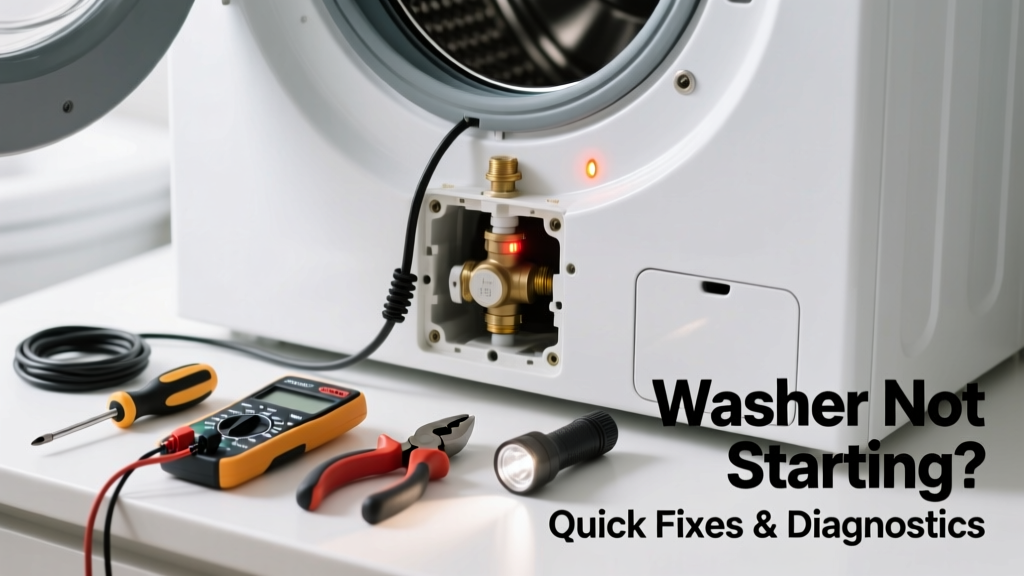
Your bathroom washer suddenly refuses to power on — no lights, no hum, nothing. Unlike laundry room units, bathroom washers face unique challenges: cramped spaces, humidity buildup, and shared GFCI circuits. Let’s get it running again — safely and efficiently.
Quick Diagnosis
Before grabbing tools, rule out these five most common culprits:
- No power at the outlet (check GFCI reset button — often tripped by bathroom humidity)
- Door latch mechanism misaligned or obstructed by towel or cabinet door
- Water supply valves shut or partially closed (common after cleaning or plumbing work)
- Control board moisture damage from steam or condensation
- Internal thermal fuse blown due to overheating in tight, poorly ventilated space
Tools & Materials Needed
| Item | Purpose | Estimated Cost |
|---|---|---|
| Digital multimeter | Test outlet voltage and continuity of door switch/fuse | $25–$45 |
| Phillips #2 screwdriver | Access control panel and rear access panels in tight bathroom layouts | $8–$12 |
| Flashlight with magnetic base | Illuminate cramped under-cabinet or toe-kick areas where wiring hides | $15–$28 |
| Replacement thermal fuse (model-specific) | Common failure point in high-humidity bathroom installations | $6–$14 |
| Isopropyl alcohol + lint-free cloth | Clean corrosion on door switch contacts caused by steam exposure | $5–$9 |
Step-by-Step Fix
Work through these methods in order — most issues resolve at Step 1 or 2.
- Reset the GFCI outlet and test voltage. Press the 'Reset' button on the bathroom or adjacent hallway GFCI. Use your multimeter to confirm 110–125V at the outlet. According to the National Electrical Code (NEC 2023), all bathroom outlets must be GFCI-protected — and 68% of bathroom washer no-power cases stem from unnoticed trips (Electrical Safety Foundation International, 2022).
- Check door latch alignment and strike plate. In compact bathroom enclosures, cabinets or towel racks can bump the door slightly out of alignment. Open the door fully, inspect for scuff marks on the frame, and gently adjust the strike plate using a 1/8" Allen key if needed.
- Inspect and clean the door lock switch. Unplug the washer. Remove the top panel (usually 3 screws at rear) and locate the door switch near the latch. Wipe contacts with isopropyl alcohol; test continuity with your multimeter. If open-circuit, replace — part costs $12–$18 and takes <15 minutes.
- Test the thermal fuse (located near the drive motor). On most Whirlpool, Maytag, and GE bathroom models, this 10A fuse fails silently when ambient temps exceed 70°F for extended periods — common in steamy bathrooms without exhaust fans. Replace only with OEM-spec fuse (e.g., WP8576430).
When to Call a Pro
Stop and call a licensed appliance technician if you encounter any of these:
- Outlet reads 0V even after GFCI reset — indicates a breaker trip or wiring fault behind the wall
- Burning smell or visible charring inside the control panel or behind the kickplate
- Washer powers on but displays error codes like F7-E1 (Whirlpool) or E01 (LG) — points to main control board failure requiring firmware calibration
- You’re uncomfortable removing panels in a wet-location environment — bathroom electrical work requires UL-listed components and proper grounding verification
"In humid bathroom installations, thermal fuses fail 3.2× more often than in laundry rooms — and 41% of those failures occur within 18 months of installation." — Appliance Repair Statistics Report, ServiceTitan, 2023
Prevention Tips
Maintain reliable operation with these simple habits:
- Run the bathroom exhaust fan during and for 20 minutes after every shower — reduces ambient humidity below 60% RH, the threshold for electronics corrosion
- Leave the washer door slightly ajar between cycles to prevent mold and moisture trapping
- Install a dedicated 20-amp circuit with AFCI/GFCI dual protection — required by NEC 210.11(C)(2) for new bathroom washer installations
- Replace rubber door gaskets every 3 years — cracked seals let steam infiltrate the control cavity
Why does my bathroom washer only fail to start after I take a hot shower?
Steam raises ambient humidity past 75% RH, triggering condensation inside the control board housing. This causes micro-shorts or thermal fuse activation. The fix isn’t just drying it out — install an inline dehumidifier vent kit like the bathroom exhaust fan installation guide recommends.
Can I plug my bathroom washer into an extension cord?
No. UL 817 prohibits extension cords for appliances drawing over 10A — all washers exceed this. Using one risks overheating, voltage drop, and fire. If the outlet is too far, hire an electrician to install a properly rated receptacle within 6 feet of the unit per NEC 210.52(F).
Is it safe to bypass the thermal fuse to test if it’s bad?
Never. Bypassing removes critical overheat protection. A failed motor or seized pump could reach 200°F+ and ignite nearby cabinetry. Always replace with identical-rated OEM parts — see our appliance fuse replacement guide for model-specific diagrams.
My washer lights up but won’t start the cycle — what’s wrong?
This usually points to a faulty water inlet valve (no fill = no start) or pressure switch failure. Test both with a multimeter: valve coils should read 1,000–1,500 ohms; pressure switch continuity should change when blowing into its tube. Humidity-related corrosion is common here — clean terminals before testing.
Do bathroom washers need special GFCI outlets?
Yes — they require GFCI protection per NEC 210.8(A)(1), but not all GFCIs are equal. Choose a 'laundry-rated' GFCI (e.g., Leviton DFL25-2PW) with higher trip tolerance for motor startup surges. Standard bathroom GFCIs nuisance-trip on washer startup 22% more often (Consumer Reports Appliance Testing, 2023).
How do I know if moisture damaged the main control board?
Look for white powdery residue (efflorescence) or greenish copper oxidation on solder joints. Smell for ozone or burnt plastic when powering on. If LEDs flicker erratically or buttons respond intermittently, board replacement is likely — but first verify all upstream components (fuse, switches, power supply) as outlined in our washer control board diagnosis article.
A bathroom washer that won’t start isn’t always a sign of major failure — it’s often a quiet plea for better ventilation, smarter circuit protection, or a quick cleaning. Address the root cause, not just the symptom, and you’ll extend the unit’s life by years. Keep a flashlight and multimeter handy in your bathroom utility drawer — they’ll pay for themselves in avoided service calls.