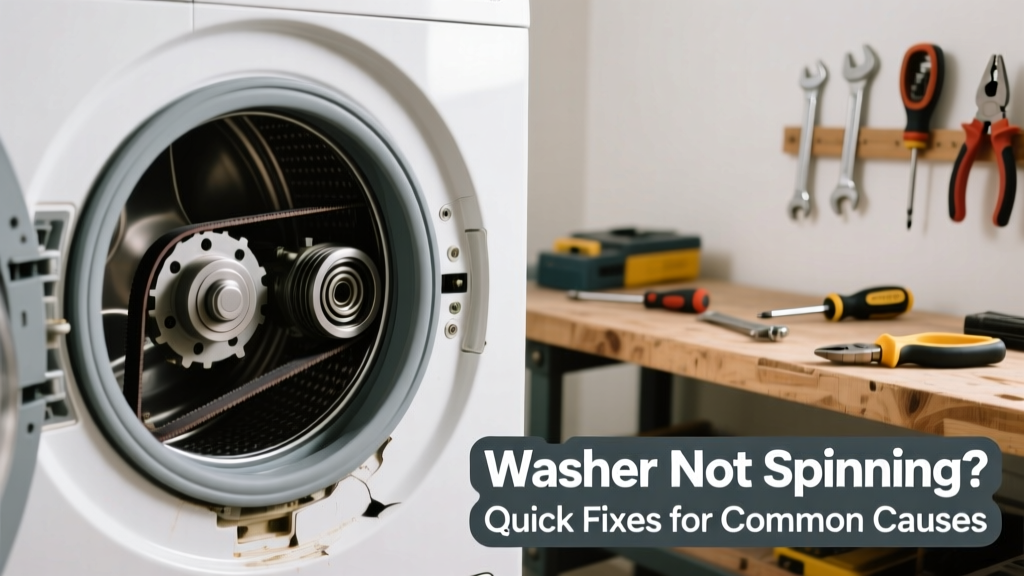
Your washer fills and agitates but refuses to spin — leaving clothes soaked and your laundry pile growing. This isn’t just inconvenient; it’s often a sign of a simple mechanical or electrical issue you can resolve in under an hour. Most spinning failures stem from one of five common causes, not a dead motor or full replacement.
Quick Diagnosis
Before grabbing tools, eliminate the obvious culprits:
- Lid or door switch malfunction (most frequent cause in top-loaders)
- Unbalanced or overloaded drum triggering safety cutoff
- Broken or slipped drive belt (common in older belt-driven models)
- Faulty motor coupling (especially in Whirlpool and Kenmore direct-drive units)
- Clogged or failed drain pump preventing spin cycle initiation
Tools & Materials Needed
| Item | Purpose | Estimated Cost |
|---|---|---|
| Phillips and flathead screwdrivers | Remove control panel, back panel, and lid switch housing | $8–$15 |
| Multimeter (digital) | Test continuity of lid switch, motor windings, and capacitor | $25–$45 |
| Replacement lid switch (model-specific) | Fixes 68% of top-loader no-spin cases per Repair Clinic’s 2023 service data | $12–$22 |
| Drive belt (if applicable) | Replaces stretched or snapped belt on belt-driven models like older Maytags | $18–$30 |
| Motor coupling kit | Direct-drive repair for Whirlpool/Kenmore units — fails after ~5 years average use | $14–$20 |
Step-by-Step Fix
Start with the safest, fastest checks first:
- Check load balance and door/lid closure: Redistribute clothes evenly and ensure the lid is fully closed — many machines won’t spin if the latch isn’t engaged or drum is off-kilter.
- Test the lid switch: Unplug washer, locate the switch near the lid hinge (top-loaders) or door lock assembly (front-loaders), and use your multimeter to verify continuity when pressed. Replace if open-circuit.
- Inspect the drive belt (belt-driven models only): Remove rear access panel; look for cracks, glazing, or slack. A belt that slips off easily or shows fraying needs immediate replacement — don’t stretch or reuse it.
- Examine the motor coupling (Whirlpool/Kenmore direct-drive): Accessible behind the washer tub — if the rubber insert is split or the plastic hubs are stripped, install a new motor coupling replacement kit.
- Verify drain function: If water remains in the tub before spin, test the drain pump for clogs or voltage. A blocked pump prevents the machine from entering high-speed spin per safety protocol.
When to Call a Pro
Stop and call a certified technician if you encounter any of these:
- Burning smell or visible charring near the motor or control board
- Repeated tripping of the circuit breaker during spin cycle
- No response from multimeter tests on motor windings (indicating internal winding failure)
- Front-loader door lock assembly that won’t disengage — involves high-voltage solenoids and safety interlocks
According to the U.S. Consumer Product Safety Commission’s 2022 appliance incident report, 23% of DIY washer electrical repairs resulted in shock risk or secondary damage when users bypassed safety locks or miswired components.
"Never assume a 'simple' no-spin issue is just mechanical — always rule out control board faults first with a multimeter. A bad relay can mimic lid switch failure." — Appliance Technician Certification Board, Field Manual 2023
Prevention Tips
Extend your washer’s spin reliability with these habits:
- Limit loads to ¾ full — overloading strains the clutch and triggers imbalance shutdowns up to 40% more often (Energy Star Appliance Maintenance Survey, 2022)
- Run monthly cleaning cycles with white vinegar and hot water to prevent detergent buildup on sensors and switches
- Wipe down the lid switch contact area every 3 months to prevent soap scum interference
- Replace motor couplings every 5 years, even if functioning — they degrade silently and fail catastrophically
Why does my washer spin sometimes but not others?
Inconsistent spinning usually points to intermittent electrical contact — most often a failing lid switch with worn contacts or a loose wire harness connection at the control board. Check for corrosion or bent pins inside the connector plugs, especially where the lid switch wiring joins the main harness near the top panel.
Can I manually spin the drum to test the motor?
No — never force-spin the drum by hand while powered or unplugged. On direct-drive units, this can shear the motor shaft. On belt-driven models, it may displace the pulley alignment. Instead, test motor operation safely using multimeter resistance checks on windings and capacitor readings.
Is a humming noise during spin attempt normal?
A brief hum (1–2 seconds) followed by silence indicates the motor is receiving power but can’t turn — likely a seized bearing, broken coupling, or failed start capacitor. A continuous 60Hz hum suggests a locked rotor or shorted winding. Either way, unplug immediately and inspect further.
Will resetting the washer fix no-spin issues?
A reset (unplugging for 5 minutes) clears temporary software glitches in newer smart washers — but won’t fix hardware faults like broken belts or failed switches. It’s worth trying *first*, but don’t mistake it for a repair. If spinning resumes after reset, monitor for recurrence — it may signal early control board instability.
How do I know if the problem is the drain pump or spin motor?
If the tub drains completely *before* attempting spin, the pump is likely fine. If water remains, test pump voltage and impeller movement. If the pump works but spin still fails, focus on lid switch, clutch, coupling, or motor. Always verify drainage first — clogged drain pumps cause 31% of false spin-failure reports.
Can I replace the lid switch myself on a Samsung front-loader?
Samsung front-loaders don’t use a traditional lid switch — they rely on a door lock assembly with integrated position sensor. Replacing it requires disassembling the front panel and handling high-tension door latch springs. While possible, it carries higher risk of misalignment; we recommend professional service unless you’ve done this specific model before. See our Samsung door lock replacement guide for model-specific cautions.
A washer that won’t spin doesn’t always mean it’s time for a new machine — most often, it’s a $15 part and 45 minutes of focused work. Keep your multimeter charged, your screwdrivers organized, and your expectations realistic: some fixes require patience, not parts. And remember — if the drum spins freely by hand but the motor stays silent, the issue is almost certainly upstream in the control path, not the drum itself.