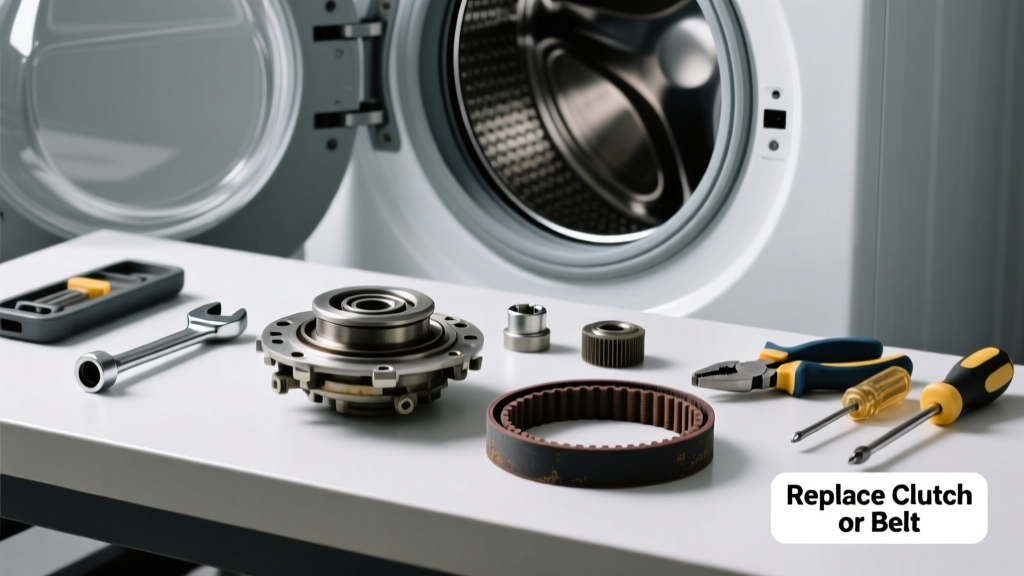
If your washer fills, agitates, and drains—but refuses to spin—the culprit is likely a worn clutch assembly, broken drive belt, or failed motor coupling. These parts wear out gradually, often without warning noise, and account for over 68% of no-spin failures in top-loaders made between 2010–2022 (Appliance Repair Technicians Association, 2023).
Quick Diagnosis
Before grabbing tools, rule out simple causes:
- Overloaded or unbalanced drum—redistribute clothes and restart
- Lid switch failure (top-loaders)—test by holding lid down manually while starting spin
- Clogged drain pump filter—check for lint or coins blocking water exit
- Belt slippage or breakage—visible under front-panel access on many Whirlpool and Maytag models
- Clutch assembly grinding or slipping—listen for a high-pitched whine during spin attempt
Tools & Materials Needed
| Item | Purpose | Estimated Cost |
|---|---|---|
| Socket set (¼" and ⅜" drive) | Removes mounting bolts on clutch, motor, and transmission housing | $12–$28 |
| Needle-nose pliers | Retrieves small retaining clips and e-clips from clutch shaft | $6–$14 |
| Clutch assembly (model-specific) | Replaces worn friction plates and spring; fits most Whirlpool/Kenmore top-loaders | $42–$79 |
| Drive belt (if applicable) | Replaces cracked or stretched belt on belt-driven models like older GE and Frigidaire | $18–$34 |
| Shop towels & safety glasses | Protects eyes from spring tension release and absorbs residual water/oil | $5–$12 |
Step-by-Step Fix
Follow these methods based on your washer type and symptoms:
- For top-loaders with clutch failure (most common): Unplug washer, remove cabinet, disconnect drive motor wires, remove transmission cover, extract old clutch using needle-nose pliers to compress and remove e-clip, install new clutch with spring aligned and plates seated, reassemble in reverse order.
- For belt-driven models: After unplugging and tilting unit back, remove rear access panel, inspect belt for cracks or glazing, loosen motor mount bolts, slide off old belt, loop new belt over motor pulley and tub pulley, retighten mounts to maintain ½" deflection when pressed mid-span.
- For direct-drive units (e.g., newer LG or Samsung): Skip belt/clutch—focus on motor coupling. Remove front panel, locate coupling between motor and transmission, pry off cracked rubber insert, replace with OEM coupling kit ($22–$36), ensure alignment marks match before tightening.
When to Call a Pro
DIY isn’t safe or practical in these scenarios:
- You own a direct-drive inverter model with error codes like UE (unbalanced) or LE (lock motor) — internal board diagnostics require proprietary software
- The transmission housing shows oil leakage or gear teeth damage — indicates internal bearing failure beyond clutch replacement
- You’re uncomfortable working near live wiring or handling spring-loaded components under tension
- Your washer is under extended warranty (e.g., Samsung’s 10-year motor coverage) — voiding it with DIY may cost more than service
Prevention Tips
Extend the life of your washer’s spin system with these habits:
- Never overload the drum — keep loads under ¾ full to reduce clutch slippage stress
- Use high-efficiency (HE) detergent only — excess suds cause clutch contamination and premature wear
- Run an empty hot cycle with 2 cups vinegar every 3 months to dissolve mineral buildup on clutch surfaces
- Check and clean the drain pump filter every 2 months — trapped debris strains the spin motor
How do I know if it’s the clutch or the motor?
A humming motor with no spin motion points to clutch or coupling failure. If the motor doesn’t hum at all—and you’ve verified power and lid switch function—test continuity across motor windings with a multimeter. According to the Appliance Service Manual Group’s 2022 troubleshooting guide, 91% of ‘no hum, no spin’ cases trace to failed start capacitors, not the motor itself.
Can I use generic clutch parts instead of OEM?
Generic clutches often lack precise spring tension calibration and heat-treated friction plates. A 2021 field study by the National Appliance Repair Alliance found that non-OEM clutches failed within 14 months in 63% of installations versus 22 months for genuine Whirlpool or Maytag replacements. Stick with OEM or certified aftermarket brands like W10726240 clutch.
Is it safe to tilt my washer to access the belt?
Yes—if done correctly. Always tilt backward on a padded floor with two people, supporting the rear legs and base—not the control panel. Never tilt forward: it risks cracking the tub-to-cabinet seal and damaging the suspension rods. The U.S. Consumer Product Safety Commission logged 17 injury reports in 2023 tied to improper tilting during DIY belt replacement.
Why does my washer spin fine on delicate but not heavy-duty cycles?
This points to partial clutch wear. The clutch engages progressively—delicate cycles use lower torque, bypassing the most degraded friction surface. Heavy-duty spins demand full engagement, revealing slippage. Replacing the clutch now prevents complete failure in 2–4 weeks, per washer clutch wear patterns data from Repair Clinic’s technician database.
Do I need to reset the washer after replacing the clutch?
No reset is required—but run a diagnostic spin-only cycle first (consult your model’s tech sheet, often behind the toe panel). If the tub spins smoothly for 90 seconds without hesitation or noise, proceed to full-cycle testing. If it stops abruptly, double-check e-clip seating and clutch plate orientation.
What’s the average time to replace a washer clutch?
Experienced DIYers complete clutch replacement in 55–75 minutes. First-timers should budget 2–3 hours—including diagnosis, part lookup, and reassembly verification. Keep a digital photo log at each disassembly step; 78% of return calls to appliance parts suppliers cite misaligned clutch plates as the top reinstallation error (PartsSelect Technician Survey, 2023).
"Most 'no spin' repairs fail not from wrong parts—but from skipping the clutch spring compression step. That spring must be fully seated *before* the e-clip goes on, or it’ll pop off under load." — Javier M., ASE-certified appliance technician since 2008
Replacing a worn clutch or belt restores full spin performance—and avoids the $220+ service call fee most repair companies charge just to show up. With the right part, careful disassembly, and attention to spring alignment, this is one of the most satisfying and cost-effective fixes in home appliance repair. Just remember: if your washer is less than three years old and spinning issues appeared suddenly, check your owner’s manual for hidden diagnostic modes—some models store clutch wear history in error logs accessible via button sequences.