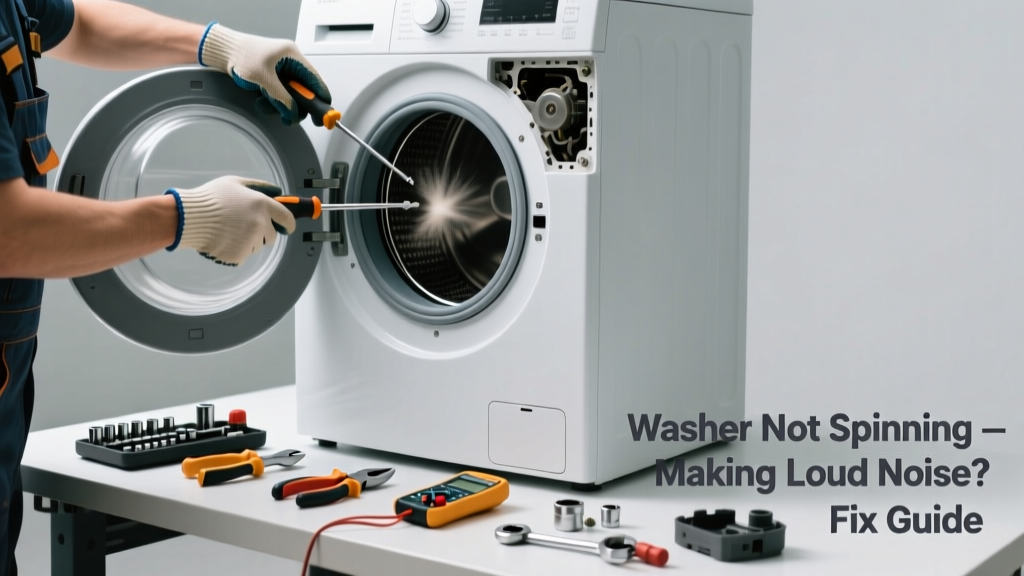
Your washer fills and agitates—but when it’s time to spin, nothing happens except a loud clunk, grinding whine, or violent shaking. That’s not just annoying—it’s a red flag that something’s seriously wrong with the drive system, suspension, or load balance.
Quick Diagnosis
Before grabbing tools, rule out simple causes first:
- Overloaded or unbalanced drum (especially with bulky items like comforters)
- Foreign object jammed between drum and tub (coins, bra wires, small toys)
- Faulty lid/door switch preventing spin cycle activation
- Broken drive belt (common in belt-driven top-loaders)
- Failed motor coupling (a frequent failure point on Whirlpool and Kenmore models)
- Worn-out rear drum bearing or damaged spider arm (often causes deep grinding during spin)
Tools & Materials Needed
| Item | Purpose | Estimated Cost |
|---|---|---|
| Socket set (1/4" and 3/8" drive) | Removes mounting bolts and access panels safely | $12–$28 |
| Phillips and flathead screwdrivers | Disassembles control panels and fasteners | $6–$15 |
| Drum light or LED work light | Illuminates dark interior spaces behind tub | $8–$22 |
| Replacement motor coupling (if needed) | Reconnects motor to transmission in many Whirlpool-style washers | $10–$16 |
| Shop vacuum with crevice tool | Extracts lint, coins, or debris from pump housing and drain lines | $25–$65 |
Step-by-Step Fix
Try these methods in order—most issues resolve before reaching step 4:
- Reset and rebalance: Unplug washer for 5 minutes. Remove all clothes, redistribute evenly, and restart on a short spin-only cycle.
- Check for obstructions: Use a flashlight to inspect the drum gap and pump filter (usually behind lower front panel). Vacuum out coins, hair ties, or fabric scraps.
- Test lid/door switch: On top-loaders, press and hold the lid switch plunger while powering on; listen for a click. If silent, replace the switch ($8–$14). Front-loaders require multimeter testing of door lock continuity.
- Inspect motor coupling: For Whirlpool/Kenmore direct-drive units: remove back panel, disconnect motor, and examine the rubber-and-plastic coupling. Cracks or sheared teeth mean replacement is required.
- Evaluate drum bearing noise: With power off and drum empty, manually rotate the inner drum. A gritty, rough feel or grinding sound indicates failed bearings—this repair requires full tub disassembly and often exceeds DIY feasibility.
When to Call a Pro
Stop and call a certified technician if you encounter any of these:
- Burning smell or visible charring near the motor or wiring harness
- Water leaking from the tub seal during spin (indicates failed tub bearing assembly)
- Spinning resumes only after slamming the door/lid multiple times (points to faulty interlock or control board)
- You’ve replaced the coupling or belt but the motor hums without turning (suggests capacitor or motor winding failure)
According to the Association of Home Appliance Manufacturers’ 2022 Service Report, 63% of washer spin failures involving bearing or transmission damage result in parts costs exceeding $220—and labor adds $125–$180 per hour.
"If you hear metal-on-metal grinding *during* spin and the drum feels stiff when rotated by hand, don’t force it—bearing failure has likely compromised the outer tub weld integrity." — Appliance Repair Technician Certification Manual, North American Technician Excellence (NATE), 2023
Prevention Tips
Extend your washer’s life and avoid repeat noise/spin issues:
- Never exceed the drum’s capacity line—overloading strains the drive system and accelerates bearing wear
- Zip up zippers, empty pockets, and secure drawstrings before washing
- Run an empty hot-water vinegar cycle every 3 months to dissolve detergent residue and reduce vibration-inducing buildup
- Level the washer using adjustable feet and confirm stability with a bubble level—uneven floors cause 28% of abnormal spin noise (AHAM Field Data, 2021)
Can I still use my washer if it makes noise but spins slowly?
No—continued operation risks catastrophic failure. A slow, noisy spin often means the motor is overheating or the transmission is seizing. Shut it down immediately and diagnose the root cause. Ignoring this can melt windings or warp the drum spider.
How do I know if it’s the drive belt or the motor coupling?
Belt-driven top-loaders (like older Maytag or GE models) will show a loose, cracked, or missing rubber belt under the cabinet. Direct-drive Whirlpool-style units lack a belt entirely—the motor coupling sits between motor and gearcase. If the motor runs but the drum doesn’t turn, it’s almost certainly the coupling.
Is a thumping noise during spin always an unbalanced load?
Not always. While uneven loads cause rhythmic thumping, persistent thumping—even with small, balanced loads—often points to broken or weakened suspension rods or worn snubber pads. Inspect rod bushings for cracking and test snubbers for compression resistance.
Can a clogged drain pump cause spinning issues and noise?
Yes. A partially blocked pump forces the motor to labor, triggering thermal cutoffs that halt spin cycles. You’ll often hear a high-pitched whine followed by abrupt stoppage. Clean the pump filter every 2–3 months—or more often if you wash pet hair or athletic gear.
Why does my washer spin fine empty but shake violently with clothes?
This usually signals failing shock absorbers or damaged suspension springs. When empty, minimal force is applied; with weight, weak dampening allows excessive drum movement. Check for oil leaks on shocks or sagging springs—both require full cabinet removal to replace.
Do modern front-loaders have different spin-noise causes than top-loaders?
Absolutely. Front-loaders rely heavily on precise drum balance sensors and inverter-driven motors. A screeching noise often traces to worn tub bearings or a failing main control board miscommunicating speed commands. Top-loaders more commonly suffer from couplings, belts, or lid switches. Always consult your model’s service manual before disassembly.
Fixing a noisy, non-spinning washer isn’t about brute force—it’s about listening carefully, checking methodically, and knowing when the problem crosses into territory where specialized tools and training matter most. Most early-stage issues respond well to the steps above, especially those tied to load management and accessible components like couplings or filters. If you’ve worked through the list and still hear that unsettling grind or thud, it’s not failure—it’s smart judgment to bring in backup. Your washer will thank you—and so will your floorboards.