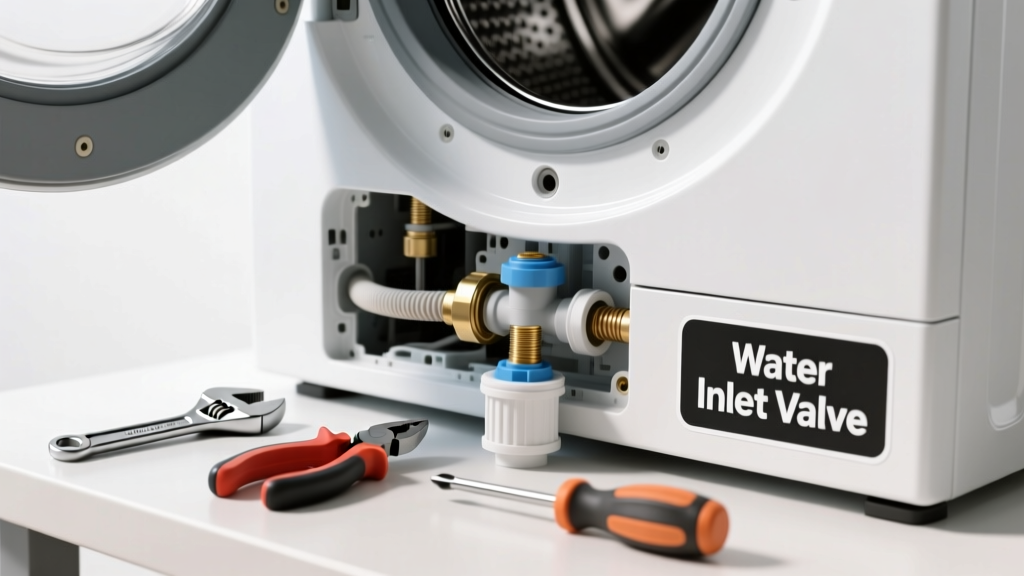
Your washer hums or clicks but never fills with water — and laundry piles up fast. This isn’t just inconvenient; it’s often a simple, solvable issue hiding behind a closed lid or behind the machine. Most no-fill problems stem from blocked screens, faulty valves, or household water supply issues — not a dead control board.
Quick Diagnosis
Before grabbing tools, eliminate the obvious. Check these in order:
- Both hot and cold water faucets are fully turned on (not just cracked)
- Water inlet hoses aren’t kinked, crushed, or frozen (especially in garages or basements below 40°F)
- The washer door or lid is fully closed and latched (many models won’t start filling if safety switch isn’t engaged)
- No error code is flashing on the display (e.g., 'F2', 'E10', or 'UE' — consult your manual)
- Other fixtures in the house have normal water pressure (if sinks/showers run weakly, it’s likely a home supply issue)
Tools & Materials Needed
| Item | Purpose | Estimated Cost |
|---|---|---|
| Needle-nose pliers | Grip and remove small debris from inlet valve screens | $8–$15 |
| Flathead screwdriver (3/32") | Remove hose clamps and access panel screws | $4–$9 |
| Small wire brush or old toothbrush | Clean sediment from inlet valve screens without damaging brass | $2–$6 |
| Bucket and towels | Catch residual water when disconnecting hoses | $0 (use what you have) |
| Replacement inlet valve (if needed) | Direct swap for failed solenoid valve; matches model number (e.g., WPW10240933) | $25–$45 |
Step-by-Step Fix
Work methodically — test after each step before moving on.
- Check and clean inlet valve screens: Shut off both water valves. Disconnect hot and cold hoses at the back of the washer. Use needle-nose pliers to gently pull out the mesh screens inside the hose connections. Soak in vinegar for 10 minutes, then scrub with a wire brush. Reinstall tightly.
- Test water pressure and flow: Remove a hose and hold it over a bucket while turning on the faucet. You need at least 20 PSI — a steady 1-gallon-in-10-seconds flow. If weak, contact your municipal water provider or check for shutoff valves near the meter.
- Listen for the inlet valve click: Start a fill cycle and listen closely at the back of the washer. A faint *click* means the control board sent power; no sound suggests either a wiring fault or failed valve. Use a multimeter to test for 120V at the valve terminals during fill (only if comfortable working with live voltage).
- Inspect the water level pressure switch hose: On top-loaders, locate the thin rubber tube running from the tub to a switch on the control panel. Ensure it’s snug, dry, and uncracked. A leak here tricks the washer into thinking the tub is full before it starts filling.
When to Call a Pro
Stop and call a technician if:
- You measure 120V at the inlet valve terminals but hear no click — the valve is defective and requires replacement (but only if you’ve confirmed power)
- You find burnt wires, melted insulation, or scorch marks near the control board or valve
- Your washer is under warranty (attempting internal repairs may void coverage)
- You’re uncomfortable testing live voltage or removing the main control panel
According to the U.S. EPA estimates that 14% of household water usage is from leaks — many caused by failing inlet valves or worn hoses that go unnoticed until they fail completely U.S. Environmental Protection Agency, WaterSense Program, 2022.
Prevention Tips
Maintain your washer year-round to avoid repeat failures:
- Flush inlet screens every 6 months — especially if you have well water or hard water (scale builds up fast)
- Replace rubber inlet hoses every 5 years; upgrade to braided stainless steel for burst resistance
- Leave water valves open year-round unless winterizing — frequent on/off cycling wears out valve seats
- Run a monthly cleaning cycle using 2 cups of white vinegar (no clothes) to dissolve mineral deposits in internal lines
Why does my washer fill slowly only on the hot water side?
This almost always points to sediment buildup in the hot water inlet screen or a partially closed hot water shutoff valve. Older water heaters can shed rust and scale into the hot line. Clean both screens and verify the hot valve is fully open. If slow fill persists only on hot, your water heater’s dip tube may be disintegrating — a plumber can inspect it.
Can I bypass the water level pressure switch to test fill function?
No — bypassing the pressure switch risks overfilling and flooding. It’s a critical safety component. Instead, use a multimeter to test continuity across its terminals (should be open when dry, closed when tube is pressurized). Or temporarily blow gently into the attached rubber hose while listening for a click — that confirms mechanical function.
My washer fills fine on cold but not hot — what’s wrong?
That’s a classic sign of a failed hot-water solenoid inside the dual inlet valve. The valve has two separate coils — one for hot, one for cold. When one fails, the other often still works. Replace the entire inlet valve assembly; individual coil repair isn’t practical or cost-effective.
Is low water pressure from the city causing my washer not to fill?
Yes — most washers require minimum 20–80 PSI to operate. If neighbors report similar issues or your kitchen faucet sputters, contact your utility. You can install a water pressure regulator (water pressure regulator installation) if readings exceed 80 PSI, which damages appliances over time.
Will resetting the washer fix a no-fill issue?
A reset (unplugging for 60 seconds) clears temporary control board glitches — but only helps if the problem is software-related, like a stuck relay or memory fault. It won’t fix clogged screens, broken valves, or low household pressure. Try it early, but don’t rely on it as a fix.
How do I know if the inlet valve is bad?
Three signs: (1) You hear no click during fill attempt, (2) You confirm 120V at its terminals with a multimeter, and (3) Cleaning the screens didn’t help. A failed valve won’t open — even with correct voltage. Replacement is straightforward on most models; find your exact part via washer model number lookup.
A washer that won’t fill doesn’t always mean it’s time for a new machine — more often, it’s a $30 part and 20 minutes of work. Keep your inlet screens clean, hoses fresh, and water pressure stable, and you’ll dodge this issue for years. If you’ve walked through these steps and still get silence instead of rushing water, it’s worth pulling the tech sheet taped inside the control panel — it’ll show the exact diagnostic mode for your model.