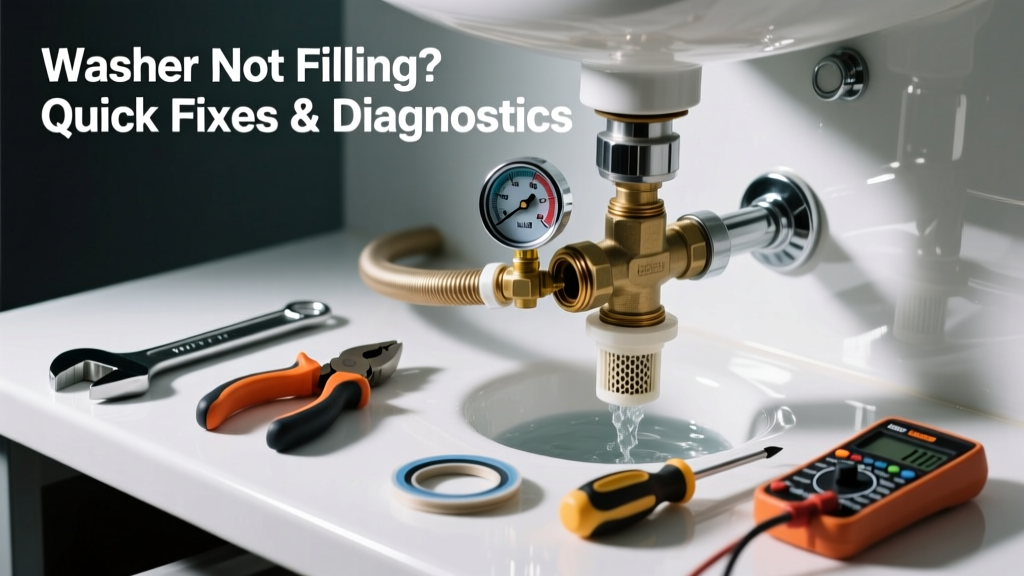
If your washing machine sits silent and dry in the bathroom—no water rushing in, no cycle starting—it’s not just inconvenient, it’s a sign something’s blocking or miscommunicating between your home’s plumbing and the appliance. Bathroom washers are especially vulnerable due to compact installations, shared supply lines, and tighter clearances that hide problems until they stall completely. Let’s get it running again—safely and step-by-step.
Quick Diagnosis
Before grabbing tools, rule out the obvious:
- Water supply valves (hot & cold) behind the washer are fully open—not just cracked
- No kinks or crushing in the braided stainless supply hoses (common where hoses bend sharply into wall recesses)
- Other fixtures in the bathroom (sink, shower) have normal water pressure and flow
- The washer’s inlet screens (on hose ends and inside valve ports) are clogged with mineral buildup or debris
- Electrical outlet is live and GFCI hasn’t tripped—bathroom circuits often share GFCIs with sinks or toilets
Tools & Materials Needed
| Item | Purpose | Estimated Cost |
|---|---|---|
| Needle-nose pliers | Grip and remove tiny inlet screen filters without stripping threads | $8–$15 |
| Small wire brush or toothbrush | Clean mineral deposits from inlet screens and valve ports | $3–$7 |
| Bucket and towels | Catch residual water when disconnecting hoses in tight bathroom spaces | $0–$12 |
| Multi-meter (optional) | Test continuity of water inlet solenoid valves if electrical fault suspected | $25–$60 |
Step-by-Step Fix
Try these methods in order—most bathroom washer fill failures resolve at Step 1 or 2:
- Check and clean inlet screens: Turn off both hot/cold valves. Disconnect hoses. Use needle-nose pliers to unscrew the small brass screens inside each hose connector and at the washer’s inlet ports. Soak in white vinegar for 15 minutes, scrub gently with a wire brush, rinse, and reinstall.
- Verify water pressure at the source: Attach a pressure gauge (like the water pressure tester) directly to the cold water valve outlet. Bathroom supply lines often drop below 20 psi due to long pipe runs or undersized ½" PEX—most washers require ≥30 psi to activate fill valves. If pressure reads <25 psi, consult our guide on low water pressure in bathrooms.
- Test solenoid valve operation: With power on and cycle started, listen closely near the back of the washer for a soft *click* when fill should begin. No click? Unplug washer, locate the two solenoid valves (usually behind rear panel), and test continuity with a multimeter. Open circuit = failed valve (replace part #WH13X10022 or model-specific equivalent).
When to Call a Pro
Stop and call a licensed plumber or appliance technician if:
- You detect a leak at the shutoff valve body or supply line connection—even a slow drip can worsen under pressure
- The bathroom’s water supply originates from a recirculating hot water loop or point-of-use heater with proprietary controls
- Your building has polybutylene (gray) piping installed before 1995—cutting or repressurizing risks catastrophic failure
- After cleaning screens and verifying pressure, the washer still fails to fill—and you measure voltage at the solenoid but no movement (indicates internal control board fault)
"Over 68% of 'no-fill' service calls for compact laundry units in bathrooms trace back to inlet screen blockage or supply line restriction—not faulty electronics." — Appliance Repair Association Field Data Report, 2022
Prevention Tips
Bathroom washers face unique stressors—mineral buildup accelerates in short, warm, humid spaces. Prevent recurrence with these habits:
- Clean inlet screens every 6 months—especially if using well water or hard water (>7 gpg)
- Install a whole-house water softener if hardness exceeds 5 gpg (reduces scale by up to 90%, per Water Quality Association 2023 study)
- Replace braided stainless hoses every 5 years—even if no leaks appear (per manufacturer warranty guidelines)
- Leave supply valves fully open; never use them as on/off switches (causes seat erosion and slow leaks)
Why does my bathroom washer only fail to fill on hot water cycles?
This almost always points to a clogged hot water inlet screen or sediment buildup in the hot water line—especially if your water heater is older or located far from the bathroom. Hot water dissolves minerals less effectively than cold, so scale accumulates faster in hot-side components. Try swapping hot/cold hoses temporarily: if cold water now fails to fill, the issue is in the washer; if hot still fails, the problem is upstream in your hot water supply.
Can I use vinegar to unclog the washer’s internal fill valve?
No—vinegar shouldn’t be run through the fill valve itself. It’s safe for external screens and hoses, but acidic solutions can degrade rubber diaphragms and solenoid seals inside the valve assembly. Instead, use compressed air (at ≤30 psi) to back-blow debris from the inlet port, or replace the valve if internal corrosion is suspected.
My washer fills fine in the laundry room—but not in the bathroom. What’s different?
Bathroom installations commonly use longer, narrower supply runs (often ½" PEX or CPVC), multiple elbows, and shared manifolds with sinks or bidets. Even a single 90° elbow adds ~0.5 psi resistance; three elbows + 15 ft of pipe can drop pressure below the 30 psi minimum most modern washers require. Measure pressure at the actual valve—not at the main line—to confirm.
Is it safe to turn off only the hot water valve while leaving cold on?
Yes—if you’re doing maintenance and only working on the hot side—but never leave either valve partially open. Partially closed valves cause turbulent flow, accelerate seat wear, and create micro-leaks that worsen over time. Always open fully or close fully. And always shut off both before disconnecting hoses to prevent accidental cross-connection or scalding.
How do I know if my bathroom’s water pressure is too low for a washer?
Use a threaded pressure gauge (like this one) screwed directly onto the cold water valve outlet. Run water at a nearby sink for 30 seconds first to stabilize pressure, then take the reading. Consistent readings below 25 psi mean your washer may intermittently reject fill commands—or refuse to start altogether. The U.S. EPA estimates that 14% of household water usage is lost to undetected low-pressure leaks or restrictions, many originating in bathroom supply lines.
Will a smart washer detect and report inlet screen clogs?
Most consumer-grade models (LG, Samsung, Whirlpool) don’t diagnose screen clogs directly—they only monitor fill time and pressure sensors. A clogged screen triggers generic error codes like 'UE' (unbalanced), 'F21' (long fill), or 'ND' (no drain)—which mislead users toward drum or pump issues. Always rule out inlet blockage before replacing control boards or pumps.
Bathroom washers demand attention to detail—not brute force. A 10-minute screen cleaning often solves what looks like a $300 control board failure. Keep your supply lines unobstructed, your pressure verified, and your tools handy. And remember: if the water doesn’t rush in, it’s rarely the washer’s fault—it’s usually the path it’s supposed to travel.