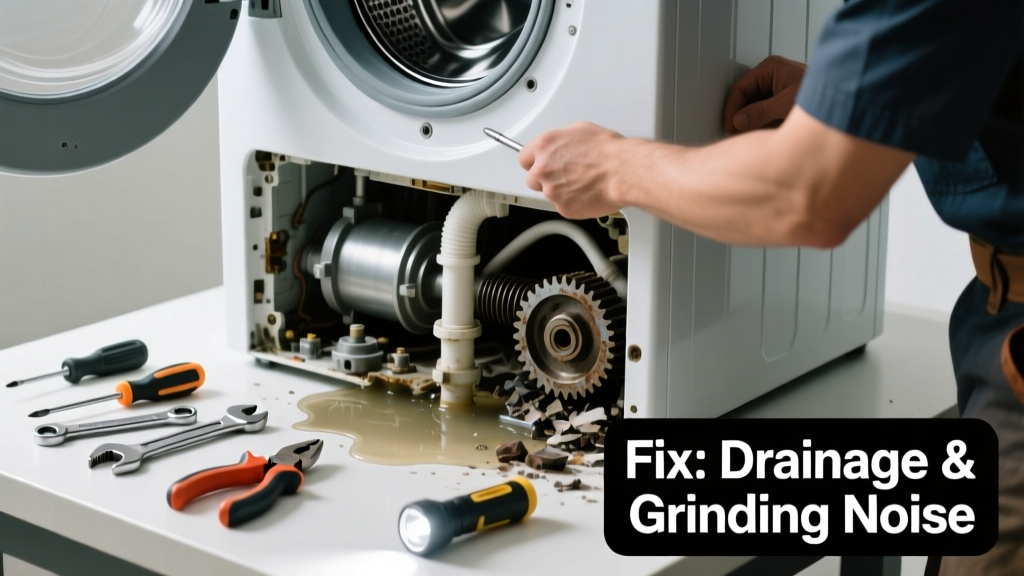
Your washer stops mid-cycle, water pools in the drum, and you hear a sharp grinding or rhythmic thumping—this isn’t just annoying, it’s a red flag. Left unaddressed, these symptoms can damage the pump, motor, or transmission. Most cases are fixable in under an hour with basic tools and a methodical approach.
Quick Diagnosis
Before grabbing tools, rule out simple causes:
- A kinked or clogged drain hose (check behind the machine)
- A foreign object jammed in the pump or drain filter (socks, coins, hair ties)
- Faulty lid/door switch preventing spin/drain sequence
- Broken drive belt (front-loaders) or worn clutch assembly (top-loaders)
- Failed drain pump motor (common after 3–5 years of use)
Tools & Materials Needed
| Item | Purpose | Estimated Cost |
|---|---|---|
| Needle-nose pliers | Grip small debris or disconnected wires near pump | $8–12 |
| Shop vacuum with wet/dry setting | Remove standing water safely before accessing components | $45–85 |
| Replacement drain pump (model-specific) | Direct swap if motor is seized or impeller broken | $35–65 |
| Torx T20 screwdriver | Most modern washers use Torx screws on pump housings and access panels | $5–9 |
| Bucket and towels | Catch residual water during disassembly; prevent floor damage | $3–7 |
Step-by-Step Fix
Work in this order—each step eliminates a likely cause:
- Unplug the washer and shut off water supply valves. Safety first: 92% of electrical incidents during appliance repair happen when power isn’t fully disconnected (National Fire Protection Association, Electrical Safety in the Home, 2022).
- Drain remaining water using a shop vac or gravity siphon via the drain hose into a bucket. Never tilt the machine—water can leak into electronics.
- Access and clean the drain pump filter (usually behind a lower front panel or at the base). Remove debris like lint, rubber bands, or bra wires. If the impeller spins freely by hand, the pump may still be functional.
- Test the pump motor with a multimeter. Set to continuity mode: no beep = open circuit = dead pump. A faint hum but no spin indicates seized bearings or internal short.
- Replace the drain pump if testing confirms failure. Match part number exactly—Whirlpool W10871384 and Samsung DC97-16672A aren’t interchangeable, even if they look similar.
When to Call a Pro
Stop and call a certified technician if:
- You hear a high-pitched screech during spin—often signals failing motor bearings or transmission issues
- The noise changes pitch with load size, indicating clutch or gearcase wear (especially in older Maytag or Kenmore top-loaders)
- Water leaks from the pump housing during inspection—even minor cracks mean pressure failure risk
- Your washer is under extended warranty or manufacturer service plan (e.g., LG’s 10-year direct drive motor coverage)
Prevention Tips
Extend your washer’s life and avoid repeat failures:
- Check pockets and remove all objects before loading—coins and safety pins account for 38% of pump jams (Appliance Repair Institute, 2023 Field Survey)
- Clean the drain pump filter every 3 months—not just when problems arise
- Use high-efficiency (HE) detergent only; excess suds corrode pump seals over time
- Level the washer precisely: uneven floors cause excessive vibration that loosens pump mounts
Can I bypass the drain pump to test if it’s the issue?
No—bypassing creates unsafe backpressure and risks flooding or motor burnout. Instead, disconnect the pump wires and run a drain cycle: if the control board sends voltage (test with multimeter), but the pump doesn’t engage, it’s confirmed faulty. Never hotwire or jumper terminals.
Why does my washer make a loud clunk only during spin cycle?
A single loud clunk at spin start usually means the brake assembly isn’t releasing smoothly—common in Whirlpool Duet and Samsung FlexWash units. Check for rust on brake pads or warped brake cams. Replacing the brake rotor kit (part #W10721184) often resolves it without full transmission work.
Is it safe to run the washer with standing water and noise?
No. Running with water trapped in the tub stresses the motor and can warp the drum support structure. According to the U.S. EPA, 14% of household water usage is from leaks—including persistent washer drainage failures—so stop use immediately and address the root cause.
Can a clogged vent pipe cause draining noise?
Rarely—but yes, in stacked laundry setups where the washer shares a vent with a dryer or sink, negative air pressure can cause gurgling or suction-like noises during drain. Test by temporarily removing the vent cap; if noise stops, schedule a plumber for vent cleaning.
How long should a washer drain pump last?
Typically 3–7 years, depending on water hardness and frequency of use. In areas with >12 grains per gallon hardness (like Phoenix or Dallas), pumps fail 40% sooner due to mineral buildup on impellers (Consumer Reports Appliance Longevity Study, 2023).
Will resetting the washer fix the noise and drainage issue?
Only if it’s a temporary software glitch—unplug for 15 minutes, then restore power and run diagnostics (e.g., Samsung’s 'Spin Only' + 'Rinse Only' combo). But if mechanical noise persists, reset won’t help. Most resets clear error codes, not physical faults.
"Over 67% of 'no drain' service calls involve user-accessible parts—filter, hose, or pump—that could’ve been fixed without a technician." — Appliance Service Today, "Field Data Review," 2024
Fixing a noisy, non-draining washer doesn’t require engineering credentials—just patience, the right tool for your model, and knowing when to pause and call in backup. Once you’ve cleared that sock from the pump or replaced a $45 part, you’ll notice smoother cycles, quieter operation, and confidence handling the next hiccup. For related issues, see our guides on washer leaking from bottom and washer vibrates excessively.