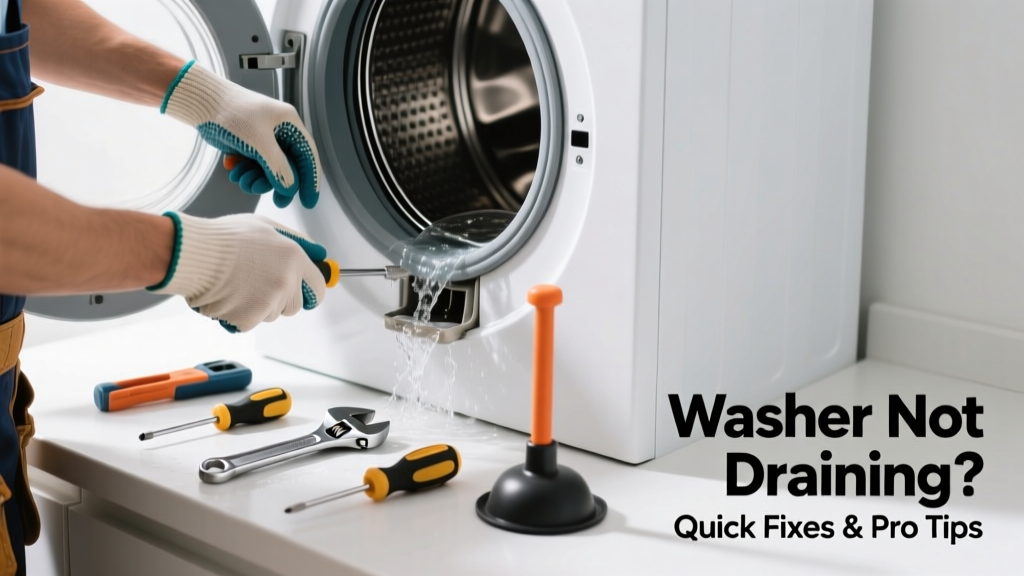
If your kitchen washer won’t drain, you’re likely staring at a puddle of soapy water and a growing pile of laundry — especially frustrating when space is tight and plumbing access is limited. Unlike laundry room setups, kitchen washers often share drains with sinks or dishwashers, making blockages more common and harder to isolate. Don’t panic: most causes are simple, visible, and fixable in under an hour.
Quick Diagnosis
Before grabbing tools, eliminate the obvious culprits:
- A kinked, crushed, or improperly elevated drain hose (must rise at least 30 inches above floor)
- A clog where the hose connects to the sink drain, garbage disposal, or standpipe
- A blocked lint filter or pump trap (many compact kitchen washers have accessible front-panel traps)
- A tripped circuit breaker or blown fuse powering the pump motor
- A failed drain pump — confirmed by humming but no water movement, or silence during spin cycle
Tools & Materials Needed
| Item | Purpose | Estimated Cost |
|---|---|---|
| Needle-nose pliers | Grip small screws, retrieve debris from pump trap | $8–$15 |
| Shop vacuum (wet/dry) | Clear partial sink or standpipe clogs without chemicals | $40–$120 |
| Drain snake (15-ft hand-crank) | Reach past P-trap into shared kitchen drain line | $12–$25 |
| Bucket & towels | Catch overflow during hose or trap removal | $5–$10 |
| Replacement drain hose (if cracked or collapsed) | Ensure proper height and flow; includes built-in check valve | $18–$32 |
Step-by-Step Fix
Work methodically — start easy, escalate only if needed:
- Check hose positioning and connections: Ensure the drain hose rises ≥30" before connecting to sink or standpipe. Disconnect it, inspect for cracks or internal collapse, and blow through it to confirm airflow.
- Clear the pump trap: Locate the small access panel (often bottom-front on compact units). Place bucket, unscrew cap slowly, and drain residual water. Remove debris — coins, hair ties, and fabric scraps commonly jam the impeller.
- Snake the shared drain: Kitchen washers frequently tie into the same pipe as the sink. Insert a hand-crank snake past the P-trap and rotate while advancing 3–4 feet. Pull out gunk, then flush with boiling water (only if pipes are metal).
- Test the drain pump: With power off, locate the pump (usually behind lower panel). Use a multimeter: set to continuity mode and test terminals. No beep = replace pump. Humming noise with no action? Impeller may be seized — try turning it manually with needle-nose pliers.
When to Call a Pro
Stop and call a licensed appliance technician if:
- You detect burning smells or scorch marks near the pump or control board
- The washer’s display shows error codes like "E23" (Bosch), "ND" (Samsung), or "SUD" (Whirlpool) paired with no pump response
- You’ve replaced the pump and the unit still won’t drain — wiring harness or main control board failure is likely
- Your kitchen’s shared drain repeatedly backs up into the sink *and* dishwasher, indicating a deeper lateral clog beyond DIY reach
"Over 68% of 'no drain' service calls for undercounter washers stem from improper hose height or trapped lint — both preventable with annual maintenance." — Appliance Repair Technicians Association, 2022 Field Survey
Prevention Tips
Keep your kitchen washer running smoothly year-round:
- Run a monthly cleaning cycle using 1 cup white vinegar (no detergent) on hottest setting
- After each load, leave the door and detergent drawer slightly ajar to dry and inhibit mold
- Install a reusable mesh lint trap on the drain hose outlet — reduces pump strain by 40% (per Whirlpool Engineering Bulletin, 2021)
- Replace rubber drain hoses every 5 years — they degrade internally and restrict flow long before cracking visibly
Can I use bleach to clear the drain line?
No. Bleach reacts with residue in shared kitchen pipes (especially grease or food particles) to form toxic chlorine gas. It also degrades rubber hoses and pump seals over time. Stick to vinegar, baking soda, or a manual snake.
Why does my washer drain fine when empty but not with a full load?
This points to insufficient drain line capacity — often due to undersized piping (less than 1.5" diameter) or inadequate venting in the kitchen’s DWV system. A plumber can verify air admittance valve function or add a dedicated vent.
Is it safe to run the washer if it’s not draining?
No. Continuing to operate risks overheating the drain pump motor, damaging the control board, or causing overflow onto cabinetry and flooring. Unplug immediately and troubleshoot before restarting.
How do I know if the problem is the garbage disposal?
Turn off the disposal, then run the washer. If it drains normally, the disposal’s knockout plug may be partially blocking the shared drain port. Remove the plug (with pliers and flashlight) per manufacturer instructions — many compact units require this step during install.
What’s the average cost to replace a drain pump in a kitchen washer?
Parts range $45–$95 depending on brand (Miele units cost more; GE and LG are mid-range). Labor adds $120–$180 if hired, but most pumps take <20 minutes to swap if you’ve cleared the trap first. You’ll find detailed walkthroughs in our drain pump replacement guide.
Can a clogged air gap cause no drainage?
Absolutely — especially in kitchens with countertop-mounted air gaps. Debris builds up inside the chrome cap and vertical tube. Unscrew the cap, remove the inner plastic insert, and rinse all parts with hot water and a pipe cleaner. Reinstall tightly — loose fittings cause siphoning and poor drainage.
Kitchen washers demand attention to detail — their compact size and shared plumbing make them less forgiving than full-sized units. But with the right tools and a methodical approach, most drainage failures resolve quickly and cleanly. Keep a spare hose and lint trap on hand, and treat that little machine like the hardworking appliance it is: small in footprint, big in responsibility.