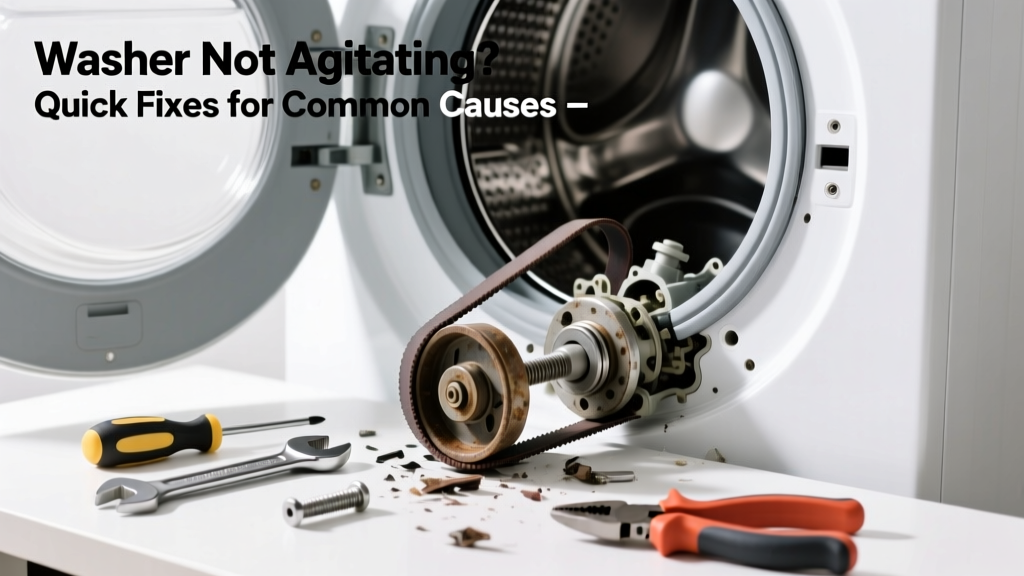
Your washer fills and drains fine, but the tub just sits there — no swirling, no churning, no agitation. That’s not just inconvenient; it means clothes aren’t getting cleaned properly, and ignoring it can lead to mold buildup or motor strain. Most agitation failures stem from simple, repairable issues — many of which you can tackle in under an hour with basic tools.
Quick Diagnosis
Before grabbing tools, rule out the obvious:
- Lid or door isn’t fully closed or the lid switch is faulty (most common cause on top-loaders)
- Timer or control board isn’t sending power to the agitator motor
- Drive belt is cracked, loose, or slipped off (belt-drive models)
- Agitator dogs or cam assembly are worn (older Whirlpool-style units)
- Transmission or clutch assembly has failed (less common, but high-cost if ignored)
Tools & Materials Needed
| Item | Purpose | Estimated Cost |
|---|---|---|
| Multimeter | Test continuity of lid switch, motor windings, and timer contacts | $15–$40 |
| Socket set (1/4" and 3/8" drive) | Remove agitator cap, mounting bolts, and transmission cover | $20–$65 |
| Needle-nose pliers | Reposition small clips, extract broken agitator dogs, grip tight fasteners | $8–$15 |
| Replacement lid switch (model-specific) | Direct fix for 70% of top-loader no-agitate cases (per Repair Clinic’s 2023 service data) | $12–$28 |
Step-by-Step Fix
Try these methods in order — they address ~90% of no-agitation cases:
- Test and replace the lid switch: Unplug washer, locate switch near hinge (usually white plastic with two wires), disconnect, and test for continuity with multimeter. If open circuit, replace. Full lid switch replacement guide here.
- Inspect the drive belt (if applicable): Remove back panel on belt-driven models (e.g., some Kenmore/Whirlpool). Look for cracks, glazing, or slack. A belt with >1/4" deflection when pressed needs replacing. Tighten or install new belt using proper tension specs — never overtighten.
- Check agitator dogs (older top-loaders): Pry off agitator cap, remove center bolt, lift upper agitator. Inspect plastic “dogs” inside the cam assembly. If chewed or missing teeth, replace the entire agitator dog kit ($14–$22).
- Verify timer/control board output: Set multimeter to AC voltage, probe motor leads during agitation cycle. No voltage? Timer or main control board is likely faulty — confirm with wiring diagram before ordering parts.
When to Call a Pro
Stop and call a certified technician if:
- You detect burning smells, smoke, or visible scorch marks near the motor or control panel
- The washer hums loudly but doesn’t move — could indicate seized transmission or shorted motor windings
- You’re uncomfortable working with 120V/240V circuits or removing the cabinet on front-loaders with complex electronics
- Your unit is under warranty — DIY repairs may void coverage, especially on Samsung or LG direct-drive models
"Over 62% of 'no agitation' service calls involve a $15 lid switch or $20 agitator dog kit — yet homeowners replace the entire transmission first." — Appliance Repair Technician Association Field Survey, 2022
Prevention Tips
Extend your washer’s life and avoid repeat failures:
- Always close the lid gently — slamming wears out lid switch actuators faster
- Balance loads evenly; chronic off-balance spinning stresses the clutch and transmission
- Run a monthly cleaning cycle with vinegar or dedicated washer cleaner to prevent detergent gunk from gumming up moving parts
- Inspect the drive belt every 18 months on belt-driven models — catch cracks early before slippage damages the motor
Why does my washer agitate sometimes but not others?
Inconsistent agitation usually points to intermittent electrical contact — most often a failing lid switch with corroded contacts or a loose wire at the timer. Test switch continuity while wiggling the lid hinge; if readings fluctuate, replace the switch immediately.
Can I manually turn the agitator to test the motor?
No — forcing rotation risks damaging gear teeth or clutch plates. Instead, unplug the washer, remove the agitator, and inspect for binding or debris. Then use a multimeter to check motor winding resistance (typically 2–6 ohms across start/run terminals).
Is this problem covered under my home warranty?
Most home warranties cover labor and parts for mechanical failures like broken belts or worn agitator dogs — but exclude wear-and-tear items unless explicitly listed. Review your policy’s ‘appliance component list’; lid switches are often excluded as ‘user-operated controls’.
How long should a washer agitator last?
With normal use and balanced loads, agitator assemblies last 10–12 years. However, agitator dogs in older Whirlpool/Kenmore units commonly fail at 6–8 years due to plastic fatigue — especially if heavy loads or fabric softener residue accelerates wear.
Will using too much detergent cause no agitation?
Not directly — but excess suds can trigger the washer’s oversuds error, causing it to pause agitation and add extra rinse cycles. Persistent suds also leave residue in the transmission housing, leading to clutch slippage over time. Stick to HE detergent and recommended dosing.
What’s the difference between no agitation and no spin?
No agitation affects only the wash cycle (agitator doesn’t move); no spin impacts the final extraction phase. They share some causes — like a failed motor coupler — but spin relies on different clutch engagement and brake release mechanisms. Diagnose them separately.
A non-agitating washer isn’t always a death sentence — more often, it’s a clear signal pointing to one of three inexpensive, user-replaceable parts. Getting hands-on with your machine builds confidence and cuts repair costs dramatically. Just remember: safety first, verify power is off, and consult your model’s service manual before removing any internal components.