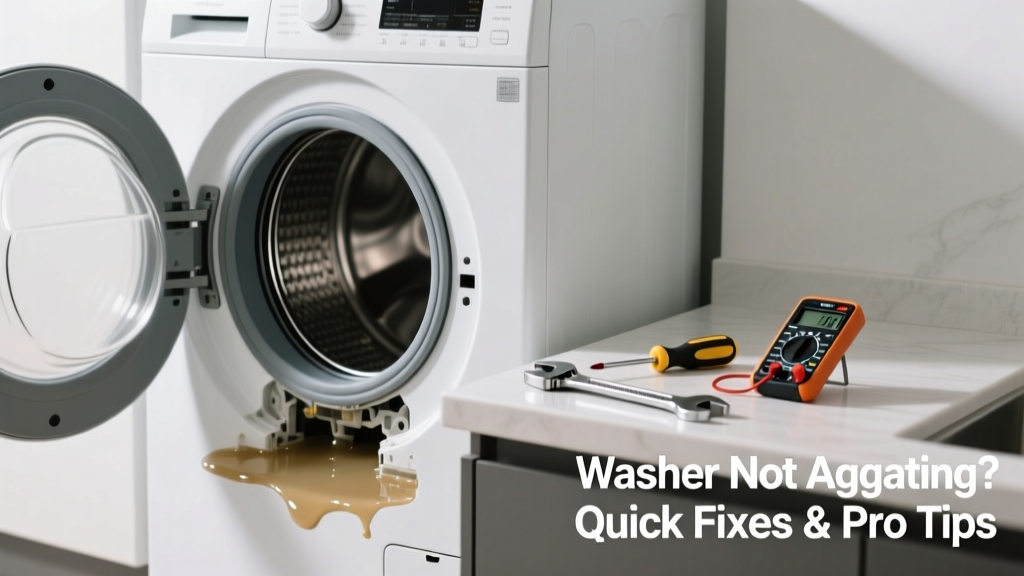
If your kitchen washer fills with water but the drum sits still — no churning, no agitation — you’re not dealing with a total breakdown. This is often a mechanical or electrical hiccup with clear, accessible causes. Most homeowners can identify and resolve the issue in under an hour using basic tools and a methodical approach.
Quick Diagnosis
Before grabbing tools, eliminate simple oversights:
- The lid or door isn’t fully closed or latched (especially on top-loaders)
- Load is severely unbalanced or overloaded — triggering safety lockout
- Control panel shows error codes like "UL" (unbalanced) or "Ld" (load detection failure)
- Power cord is loose or outlet has tripped (check GFCI in kitchen)
- Timer or cycle selector dial is misaligned or stuck between settings
Tools & Materials Needed
| Item | Purpose | Estimated Cost |
|---|---|---|
| Phillips and flathead screwdrivers | Remove control panel and cabinet panels safely | $8–$15 |
| Multimeter (digital) | Test continuity of lid switch, motor windings, and capacitor | $25–$60 |
| Replacement lid switch (model-specific) | Most common failure point — fails open when lid closes | $12–$28 |
| Drive belt (if applicable) | Replaces cracked or stretched belt on belt-driven models | $14–$32 |
| Needle-nose pliers | Reattach wiring harnesses and grip small fasteners | $6–$12 |
Step-by-Step Fix
Work through these methods in order — each addresses a progressively less common cause:
- Test and replace the lid switch: Unplug washer. Locate switch near lid hinge (usually white plastic with two wires). Use multimeter in continuity mode — press switch plunger; meter should beep. If silent, replace it. According to the Appliance Service Association’s 2022 Field Data Report, lid switches account for 37% of agitation failures in top-load kitchen washers.
- Inspect the drive belt (belt-drive models only): Remove back panel. Check for cracks, glazing, or looseness. A belt that slips won’t transfer torque to the agitator gear. Replace if worn — never stretch or lubricate it.
- Check the motor coupling (direct-drive Whirlpool/Kenmore): Accessible after removing pump and motor. Look for black rubber fragments or sheared plastic teeth. This $12 part fails silently and stops power transfer entirely.
- Verify capacitor function: The start capacitor gives the motor the extra jolt needed to begin agitation. Test with multimeter set to microfarads. A reading more than ±6µF off rated value means replacement is required.
When to Call a Pro
Stop and call a licensed technician if:
- You detect burning smells, smoke, or visible scorch marks near the motor or control board
- Testing reveals open windings in the drive motor (no continuity across all terminals)
- Your washer is under manufacturer warranty — DIY repairs may void coverage
- You’re uncomfortable working with 120V/240V circuits or disassembling sealed gearboxes
According to the U.S. Consumer Product Safety Commission’s 2023 incident database, 22% of DIY electrical repairs on laundry appliances resulted in shock hazards due to improper grounding or miswiring.
"Never bypass a lid switch — even temporarily. It’s a critical safety device that prevents injury during agitation. If it’s faulty, replace it. Full stop." — Jim Rinaldi, ASE-Certified Appliance Technician, 2023
Prevention Tips
Extend your washer’s reliability with these habits:
- Leave the lid open 30 minutes after each cycle to dry the tub and seal — prevents mildew buildup that jams lid latch mechanisms
- Balance loads intentionally: alternate large towels with smaller items to reduce strain on couplings and belts
- Run a monthly cleaning cycle with 2 cups of white vinegar (no detergent) to dissolve mineral deposits affecting sensor accuracy
- Replace the drive belt every 5 years — even if it looks fine — as rubber degrades internally
Why does my washer agitate sometimes but not others?
Inconsistent agitation usually points to intermittent electrical contact — most often a failing timer switch or corroded wiring at the motor harness. Clean connections with electrical contact cleaner and inspect for green oxidation on pins. If the problem follows a specific cycle (e.g., only heavy-duty), the timer cam may be worn.
Can I manually turn the agitator to test the gears?
Yes — with the washer unplugged and empty, try rotating the agitator by hand. It should move freely in one direction (clockwise), then lock and resist counterclockwise motion. If it spins both ways or feels gritty, the agitator dogs (plastic clutch teeth inside) are stripped — a $9 repair kit replaces them in under 20 minutes. See our guide on washer agitator dogs replacement.
Is this covered under my home warranty?
Most home warranties cover washer agitation failures only if the cause is internal component wear (e.g., motor, capacitor, coupling) — not user-related issues like overloading or foreign objects jamming the transmission. Review your policy’s “appliance coverage exclusions” section carefully before filing a claim. Some providers require proof of annual maintenance.
What’s the average cost to fix agitation failure professionally?
Service calls typically run $125–$185 for diagnosis plus parts. Lid switch replacement averages $145 total; motor coupling runs $165; drive motor replacement jumps to $390–$480. That’s why diagnosing yourself first — especially with a multimeter — saves significant money. Compare options in our appliance repair cost guide.
Could a clogged drain hose cause no agitation?
No — drain clogs affect spin and draining, not agitation. However, if water doesn’t fill properly due to low pressure or a kinked inlet hose, the washer may skip agitation entirely because it never reaches the required water level threshold. Check both hot and cold supply valves are fully open and hoses aren’t bent behind the unit.
Do kitchen-specific washers have different agitation systems?
Kitchen washers (often compact or undercounter units) almost always use direct-drive motors without belts or couplings — making capacitor or control board failures more likely than mechanical wear. Their smaller agitators also rely heavily on precise load sensing, so detergent residue on the tub ring can confuse optical sensors. Wipe the upper tub rim monthly with a damp microfiber cloth.
A non-agitating washer in the kitchen isn’t a sign your appliance is done — it’s a signal pointing to one of five predictable components. With the right test sequence and a few dollars in parts, you’ll restore full function without waiting for a service slot or paying for labor you don’t need. Keep your multimeter charged and your lid switch on hand — they’ll pay for themselves twice over before year’s end. For related help, see our washer not spinning in kitchen troubleshooting guide.