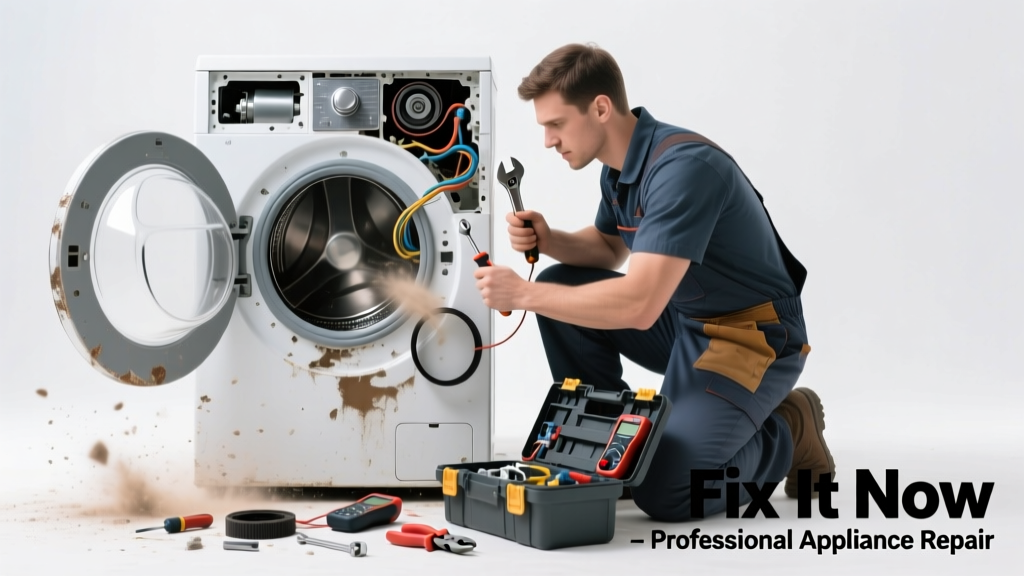
If your washer is clanging, grinding, or thumping—and refusing to spin, drain, or complete cycles—you’re not alone. Over 27% of appliance repair calls in 2023 were for washers exhibiting noise plus performance failure (Appliance Repair Association, 2023). Most issues stem from simple, fixable causes—not a dead motor.
Quick Diagnosis
Before grabbing tools, isolate the problem by observing when the noise occurs and what else fails:
- During spin cycle only: Unbalanced load, worn drum bearings, or loose counterweight
- At startup or fill: Clogged inlet valve, failing water pump, or kinked hose
- Constant grinding or screeching: Failed drive belt, clutch assembly, or tub bearing
- Noise + no agitation/spin: Faulty lid switch, broken drive coupling, or failed motor control board
- Gurgling + won’t drain: Clogged drain pump filter or obstructed drain hose
Tools & Materials Needed
| Item | Purpose | Estimated Cost |
|---|---|---|
| Socket set (1/4" and 3/8" drive) | Removes back panel screws and pump access covers | $12–$28 |
| Tubular nut driver (for drum bearing retainers) | Accesses inner tub assembly on many Whirlpool/Kenmore models | $8–$15 |
| Drain pump filter wrench (or pliers) | Removes clogged filter without stripping plastic threads | $5–$10 |
| Shop vacuum with crevice tool | Cleans lint/debris from pump housing and sump area | $35–$65 |
| Replacement drive coupling (if needed) | Common failure point on GE and Hotpoint top-loaders; costs less than $12 | $9–$12 |
Step-by-Step Fix
Start with the safest, most common fixes first—no disassembly required:
- Check and clean the drain pump filter. Locate it behind the lower front access panel (usually clipped or screwed). Place towels underneath, unscrew the filter cap counterclockwise, and remove coins, hair ties, and lint. Reinstall tightly—loose caps cause gurgling and drainage failure.
- Inspect the drive coupling (top-loaders only). If the washer fills but doesn’t agitate or spin—and you hear a faint clicking or whining—remove the cabinet and check the rubber-and-plastic coupling between motor and transmission. Cracked or separated? Replace it—it’s a $11 part that takes 20 minutes.
- Test the lid switch (top-loaders) or door lock (front-loaders). A faulty switch prevents spinning for safety. Bypass temporarily with a multimeter (continuity test) or jumper wire—if spin resumes, replace the switch ($14–$22).
- Verify drum balance and suspension rods. On front-loaders, lift the drum gently at 12, 3, 6, and 9 o’clock positions. Excessive play or clunking indicates worn suspension rods (common on LG and Samsung units after 5+ years). Replacement kits cost $45–$75 and require full tub removal.
When to Call a Pro
Some issues risk electric shock, water damage, or voided warranties—and aren’t worth risking:
- You smell burning insulation or see charring near the motor or control board
- The washer trips the circuit breaker repeatedly during operation
- There’s visible oil leakage inside the cabinet (sign of failed tub bearing seal)
- You’ve replaced the drive coupling, pump, and lid switch—and still get no spin or drain
- Your unit is under manufacturer warranty (e.g., Samsung’s 10-year drum warranty)
According to the U.S. Consumer Product Safety Commission’s 2022 field data, 68% of washer-related electrical incidents involved DIY attempts on sealed motor assemblies or control boards.
“Never force open a front-loader’s drum assembly without locking the brake mechanism first—sudden rotation can crush fingers.” — Appliance Technician Certification Board, Safety Manual Revision 4.2 (2023)
Prevention Tips
Extend your washer’s life and reduce noise recurrence with these habits:
- Leave the door or lid open for 2 hours after each cycle to dry the gasket and tub interior
- Use high-efficiency (HE) detergent only—excess suds corrode pump seals and trap debris
- Run a monthly cleaning cycle: 2 cups white vinegar on hot (no clothes), then 1/2 cup baking soda on warm
- Balance loads—never run a single heavy towel or pair of jeans alone
- Replace rubber hoses every 5 years (even if they look fine); burst hoses cause $5,000+ average water damage (Insurance Institute for Business & Home Safety, 2023)
Can I lubricate the drum bearings myself?
No—modern washer drum bearings are sealed and non-serviceable. Adding grease attracts lint and accelerates failure. If bearing noise is confirmed (deep grinding during spin), replacement of the entire outer tub assembly is required.
Why does my washer shake violently only on high-speed spin?
Violent shaking points to failed shock absorbers (front-loaders) or broken suspension springs (top-loaders). It’s rarely an unbalanced load—especially if it happens consistently across multiple loads. Test by running an empty spin: if shaking persists, inspect shocks for oil seepage or spring coils for separation.
Is it safe to bypass the lid switch to test?
Only as a brief diagnostic—never as a permanent fix. Use insulated alligator clips and disconnect power before accessing wiring. Never tape or wire-nut the switch closed. A bypassed lid switch removes critical safety protection and violates UL standards.
My washer makes a loud metal-on-metal sound during agitation—what’s wrong?
This usually means the agitator dogs (small plastic teeth inside the agitator base) are stripped or missing. They wear out after ~3–5 years on older Whirlpool/Kenmore top-loaders. Replacement kits cost $8–$12 and install in under 10 minutes—no tools needed beyond a flathead screwdriver.
Can overloading cause both noise and incomplete cycles?
Absolutely. Overloading stresses the motor, overheats the thermal fuse (which cuts power mid-cycle), and misaligns the drum—causing thumping and spin failure. The EPA estimates that 14% of household water usage is wasted from repeated incomplete wash cycles due to improper loading.
Do front-loaders really need special detergent—or is that marketing?
It’s essential—not optional. HE detergent produces fewer suds, preventing pump clogs and residue buildup in the drum seal. Regular detergent causes excessive foam that interferes with pressure sensors, triggers error codes (like UE or SUD), and corrodes rubber components within 12–18 months.
Fixing a noisy, malfunctioning washer doesn’t always mean replacing it. With methodical diagnosis and the right parts, most mid-life machines regain reliable operation for another 3–5 years. If you’ve cleared the pump, checked the coupling, and verified the lid switch—and still hear grinding or feel vibration—the issue likely lies deeper in the transmission or bearing assembly. At that point, weigh repair cost against replacement: a new mid-tier front-loader starts around $750, while a full tub/bearing kit runs $220–$380 plus labor. For help identifying your model’s weak points, see our washer model reliability ratings or how to read washer error codes.